
Kioni Holdings: Early-Stage Back-Office Solutions Facing Scaling and Sustainability Hurdles
With limited revenues and rising expenses, Kioni Holdings Ltd remains in a formative phase, balancing the need for operational scale against funding constraints in a competitive sector with low barriers to entry.
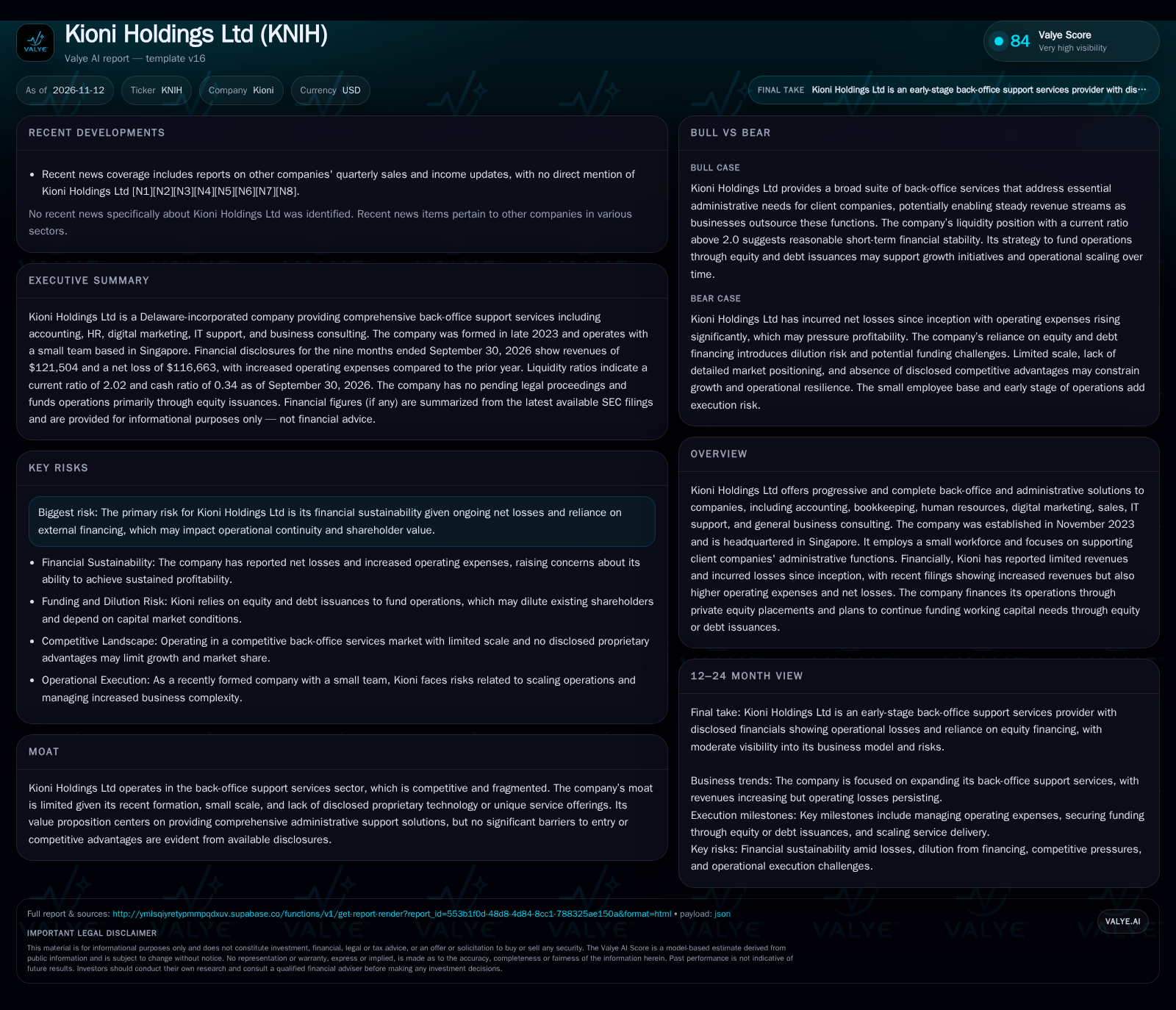
Kioni Holdings Ltd, formed in late 2023 and headquartered in Singapore, provides a broad range of back-office support services. Despite modest revenue growth, the company reported a net loss for the nine months ended September 30, 2026, as operating expenses increased significantly. With no bank financing and a reliance on private equity placements, Kioni’s path to profitability and sustainable scale remains unproven in a fragmented and competitive market. Execution on cost control, operational leverage, and market differentiation will be critical for future viability. [S2]
Kioni Holdings Ltd, a Singapore-headquartered provider of back-office support services, is navigating the realities of early-stage growth in a crowded, undifferentiated market. With a small workforce and limited operating history, the company has shown incremental revenue gains but faces mounting losses driven by rising expenses and the absence of meaningful scale. Its reliance on external equity funding underscores the challenge of reaching operational sustainability, while the lack of disclosed competitive advantages raises questions about long-term differentiation. The coming quarters will test whether Kioni can manage costs, build client relationships, and carve out a niche in a sector dominated by both local providers and global outsourcing firms.
Recent Financial Performance Underscores Scaling Challenge
For the nine months ended September 30, 2026, Kioni Holdings Ltd reported revenue of $121,504 and a net loss of $116,663, compared to revenue of $108,988 and net income of $33,674 for the same period in 2025. This swing from profitability to loss was driven by a sharp increase in operating expenses and professional fees, which rose to $224,179 from $67,606 year-over-year. The company’s cost of revenue for business advisory services was $13,988 in the period. As of September 30, 2026, Kioni had total assets of $415,850, current liabilities of $199,479, and stockholders’ equity of $216,371. Liquidity metrics included a current ratio of 2.02 and a cash ratio of 0.34, with cash and cash equivalents totaling $68,154. Kioni continues to fund operations through private equity placements, with no lines of credit or bank financing in place. [S2]
Revenue Model, Cost Structure, and the Path to Operating Leverage
Kioni’s business model is centered on providing a suite of back-office services—accounting, bookkeeping, HR, digital marketing, IT support, and consulting—typically purchased by small to midsize enterprises seeking to outsource non-core functions. In this segment, pricing can range from fixed-fee retainers to hourly or project-based billing, but the company has not disclosed its commercial mechanics or client retention rates. The small scale (12 employees as of December 2025) suggests a limited client base, and with cost of revenue at $13,988 versus much higher operating expenses, gross margins may be positive but are currently overwhelmed by fixed costs and overhead.
Operating leverage in this business is plausible if Kioni can grow its client roster without proportionally increasing headcount or overhead, as many administrative and digital services are scalable. However, the sharp rise in operating expenses suggests the company is investing ahead of revenue, possibly in business development, compliance, or infrastructure. With no bank financing, Kioni’s capital needs are met through equity issuance, but this comes at the cost of dilution and potential investor fatigue if losses persist. Achieving breakeven will likely require either a step-change in client volume or a significant reduction in expense growth.
Competitive Dynamics in a Fragmented Back-Office Services Market
Kioni operates in a highly competitive and fragmented market, facing competition from local accounting and consulting firms, regional outsourcing providers, and larger multinational business process outsourcers. Barriers to entry are low, with limited evidence of proprietary technology, unique service bundles, or network effects in Kioni’s current model. Larger competitors may benefit from brand recognition, broader service portfolios, and economies of scale, allowing them to offer lower prices or bundled solutions. Meanwhile, specialized SaaS platforms and automated tools increasingly substitute for traditional manual services, potentially compressing margins and reducing switching frictions for clients.
Absent a strong differentiator—such as vertical specialization, proprietary workflow automation, or a compelling technology platform—Kioni risks being perceived as a commodity provider. The company’s Singapore headquarters offers access to regional markets, but also pits it against both local and global players targeting the Asia-Pacific SME segment. Long-term defensibility will depend on Kioni’s ability to build sticky client relationships, demonstrate measurable value, or carve out expertise in niche verticals.
If Kioni Achieves Scale and Service Differentiation
A favorable trajectory for Kioni would involve rapidly building its client base, leveraging its comprehensive service suite to cross-sell and deepen relationships, and realizing operating leverage as revenue outpaces expense growth. If the company can standardize offerings, automate delivery, or develop proprietary tools, it may achieve higher margins and reduce reliance on manual labor. Demonstrated success in securing multi-year contracts or recurring revenue streams would improve visibility and investor confidence.
Evidence supporting this scenario would include disclosures of client wins, renewal rates, or backlog; improved gross and operating margins; and a return to profitability. Successful fundraising on favorable terms, or the establishment of strategic partnerships, would further validate the scalability and attractiveness of the business model. Adoption of technology to automate core processes or provide real-time analytics could also serve as a differentiator, reducing churn and increasing switching costs.
Incremental Growth Offset by Persistent Cost Pressures
The most plausible scenario is that Kioni continues to grow revenue modestly as it adds new clients and expands its service portfolio, but operating losses persist due to elevated expenses and limited scale. The company’s reliance on equity financing remains, with periodic capital raises required to fund working capital and operating shortfalls. Absent a material shift in cost structure or client acquisition efficiency, Kioni may struggle to achieve breakeven, making it vulnerable to dilution and funding risk if capital conditions tighten.
Confirmation of this scenario would come from continued revenue growth paired with flat or rising losses, ongoing equity issuances, and no significant announcements of technology adoption, major client contracts, or margin improvement. If cost controls are implemented but revenue growth stalls, the company could plateau at sub-scale levels, maintaining operations but not delivering meaningful returns to shareholders.
Escalating Losses and Funding Constraints Threaten Viability
In a more adverse outcome, Kioni’s operating expenses continue to escalate faster than revenue, eroding cash reserves and forcing increasingly dilutive financings or unfavorable debt terms. If the company is unable to secure new clients at an adequate pace, or if existing clients churn due to undifferentiated offerings or price competition, revenue could stagnate or decline.
Evidence of this scenario would include accelerating net losses, declining cash balances, reduced current ratios, or the need for emergency capital infusions. Negative working capital trends, the inability to pay vendors or employees on time, or disclosures of going-concern risks would signal acute financial distress. Should competitors adopt new technologies or undercut pricing, Kioni could be squeezed out of key markets, resulting in business contraction or forced restructuring.
Milestones and Metrics That Will Shape Kioni’s Next Chapter
Net revenue growth rate quarter-over-quarter, especially relative to increases in operating expenses.
Gross margin trends, if disclosed, to assess the scalability of service delivery and pricing power.
Number of active clients, average revenue per client, and client retention or churn rates—these would clarify whether Kioni is building a sustainable client base.
Breakdown of operating expenses, including sales, marketing, and professional fees, to determine efficiency of growth investments.
Frequency, size, and terms of future equity or debt issuances, as a gauge of funding runway and dilution risk.
Any disclosures of technology adoption, workflow automation, or integration of SaaS platforms that could improve efficiency and differentiation.
Evidence of multi-year contracts, recurring revenue streams, or backlog, which would indicate improved revenue visibility and client stickiness.
Management commentary or filings regarding competitive positioning, vertical focus, or plans for geographic expansion.
Disclaimer: This is research-only, informational analysis and not investment advice. It may include AI-generated interpretation and general industry context. Always verify important details using primary sources.

Comments