
Artelo Biosciences: Advancing Lipid Signaling Science Toward Commercial Breakthroughs
With a diversified pipeline in endocannabinoid and lipid signaling therapeutics and a recent string of patent wins, Artelo Biosciences faces the classic crossroads for clinical-stage biotechs: moving from promising early data and IP strength to regulatory, funding, and market milestones amid competitive and listing pressures.
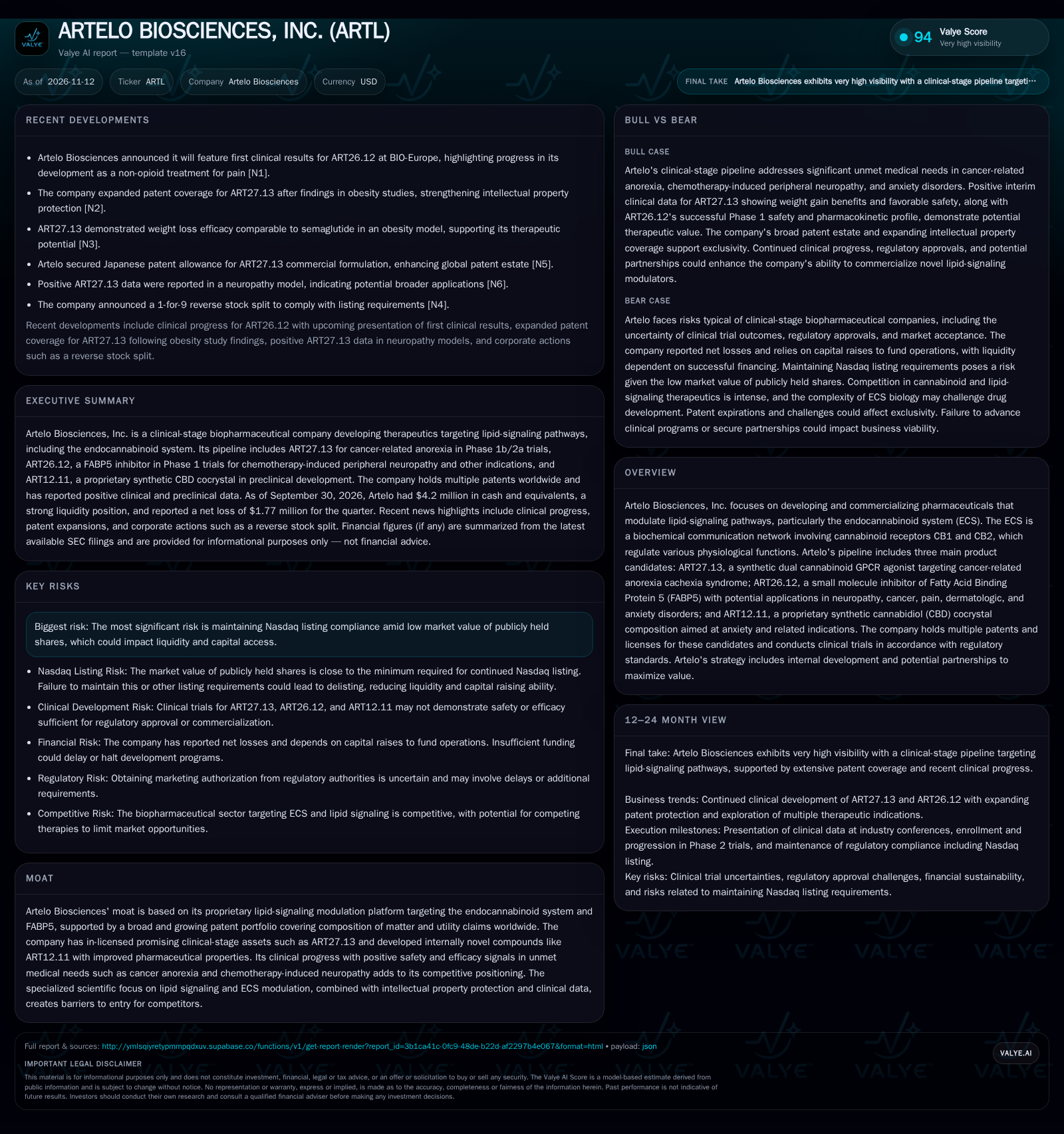
Artelo Biosciences develops therapeutics targeting the endocannabinoid system and lipid signaling pathways, with three main candidates spanning oncology, pain, and psychiatric indications. Recent progress includes expanded global patent coverage and first human data for its FABP5 inhibitor, but the company remains pre-revenue, reports continuing net losses, and faces the dual challenges of clinical risk and maintaining Nasdaq listing compliance. The next inflection points hinge on advancing clinical development and securing additional funding or partnerships to bridge the path to commercialization.[S2] [N1] [N2] [N4]
Artelo Biosciences sits at a pivotal juncture typical for innovative clinical-stage biotechs: its differentiated focus on lipid signaling modulation and the endocannabinoid system has yielded a robust, IP-protected pipeline with early clinical and preclinical validation. Yet, the company faces the daunting realities of sustained net losses, capital dependence, and the looming risk of Nasdaq delisting. Upcoming clinical data, regulatory milestones, and the ability to secure funding or partnerships will determine whether Artelo can convert scientific promise into a sustainable commercial enterprise in a crowded and fast-evolving field.[S2] [N1] [N2] [N4]
Recent Patent Wins and Clinical Advances Shift Artelo’s Risk-Reward Balance
Three developments stand out in Artelo Biosciences' recent trajectory: First, the company expanded patent coverage for ART27.13, including a Japanese patent allowance, strengthening global exclusivity for its lead candidate targeting cancer-related anorexia and potentially obesity.[N2] [N5] Second, Artelo reported first clinical results for ART26.12, its non-opioid FABP5 inhibitor, at BIO-Europe, marking a key step toward establishing human safety and pharmacokinetics in pain indications.[N1] Third, the company enacted a 1-for-9 reverse stock split in August 2026 to address Nasdaq minimum listing requirements after market value dipped near compliance thresholds.[N4]
The company reported a current ratio of 10.47 for the period. [S2]
Translating Lipid Signaling Insights into Commercial Pipeline Opportunities
Artelo’s business model is classic clinical-stage biotech: value is created by advancing differentiated therapeutic candidates through key clinical and regulatory milestones, with monetization typically occurring via out-licensing, co-development deals, or direct commercialization if resources permit. The company’s assets—ART27.13 (cancer-related anorexia/obesity), ART26.12 (pain, cancer, dermatology, anxiety), and ART12.11 (psychiatric/neurologic disorders)—each target substantial markets where current therapies have limitations.
The core economic drivers will be the ability to demonstrate robust efficacy and safety in pivotal trials, secure regulatory approval, and either commercialize directly or partner with larger pharmaceutical players. If successful, drugs with composition-of-matter patent protection can command premium pricing, especially in indications like cachexia or neuropathic pain where few options exist. However, the fixed costs of R&D, regulatory filings, and pre-launch activities are high, and variable costs (largely COGS and SG&A) only scale after approval.
Artelo’s need for frequent capital raises is typical for its stage and reflects the mismatch between near-term cash needs and long-term value realization. The company’s strong patent estate could enable attractive licensing economics if compelling data are generated, but absent near-term revenue, dilution risk remains high.
Artelo’s Patent Portfolio and Its Role Amidst Intense Lipid Signaling Competition
Artelo’s principal competitive assets are its broad and growing patent estate covering composition-of-matter and use claims for each lead candidate, and its specialized focus on lipid signaling and the endocannabinoid system. This IP position, including recent expansions for ART27.13, could deter fast followers and support exclusivity into the next decade.[N2] [N5]
However, the competitive landscape for cannabinoid and lipid signaling therapeutics is intense. Numerous biotech and pharma companies are targeting CB1/CB2 pathways, FABP5, and related mechanisms for overlapping indications. The field has seen both high-profile clinical failures and regulatory skepticism, particularly for CNS-active cannabinoids due to concerns about side effects and abuse potential.
Differentiation for Artelo will depend on demonstrating superior safety (especially lack of CNS side effects for ART27.13), efficacy in hard-to-treat indications, and pharmacokinetic advantages (as with ART12.11’s cocrystal formulation). The company’s ability to secure global IP and generate compelling human data will be the main bulwarks against both generics and better-funded competitors.
Potential for Early Clinical Wins to Unlock Licensing or Acquisition Deals
The bull case for Artelo envisions positive Phase 2 data for ART27.13 or ART26.12 in their lead indications, validating the scientific approach and derisking the platform. Such results could catalyze partnering interest from larger pharma companies seeking differentiated assets in oncology supportive care, pain, or neuropsychiatric disorders. The breadth of Artelo’s patent coverage would strengthen its negotiating position, enabling the company to extract significant upfront payments, milestones, and royalties.
For this scenario to materialize, investors would look for: rapid enrollment and progression to mid-stage trials, publication or presentation of robust efficacy and safety data, and announcements of non-dilutive funding or strategic partnerships. Early signals might include industry conference presentations (such as the recent BIO-Europe results for ART26.12[N1]), inbound licensing discussions, or regulatory designations (e.g., orphan or fast track status).
Falsification would occur if human data fail to show clear differentiation versus standard of care or if regulatory feedback is negative, dampening external interest and delaying value realization.
Advancing Clinical Programs While Addressing Capital and Compliance Challenges
The most plausible path for Artelo is one of incremental clinical progress: advancing ART27.13, ART26.12, and ART12.11 through early- and mid-stage trials, generating additional safety and efficacy data, and gradually expanding the addressable indications. The company is likely to continue operating at a net loss and will need periodic capital raises—either through secondary offerings or targeted partnerships—to fund ongoing R&D and regulatory activities.[S2]
Success in this scenario is measured by continued positive clinical readouts, maintenance of Nasdaq listing, and preservation of patent exclusivity. Evidence supporting this trajectory would be steady news flow of clinical milestones, expanded IP coverage, and manageable dilution from new financings. Conversely, delays in trial enrollment, adverse data, or further listing compliance warnings would suggest heightened risk.
Risks from Clinical Delays, Financial Pressures, and Possible Market Exit
The bear case centers on the risk that Artelo’s clinical programs encounter efficacy or safety setbacks, leading to discontinued trials, negative regulatory feedback, or lack of partnering interest. Given the company’s cash burn and limited reserves ($4.2 million as of September 2026), any material delay or failure could precipitate funding stress, requiring highly dilutive financings or asset sales.[S2]
A secondary risk is failure to maintain Nasdaq listing, which would reduce share liquidity and likely increase the cost of capital, further constraining operations.[N4] Intensifying competition and potential patent challenges could also erode the company’s strategic position. This scenario would be confirmed by missed clinical milestones, down rounds or distressed financings, and delisting events.
Artelo’s Critical Milestones for Realizing Pipeline Value
Progression of ART27.13 and ART26.12 into and through Phase 2 trials, with focus on enrollment rates, top-line data, and regulatory feedback.
Updates on partnership, licensing, or non-dilutive funding activity—any announcement of a deal with a larger pharma or strategic investor would be highly material.
Changes in Nasdaq compliance status, including market value of publicly held shares and minimum bid price conditions.
Cash burn rate and timing of additional capital raises, as well as the terms (dilutive vs. non-dilutive) of any new financings.
Expansion or defense of the patent estate, especially in major markets and for lead indications.
Publication or presentation of peer-reviewed clinical and preclinical data supporting differentiation and efficacy.
If disclosed, patient-reported outcomes and quality-of-life metrics from clinical studies would help test the real-world impact of Artelo’s candidates.
Any regulatory designations (e.g., orphan, fast track, or breakthrough therapy) that could accelerate development or improve reimbursement prospects.
Disclaimer: This is research-only, informational analysis and not investment advice. It may include AI-generated interpretation and general industry context. Always verify important details using primary sources.

Comments