
SpyGlass Pharma: Efficacy Data, Capital Strength, and the Stakes of Pipeline-Driven Value Creation
With reported liquidity position and four-year efficacy data for its lead BIM-IOL System, SpyGlass Pharma enters a pivotal period of Phase 3 development, post-acquisition integration, and mounting losses. The company’s future now hinges on clinical success, regulatory milestones, and whether its intraocular drug delivery platform can carve out a differentiated position in a competitive ophthalmology landscape.
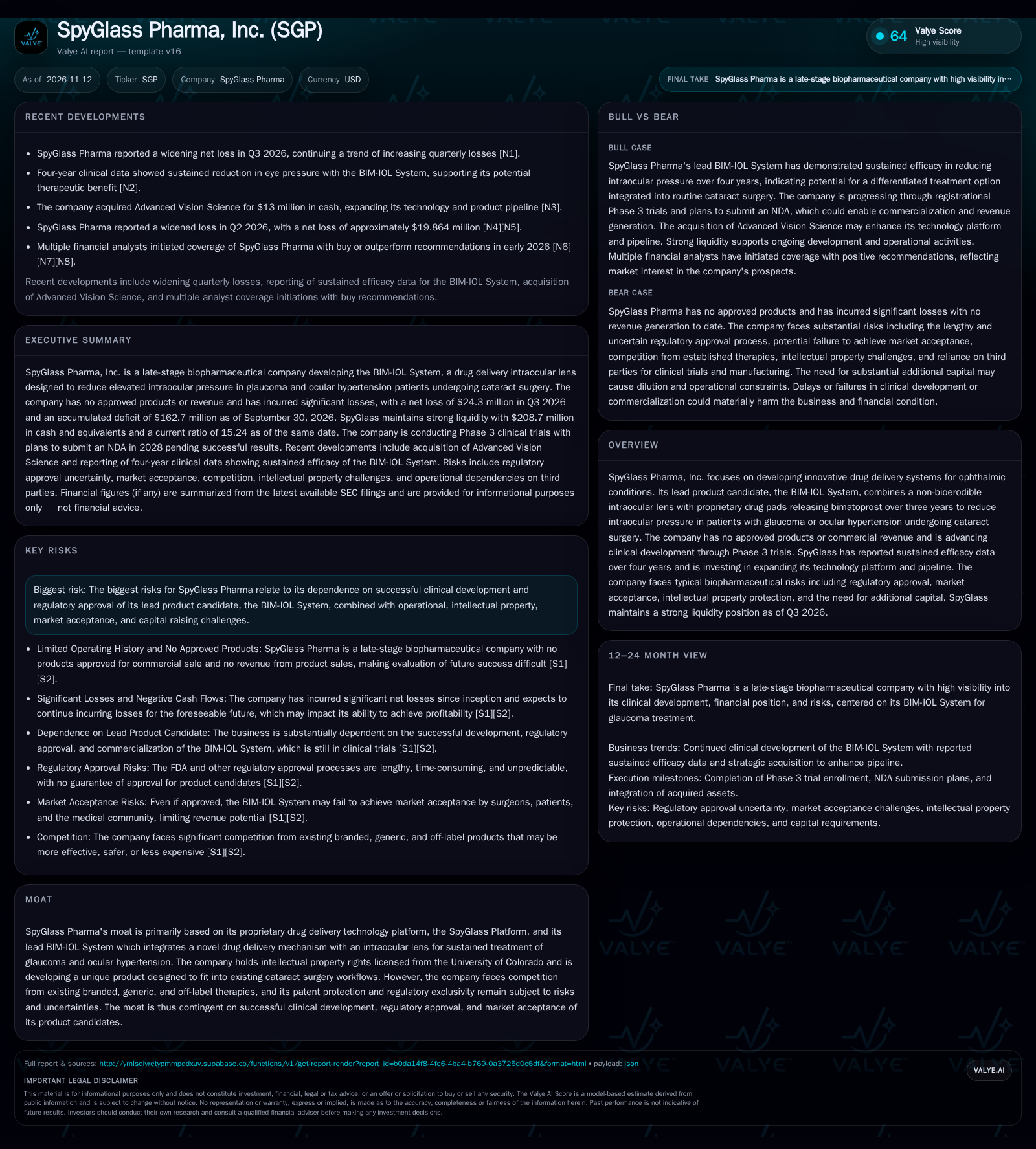
SpyGlass Pharma continues to report widening losses as it advances the BIM-IOL System, an implantable drug-delivery lens for glaucoma, through Phase 3 trials. Four-year data show sustained efficacy, and a recent acquisition expands its platform, but the company remains pre-revenue and exposed to regulatory and market acceptance risks. [S2] [N1] [N2] [N3]
SpyGlass Pharma stands at a crucial juncture as it pushes its BIM-IOL System—a novel intraocular lens delivering bimatoprost for glaucoma—through late-stage clinical trials. Four-year efficacy data fuel optimism about the platform’s clinical merit, while a recent technology acquisition signals ambitions to expand its ophthalmic portfolio. Yet, with no commercial revenue, mounting losses, and dependence on regulatory and market outcomes, the company’s high cash reserves merely buy time for inflection points. The next 12–24 months will reveal if SpyGlass can convert its clinical promise into a commercially viable business before capital constraints or competitive headwinds intervene.
Recent Efficacy, Acquisition, and Cash Position Shape the Strategic Landscape
SpyGlass Pharma’s four-year clinical data for the BIM-IOL System has shown sustained reduction in intraocular pressure, reinforcing the product's potential to address a core unmet need in glaucoma management. This efficacy claim is central to the company’s differentiation thesis and will be a key factor in regulatory and commercial evaluation. [N2]
The acquisition of Advanced Vision Science for $13 million in cash expands SpyGlass’s technology platform and pipeline, potentially broadening its addressable market and deepening technical capabilities. [N3]
Despite these advances, SpyGlass remains pre-revenue and continues to post widening losses, with a Q3 2026 net loss of $24.3 million and an accumulated deficit of $162.7 million as of September 30, 2026. [N1] [S2]
How SpyGlass’s Model Could Create Value: Embedded Delivery, Procedure Integration, and Cost Structure
SpyGlass Pharma’s business model is predicated on integrating a drug-eluting intraocular lens (the BIM-IOL System) into routine cataract surgery for patients with co-morbid glaucoma or ocular hypertension. The economic logic is to capture value through a device-plus-drug hybrid, potentially reimbursed as part of a standard surgical workflow rather than as a separate pharmaceutical regimen.
If approved, revenue could be driven by volume adoption among cataract surgeons and ophthalmology centers, with pricing power dependent on the extent of clinical benefit, payer coverage, and procedure reimbursement codes. The product’s three-year sustained drug delivery could allow for premium pricing versus topical drops, but payers may push back on up-front costs compared to chronic, lower-cost generics.
SpyGlass’s cost structure is currently dominated by R&D and clinical spend, as evidenced by persistent losses. If the BIM-IOL System is commercialized, gross margins may initially be pressured by manufacturing scale-up and salesforce buildout, but operating leverage could materialize as fixed costs are absorbed over a larger installed base. The capital model is high burn until approval, with the potential for substantial value inflection if commercial traction is achieved.
Differentiation, Substitution, and the Realities of Ophthalmic Competition
SpyGlass Pharma’s moat depends on whether its proprietary delivery platform and clinical profile for BIM-IOL can establish meaningful advantages over established therapies. The core differentiation lies in sustained, hands-free intraocular pressure reduction delivered during cataract surgery, potentially improving compliance versus topical drops and offering a unique value-add for surgeons.
However, the competitive environment is intense: branded and generic topical drugs, laser therapies, and minimally invasive glaucoma surgery (MIGS) devices are entrenched standards. Large ophthalmology device and pharma companies possess significant resources, sales infrastructure, and payer relationships. In addition, once-daily generics are inexpensive and familiar to providers and patients.
SpyGlass’s ability to win share will likely hinge on demonstrating clear clinical superiority, seamless integration into surgical workflow, and either cost-effectiveness or payer willingness to reimburse a premium device. Intellectual property protection—licensed from the University of Colorado—offers some defensibility, but the risk of design-arounds or litigation is nontrivial. Pipeline breadth, post-acquisition, may provide future diversification, but near-term success is binary around the lead asset.
If Clinical and Regulatory Milestones Align, Commercialization Could Unlock High-Value Installed Base Economics
In a favorable scenario, Phase 3 data confirm the long-term efficacy and safety profile observed in earlier trials, leading to a timely and successful NDA submission and regulatory approval. The BIM-IOL System is rapidly adopted by cataract surgeons, supported by compelling reimbursement and strong clinical endorsement. The product’s integration into routine cataract surgery creates a new standard of care for comorbid glaucoma, enabling SpyGlass to capture significant procedure-based revenue at premium pricing.
Operating leverage emerges as sales ramp and fixed costs are spread over a growing installed base. The recent acquisition enhances the pipeline, providing additional shots on goal and reducing single-asset risk. The company leverages its cash reserves to scale commercial operations without dilutive raises.
Evidence that would confirm this scenario includes: positive Phase 3 topline results, favorable FDA panel feedback, early payer coverage wins, strong surgeon adoption metrics, and expansion of the pipeline into adjacent indications or new delivery modalities.
Most Likely: Lengthy Path to Approval, Gradual Uptake, and Persistent Capital Needs
The most plausible outcome is a protracted clinical and regulatory process, with the BIM-IOL System eventually gaining approval but facing a measured adoption curve. Uptake is steady but not explosive, as surgeons and payers evaluate the system’s long-term benefit-risk and cost profile relative to established therapies.
Initial commercial revenues are offset by ongoing R&D, salesforce expansion, and post-market surveillance requirements. Operating losses narrow but do not disappear, leading to further capital raises—likely via equity—before the company achieves self-sustaining cash flow.
This scenario would be confirmed by: completion of Phase 3 with non-inferior but not clearly superior results, a drawn-out NDA review or labeling limitations, slow payer coverage decisions, and moderate but not dominant market penetration two years post-launch.
Adverse Chain: Clinical, Regulatory, or Market Hurdles Derail Commercialization and Force Strategic Reset
In a negative scenario, the BIM-IOL System fails to achieve primary endpoints in Phase 3, or safety signals emerge that prevent regulatory approval. Alternatively, even if approved, market uptake is tepid due to payer resistance, surgeon inertia, or competitive responses from incumbents.
Cash burn accelerates as the company attempts to reposition its pipeline, but additional capital is either unavailable or only accessible at highly dilutive terms. Intellectual property challenges or operational setbacks compound the problem, triggering layoffs, program discontinuations, or a forced sale of assets.
This outcome would be confirmed by: negative or equivocal Phase 3 results, FDA rejection or major delays, public payer denials, rapid cash depletion, and management guidance signaling a strategic pivot or retrenchment.
Milestones That Will Determine Whether SpyGlass Pharma’s Platform Delivers on Its Promise
The outcome of Phase 3 trials for the BIM-IOL System, including both efficacy and long-term safety data, will validate or challenge the clinical thesis.
Updates on the NDA submission timeline and regulatory interactions, especially FDA feedback on data sufficiency or safety concerns, will clarify the commercialization path.
Surgeon and cataract center adoption rates, if disclosed, will signal early traction and the degree of procedure integration.
Reimbursement decisions and payer coverage—especially whether the BIM-IOL System is included in bundled cataract procedure payments or achieves separate reimbursement—will determine pricing power.
Cash burn rate and updated runway projections as development progresses will indicate how soon additional capital may be needed.
Integration progress and pipeline expansion from the Advanced Vision Science acquisition, including new product candidates or platform enhancements, would help test the thesis of platform diversification.
Any changes in the competitive landscape, such as new launches, pricing shifts, or major clinical readouts from rivals, could alter the company’s positioning and adoption prospects.
Resolution of the material weakness in internal controls, if disclosed, would affect investor confidence and future access to capital.
Disclaimer: This is research-only, informational analysis and not investment advice. It may include AI-generated interpretation and general industry context. Always verify important details using primary sources.

Comments