
Chenghe Acquisition III Co.: SPAC Mechanics, Liquidity Boundaries, and the Race to Secure a Target
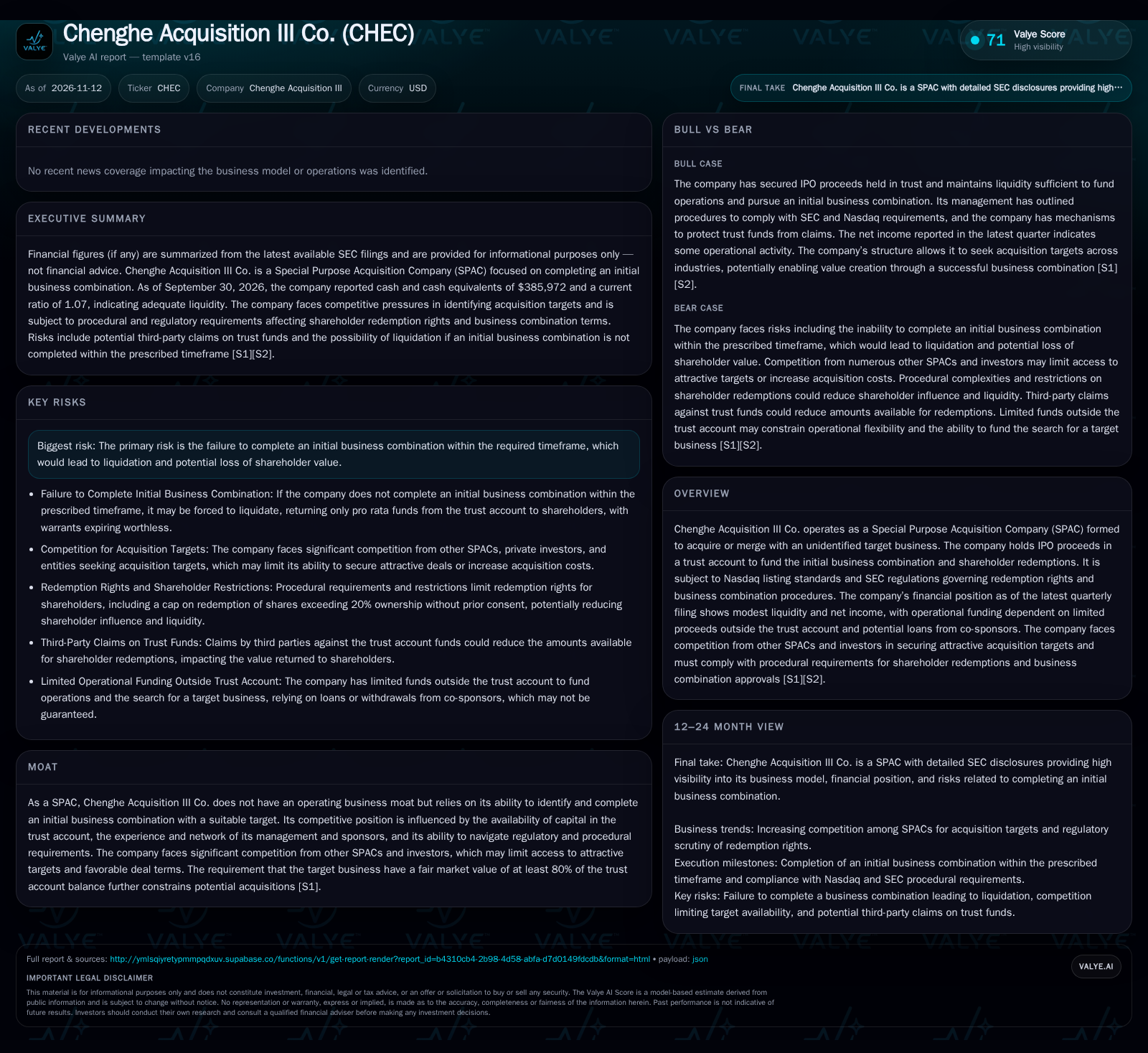
Chenghe Acquisition III Co. operates as a blank-check SPAC with IPO proceeds held in trust, modest operational liquidity, and a finite window to secure an initial business combination. Its success hinges on navigating fierce competition for targets, procedural hurdles, and the risk of liquidation if a deal is not consummated in time.
The company has not yet identified a target and faces a competitive environment, procedural restrictions on redemptions, and the risk of liquidation if a deal is not completed within the required timeframe [S2].
Chenghe Acquisition III Co. exemplifies the SPAC model: a pool of capital with a finite mandate to acquire a yet-to-be-identified business, all under the scrutiny of SEC and Nasdaq rules. The real challenge is not balance-sheet mechanics but market dynamics—facing a crowded field of SPACs, strict procedural hurdles, and a ticking clock that, if unmet, leads to liquidation and loss of the SPAC’s optionality [S2].
Liquidity, Trust Structure, and the Countdown to a Combination
Chenghe Acquisition III Co. is currently in the pre-acquisition phase typical of SPACs, with no operating revenues reported as of September 30, 2026. The company reported cash and liquidity metrics for the period; these figures do not by themselves establish operating runway, investment capacity, financial flexibility, or financing capacity. [S2] The central pool of capital—IPO proceeds earmarked in a trust account—remains reserved for the eventual business combination or shareholder redemptions. The company has not yet identified a target business. Under Nasdaq rules, any target must have a fair market value of at least 80% of the trust account at the time of signing a definitive agreement, further constraining selection options. With the countdown to a mandatory business combination or liquidation underway, the company’s window for action is shrinking, and failure to close a deal in time would trigger a pro rata return of trust assets to shareholders, with warrants expiring worthless [S2].
How SPAC Financial Engineering Shapes Value Creation and Risk
SPACs like Chenghe Acquisition III generate no operating revenue until a merger is consummated; their primary asset is the cash held in trust, and their only immediate income is from interest on those funds [S2]. The economics hinge on the ability to identify, negotiate, and close a business combination with a high-potential target. Until then, expenses are limited to regulatory, legal, and administrative costs, often funded by minimal cash outside the trust or loans from co-sponsors. The capital structure—units composed of shares and warrants—offers optionality to investors but also introduces dilution risk post-deal. Operating leverage is minimal pre-merger, but can swing dramatically depending on the economics of the acquired business. If a deal is completed, future economics will depend on the margin profile, growth prospects, and capital intensity of the target—factors completely unknown at present.
Competing for Targets in a Saturated SPAC Market
Chenghe Acquisition III faces formidable competition from a crowded field of SPACs, private equity funds, and strategic acquirers—all pursuing a finite pool of attractive targets. The surge in SPAC formations in recent years has led to a supply-demand imbalance, where targets with desirable growth, scale, or technology assets can command premium valuations or negotiate more favorable terms. Further, private investors and established companies often offer more operational value-add or certainty of execution, potentially making SPACs a less attractive suitor. Chenghe’s relative advantage, if any, stems from its management team’s network, deal-making expertise, and ability to navigate procedural and regulatory hurdles efficiently. However, the requirement that any target must have a fair market value of at least 80% of the trust account both narrows the field and increases the risk of overpaying or pursuing marginal targets simply to avoid liquidation. The company’s lack of a sector focus could be a double-edged sword: it maximizes flexibility but may dilute credibility with potential targets compared to sector-specialist SPACs.
Successful Deal Execution and Value Realization: What Could Go Right
The optimal outcome for Chenghe Acquisition III is the identification and closing of a business combination with a high-quality, scalable target before the liquidation deadline. In this scenario, the SPAC could unlock value by providing public market access and growth capital to a promising company, potentially generating returns for both initial investors and new shareholders post-merger. Evidence supporting this scenario would include a timely announcement of a definitive agreement with a target exhibiting strong fundamentals—such as robust revenue growth, operational leverage, and a clear path to public-market valuation uplift. Additional confirmation would be high shareholder support for the deal, minimal redemptions, and favorable market reaction to the transaction. Falsification would occur if the company fails to announce a credible target, faces high redemption rates, or closes a deal that is poorly received by the market due to quality or valuation concerns.
The Most Likely Trajectory: Procedural Friction and the Race Against Time
The most plausible path for Chenghe Acquisition III is a continued search for a suitable target amid intensifying competition, with deal negotiations extending close to the mandated deadline. The company may encounter procedural hurdles—including regulatory reviews, shareholder redemptions, and the need to satisfy Nasdaq’s 80% fair market value rule—that delay or complicate the process. If a target is identified, terms may be less favorable due to a competitive deal environment and time pressure. Moderate-to-high redemption rates are likely, diluting the post-deal cash available for the target and increasing pressure on the combined entity. Confirmation would come from progress updates on target identification, public filings indicating active negotiations, and evidence of deal structure adjustments to address redemption risk. Falsification would be a lack of substantive progress or material negative developments, such as public withdrawal of a previously announced target.
Liquidation Risk: When the Clock Runs Out Without a Deal
If Chenghe Acquisition III fails to identify and close a business combination within the required timeframe, the company will be forced to liquidate, returning funds in the trust account to shareholders on a pro rata basis and rendering all SPAC warrants worthless [S2]. This scenario results in no value creation for initial sponsors and only minimal, if any, upside for public shareholders (outside of interest earned in trust). Signs that this scenario is playing out would include repeated extensions of the SPAC’s timeline, lack of definitive agreement announcements as the deadline approaches, or explicit SEC filings preparing for dissolution. High competition, an unfavorable market for SPAC targets, or substantial third-party claims against the trust could accelerate this outcome.
Milestones That Will Define Chenghe Acquisition III’s Outcome
Progress toward identifying and announcing a definitive agreement with a target business; a public update or 8-K filing would be a leading indicator.
Shareholder redemption rates at the time of deal approval; high redemptions would undermine deal economics and post-merger capitalization.
Compliance with Nasdaq’s requirement that the target’s fair market value is at least 80% of the trust account balance; evidence would be provided in deal documentation.
Procedural or regulatory delays, including SEC review cycles or amendments to the SPAC’s charter to extend deadlines.
Material third-party claims or litigation against the trust account; any such disclosure would threaten funds available for redemptions.
Loans or capital infusions from co-sponsors to cover ongoing operating expenses, if reported, would signal operational runway stress.
Changes in SPAC market sentiment or regulatory environment that may affect the availability or terms of potential deals.
If disclosed, updates on negotiations with potential targets or market rumors corroborated by company statements would help test deal momentum.
Disclaimer: This is research-only, informational analysis and not investment advice. It may include AI-generated interpretation and general industry context. Always verify important details using primary sources.

Comments