
REED'S, INC.: Navigating Financial Strain Amid Natural Beverage Market Ambitions
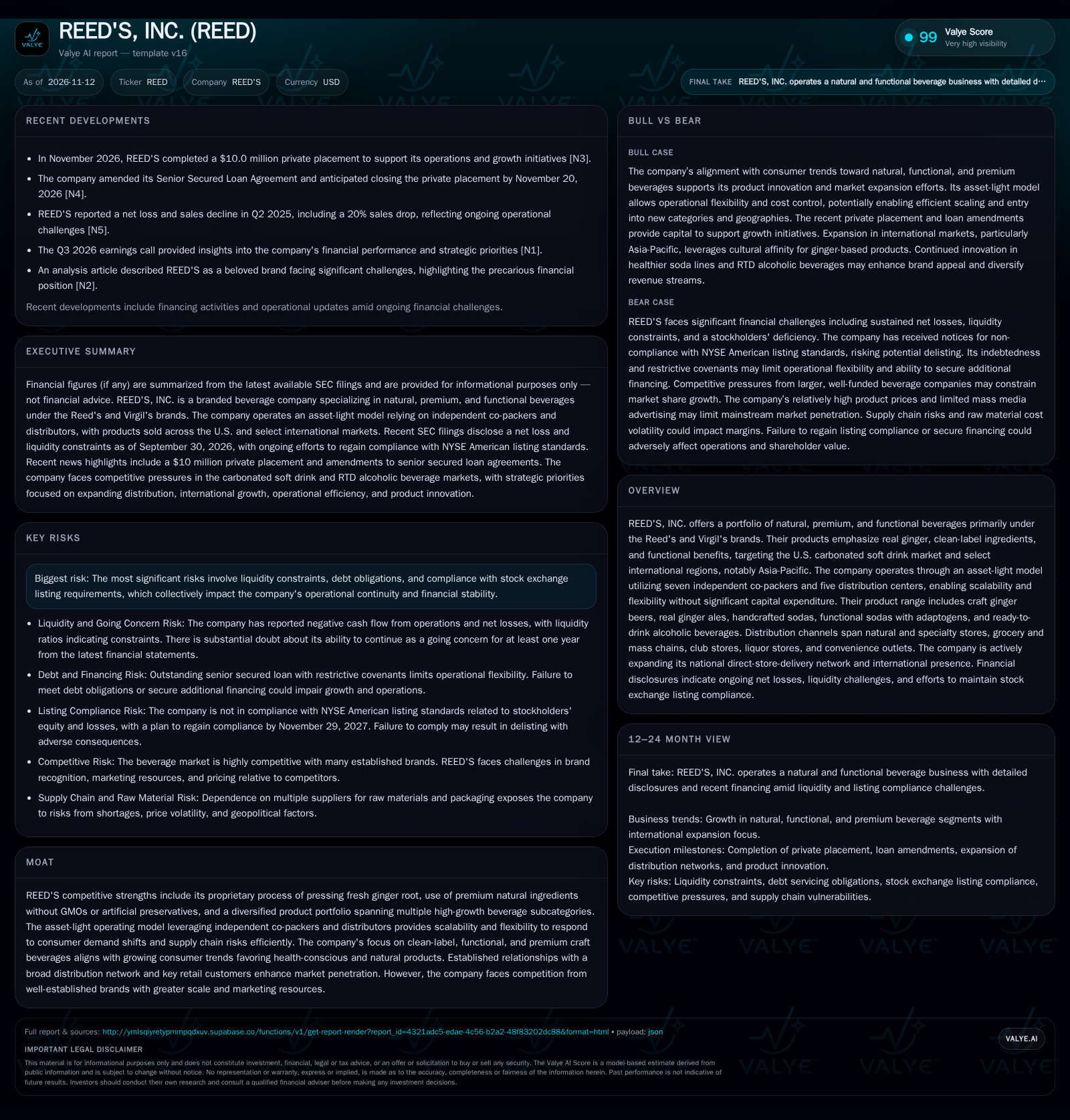
REED'S, INC. faces acute liquidity and compliance pressures while pursuing growth in the natural, functional, and premium beverage categories. A recent $10 million private placement addresses immediate capital needs, but persistent losses, high leverage, and competition from established beverage giants frame a precarious path forward.
REED'S, INC. The company’s asset-light model and focus on natural, functional beverages provide flexibility and market relevance, yet sustained losses, debt overhang, and sales declines highlight the challenge of scaling against entrenched competition. Success hinges on capitalizing on health-conscious consumer trends, operational efficiency, and restoring sales momentum, but the risk of delisting or further financial deterioration looms large. [N3] [S2]
REED'S, INC. is a branded beverage company specializing in natural, premium, and functional drinks under the Reed's and Virgil's labels. Recent emergency financing—the $10 million private placement and a reworked senior loan—buys time but does not address the core issues of scale, sales momentum, and competitive pressure. The question is whether REED'S can transform its niche appeal and operational flexibility into sustainable growth before structural financial risks force harsher outcomes.
Recent Capital Infusion and Ongoing Financial Pressures Define the Outlook
REED'S, INC. [N3] As of September 30, 2026, the company’s cash position stood at just $188,000, with current liabilities of $16.8 million far exceeding current assets of $11.3 million, resulting in a current ratio of 0.67 and a cash ratio of 0.01 [S2]. These figures underscore acute short-term financial pressure. The company has also received multiple notices from NYSE American regarding non-compliance with continued listing standards tied to equity and losses, with a compliance plan submitted in hopes of forestalling delisting [S2]. Recent quarters have seen sales declines, including a 20% drop in Q2 2025, and persistent net losses, highlighting operational and market challenges [N5].
How Reed’s Asset-Light Model Shapes Its Cost Structure and Scaling Potential
REED'S operates an asset-light business model, outsourcing production to seven independent co-packers and leveraging five distribution centers. This structure reduces fixed capital requirements and provides operational flexibility, allowing the company to scale up or down with demand and minimize overhead. The company’s product portfolio—including craft ginger beers, functional sodas, and RTD alcoholic beverages—targets premium price points due to its clean-label and natural positioning. However, the economics are pressured by relatively low gross margins typical of niche beverage companies lacking scale, and the need for continual promotional spend to maintain shelf presence and consumer mindshare.
Variable costs are influenced by raw material sourcing—especially ginger and natural sweeteners—which are subject to price volatility. The transition to aluminum cans and partnerships with national logistics providers may improve shipping efficiency but could also introduce new cost elements. The company’s recent foray into functional and alcoholic beverages could diversify mix and improve margins if these categories achieve scale. However, ongoing net losses and high leverage, including a $9.3 million senior secured loan with restrictive covenants, limit the company’s ability to invest in brand-building or absorb operational shocks [S2].
Competitive Pressures and the Limits of Differentiation in Beverage Retail
REED'S positions itself as a better-for-you alternative in the carbonated soft drink and RTD alcoholic beverage markets, emphasizing real ginger, clean labels, and functional benefits. These attributes align with long-term consumer trends toward health and natural products, offering some insulation from direct price-based competition. However, the company faces entrenched competitors—multinational beverage giants with deep marketing budgets, broad distribution, and the ability to rapidly introduce their own 'natural' or functional lines. The premium price point and relatively limited advertising budget constrain REED'S mainstream appeal and may limit velocity at mass market retailers.
Switching costs for retailers and consumers are low, and shelf space is fiercely contested. While the asset-light model enables nimbleness and targeted product innovation, it does not inherently confer pricing power or customer lock-in. The company’s ability to maintain and expand distribution relationships—especially with key accounts like Whole Foods, Kroger, and Costco—will be crucial to defending and expanding share, but these channels also demand high promotional activity and consistent service levels. International expansion, particularly in Asia-Pacific, could open new growth avenues, but local adaptation and execution risks remain significant.
What a Turnaround Would Require: From Niche Brand to Profitable Scale
A favorable outcome for REED'S would see the recent capital infusion stabilizing short-term operations and enabling targeted investments in sales, marketing, and supply chain efficiency. If the company leverages its asset-light model to expand distribution, deepen penetration in health and specialty channels, and successfully grow its functional and RTD alcoholic beverage lines, it could capture incremental share as consumer demand for natural and premium beverages expands. International markets—especially Asia-Pacific, where ginger-based flavors have cultural resonance—could provide outsized growth if local co-packing and concentrate partnerships prove cost-effective.
Confirmation of this scenario would come from a sustained reversal in sales declines, expanding gross margins, and evidence of market share gains in both legacy and new product categories. Securing renewal or expansion of key retail listings, achieving positive operating cash flow, and progress toward NYSE compliance would further validate the turnaround. Conversely, continued sales contraction, margin pressure, or inability to retain shelf space would quickly falsify this scenario.
Navigating Tightrope: Stabilization Without Breakthrough
The most plausible near-term scenario is one of fragile stabilization: the $10 million private placement and loan amendments buy time, but operational improvements come slowly. Sales may stabilize or decline modestly as REED'S focuses on core accounts and trims low-performing SKUs. Cost-cutting and supply chain optimization may blunt some losses, but high debt service and limited marketing investment cap growth potential. The company manages to maintain NYSE American compliance through incremental equity raises or cost management, but remains vulnerable to shocks.
Evidence for this scenario would include flat to modestly declining revenues, persistent but narrowing net losses, and no material improvement in market share. If the company can avoid further liquidity crises and maintain its retail distribution footprint, it could survive long enough to seek a strategic partnership, acquisition, or gradual turnaround. However, any adverse development—such as a major account loss or supply chain disruption—would threaten this balance.
When Financial Constraints Overwhelm: Delisting or Restructuring Risk
If sales declines persist or accelerate, and the recent capital infusion proves insufficient to cover ongoing losses and debt service, REED'S could face a break in operations. Failure to regain NYSE American compliance would likely trigger delisting, sharply limiting access to public capital and potentially eroding supplier and customer confidence. [S2]
In this scenario, REED'S may be forced into a distressed sale, restructuring, or even bankruptcy. Confirmation would come from further sales declines, widening losses, covenant breaches, or public notices of delisting. Lack of access to new financing, loss of key retail accounts, or supply chain disruptions would accelerate the downside. This pathway would likely result in severe dilution or loss of equity value for current shareholders.
Milestones That Will Clarify Whether REED'S Can Rebound or Falter
Quarterly revenue growth or stabilization, particularly in core Reed's and Virgil's product lines, would indicate whether the company is regaining consumer and retailer traction.
Gross margin trends, if disclosed, will reveal whether operational changes and mix shifts are yielding improved profitability or if cost pressures persist.
Updates on NYSE American compliance status and any further notices or waivers will be critical in assessing listing risk and access to public capital.
Cash flow from operations and changes in net working capital will help determine whether the business is moving toward self-sufficiency or remains reliant on external funding.
Securing or expanding contracts with major retailers (e.g., Kroger, Costco, Whole Foods) would suggest ongoing channel viability and customer confidence.
Progress in international expansion, especially sales growth or new distribution partnerships in Asia-Pacific, will clarify the potential for non-U.S. markets to offset domestic pressures.
Details on product innovation uptake (e.g., functional sodas, RTD alcoholic beverages) and their contribution to overall sales mix would help test the thesis that innovation can drive growth.
If disclosed, SKU rationalization and supply chain efficiency metrics—such as inventory turns or logistics cost per unit—would indicate execution on operational efficiency initiatives.
Disclaimer: This is research-only, informational analysis and not investment advice. It may include AI-generated interpretation and general industry context. Always verify important details using primary sources.

Comments