
United-Guardian’s Surge in Cosmetic Ingredients: Can Niche Innovation Outpace Market Pressures?
United-Guardian’s double-digit sales rebound in 2026 spotlights the leverage of its specialized hydrogel formulations and renewed demand for Renacidin, but long-term value creation hinges on sustaining product innovation and distributor relationships in a market facing persistent pricing pressure.
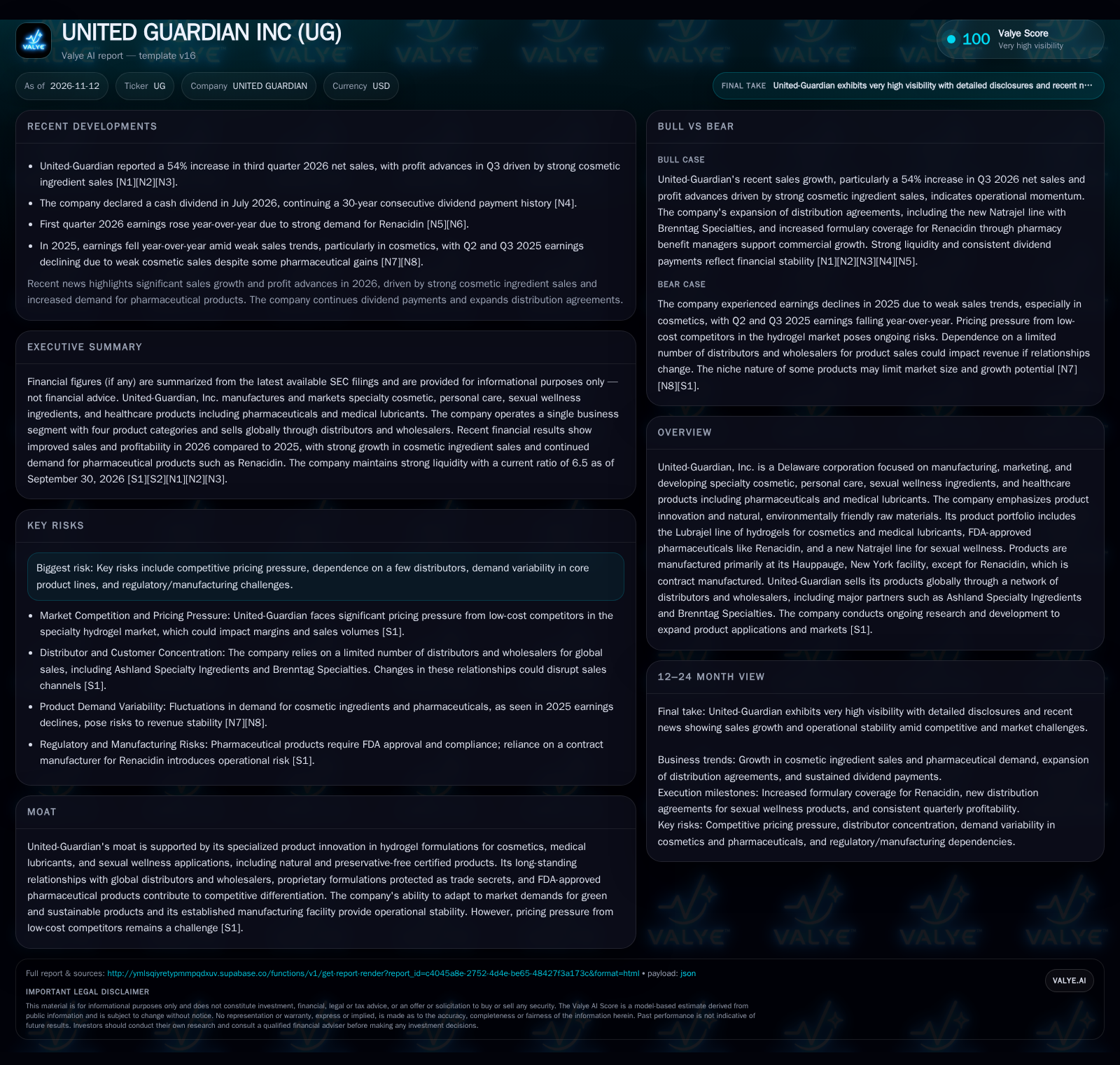
United-Guardian delivered a 54% jump in Q3 2026 net sales, primarily from cosmetic ingredient strength, and posted improved profitability after a weak 2025. The company’s R&D focus on natural, preservative-free formulations and expanded distribution for sexual wellness products are driving current momentum. However, heavy reliance on a few global distributors and exposure to low-cost competition in hydrogels could constrain future growth and margins. The next phase depends on whether United-Guardian’s innovation and channel management can offset these structural vulnerabilities. [N1] [N2] [N3] [S1]
United-Guardian’s dramatic rebound in 2026 results from a sharp recovery in its core cosmetic ingredient business—most notably its Lubrajel hydrogel line—after a challenging 2025 marked by weak sales and profit declines. The company’s longstanding focus on specialty, natural, and preservative-free formulations, bolstered by expanded distribution partnerships and increased Renacidin pharmaceutical demand, has powered recent growth. However, with competitive pricing pressure intensifying and persistent reliance on a handful of key distributors, the question is whether United-Guardian’s niche innovation and operational discipline can deliver durable value or if structural vulnerabilities will reassert themselves as market headwinds return.
2026 Sales Rebound and Strategic Moves: What’s Changed for United-Guardian?
United-Guardian reported a 54% year-over-year increase in net sales for Q3 2026, reversing the declines experienced in 2025. This resurgence was largely attributed to strong performance in cosmetic ingredient sales, particularly the Lubrajel hydrogel line [N1] [N2] [N3]. Income from operations reached approximately $1.11 million, with net income of $930,912 in the third quarter, signaling marked profitability improvement [S2].
The company also saw notable momentum in its pharmaceutical segment, with Q1 2026 earnings rising on the back of increased Renacidin demand, aided by new formulary approvals at major pharmacy benefit managers [N5] [N6] [S1]. Additionally, United-Guardian expanded distribution for its sexual wellness Natrajel line in North America and France, leveraging Brenntag Specialties as a new partner [S1].
Financially, United-Guardian maintained a reported balance sheet position as of September 2026, with a current ratio of 6.5 and a 30-year track record of uninterrupted dividend payments, underscoring its operational discipline and capital conservatism [N4] [S2].
How United-Guardian Makes Money: High-Margin Niche, Fixed Costs, and Leverage Limits
United-Guardian’s revenue is anchored in specialty hydrogel formulations for cosmetics, medical devices, and sexual wellness, with complementary pharmaceutical products. Cosmetic ingredients, including the Lubrajel line, are distributed globally through a handful of large partners, typically sold on a non-consignment, non-returnable basis, which may support working capital efficiency and limit returns risk [S1].
The company’s cost structure likely features moderate fixed costs tied to its Hauppauge manufacturing facility and R&D, with variable costs largely driven by raw materials and contract manufacturing for Renacidin. Given the niche and value-added nature of its products, United-Guardian may command higher gross margins than generic chemical suppliers, especially for proprietary or COSMOS-certified formulations. However, pricing power is constrained by the presence of low-cost competitors and the commoditization risk of hydrogel technologies.
Operating leverage is present but capped by the company’s scale and product concentration. Upside from volume growth in core lines can boost profitability, as seen in 2026, but downside risk is magnified if a major distributor reduces orders or if a core product faces substitution or regulatory setbacks.
Niche Differentiation vs. Low-Cost Threats: Where United-Guardian Stands
United-Guardian’s competitive edge rests on its specialized hydrogel formulations, long-term distributor relationships, and a track record of developing products that meet rising consumer and regulatory demands for natural, preservative-free, and certified ingredients [S1]. Its proprietary processes, protected as trade secrets, and its FDA-approved pharmaceuticals like Renacidin and Clorpactin provide some defensibility.
However, the company operates in a fragmented and price-sensitive market, where barriers to entry for basic hydrogel products are moderate and price competition is acute. Large chemical conglomerates and specialized ingredient suppliers with broader product portfolios and global reach represent constant competitive pressure. The company’s reliance on a small number of distributors, such as Ashland Specialty Ingredients and Brenntag Specialties, creates channel vulnerability: loss or weakening of these relationships could have outsized revenue impact.
Product innovation and customization for high-value applications, particularly those requiring regulatory approval or certification, are United-Guardian’s best defense against commoditization. But the sustainability of its moat depends on continued R&D investment and successful commercialization of new formulations.
When Niche Innovation Wins: Pathways to Sustainable Growth
If United-Guardian can maintain its recent momentum in cosmetic ingredient sales and successfully expand its pharmaceutical and sexual wellness lines, the company could achieve sustained double-digit growth and margin expansion. This scenario would require continued R&D breakthroughs in natural and preservative-free hydrogels, successful launches of new products like Natrajel, and deepening of distributor relationships—potentially including additional geographies or exclusive deals.
Expansion of Renacidin’s formulary coverage and penetration into new healthcare channels could further diversify revenue and reduce cyclicality. Structural discipline in manufacturing and working capital management would reinforce profitability, while the company’s financial strength could support selective acquisitions or product line extensions.
Confirmation of this scenario would come from consistent quarter-over-quarter sales growth in both cosmetics and pharmaceuticals, margin resilience despite competitive pricing, and evidence of new distribution partnerships or regulatory wins (such as further formulary inclusions or product approvals).
Steady-State: Balancing Growth Spurts with Volatility
The most plausible outcome is that United-Guardian continues to deliver moderate top-line and profit growth, punctuated by periods of volatility tied to distributor order patterns and end-market demand swings. Cosmetic ingredient sales remain the primary driver, but growth rates normalize after the 2026 rebound as the company faces ongoing price competition and market saturation in core segments.
Pharmaceutical products like Renacidin provide some counter-cyclicality and margin stability, but their contribution remains secondary to cosmetics. Ongoing R&D efforts yield incremental rather than transformative product launches, supporting customer retention and modest share gains but not fundamentally altering the company’s growth trajectory.
Evidence for this scenario would include stable (but not accelerating) quarterly sales, relatively flat gross and operating margins, and continued dependence on a handful of distributors and core SKUs. Any significant erosion in distributor relationships or regulatory setbacks could quickly shift the balance toward downside risk.
Channel Concentration and Pricing Pressure: How the Thesis Could Break
United-Guardian’s business model is susceptible to abrupt revenue declines if a major distributor reduces orders, switches suppliers, or renegotiates terms unfavorably. Such a scenario could be triggered by intensified price competition from generic hydrogel producers or by the entry of larger ingredient suppliers with greater leverage and broader product offerings.
A softening of demand in cosmetics or pharmaceuticals—whether from regulatory changes, loss of product certifications, or shifts in consumer preference—could further amplify the downside. Because the company’s fixed cost base is not trivial relative to its scale, a sharp drop in volume would quickly compress margins and potentially force cost-cutting or restructuring.
Evidence of this scenario would include a quarter or more of sharply lower sales, margin compression, order reductions from key distributors, or the loss of a major distribution agreement. Regulatory or manufacturing disruptions, especially for outsourced products like Renacidin, would intensify the impact.
Milestones and Metrics That Will Define United-Guardian’s Next Act
Quarterly sales and gross margins for the Lubrajel and Natrajel lines—if disclosed—would provide direct insight into the sustainability of cosmetic ingredient momentum.
Renacidin formulary wins and hospital/clinic penetration rates are crucial for validating the pharmaceutical revenue diversification thesis.
Distributor concentration metrics—such as the percentage of total sales from the top two or three partners—would help assess channel risk.
New product launch frequency and adoption rates, particularly for natural and preservative-free hydrogels, would confirm ongoing innovation capacity.
Quarterly operating expense trends and R&D spend as a percentage of sales would indicate the company’s ability to invest in future growth without eroding profitability.
Any material changes in manufacturing arrangements or regulatory compliance for Renacidin and other pharmaceuticals would be early warning signs for operational risk.
Disclaimer: This is research-only, informational analysis and not investment advice. It may include AI-generated interpretation and general industry context. Always verify important details using primary sources.

Comments