
Granite Point Mortgage Trust 2026: Financing Dependence, Credit Pressures, and the Uncertain Road for CRE REITs
Granite Point Mortgage Trust stands at a crossroads, navigating heavy net losses, a challenging office-loan environment, and acute reliance on a single financing partner. The company’s ability to stabilize its portfolio and maintain access to capital will shape its prospects as commercial real estate markets remain unsettled.
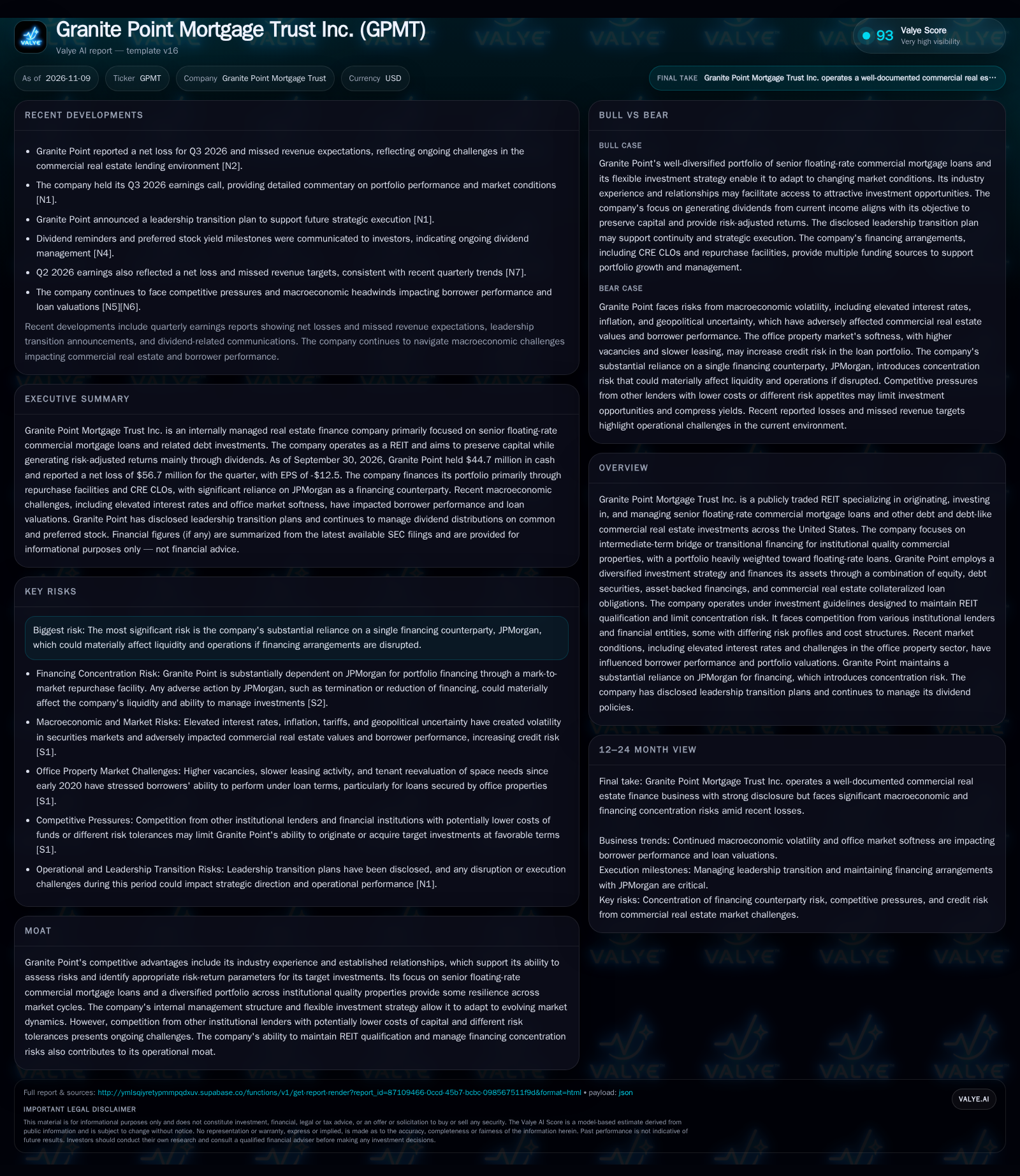
Granite Point Mortgage Trust reported a $56.7 million net loss in Q3 2026, reflecting persistent stress in its senior floating-rate loan portfolio amid office-market weakness and macro volatility. With $1.7 billion in loans and $44.7 million in cash, its heavy dependence on JPMorgan for funding and ongoing leadership transition heighten operational risk. The company’s future hinges on managing credit performance, financing access, and dividend sustainability as CRE headwinds persist. [S2] [N2]
Granite Point Mortgage Trust, an internally managed REIT specializing in senior floating-rate commercial real estate loans, faces a confluence of pressures as the U.S. CRE market remains turbulent. Its Q3 2026 net loss, driven by portfolio credit stress and muted borrower performance—especially in office properties—highlights the fragility of its business model in the current environment. The cited source reports dividend-related activity; that disclosure alone does not establish dividend-policy continuity, management confidence, or a material constraint on capital flexibility. [S2] [N2] [N1]
Recent Losses, Portfolio Exposure, and Financing Reliance Define Granite Point’s Present
Granite Point Mortgage Trust reported a net loss of $56.7 million for Q3 2026, with basic and diluted EPS of -$12.5, marking a continuation of negative performance trends seen throughout the year. Critically, Granite Point remains substantially dependent on JPMorgan for portfolio financing via a $1.1 billion mark-to-market repurchase facility, posing acute concentration risk if the counterparty’s risk appetite or terms shift. The company is also in the midst of a leadership transition, adding further uncertainty to its operational outlook. [S2] [N2] [N1]
How Granite Point’s Economics Are Shaped by Floating-Rate Loans, Funding Costs, and Credit Leverage
Granite Point’s business model centers on originating and managing senior floating-rate commercial mortgage loans, typically with three-year terms and initial loan-to-value ratios around 69%. Revenues are generated primarily from the spread between loan interest income (weighted average cash coupon of S+3.62%) and the cost of financing, which is heavily dependent on short-term rates and the terms of repurchase and CRE CLO facilities. Because nearly the entire loan book is floating-rate, the company’s net interest margin is theoretically insulated from rising base rates—provided that borrowers can service higher interest payments and that funding costs do not spike disproportionately.
However, this model has inherent vulnerabilities. Declines in property values or borrower cash flows—especially in office and transitional assets—can lead to loan impairments, defaults, or the need for loss provisioning, directly impacting earnings. In periods of credit stress, mark-to-market provisions on financed assets (especially under repurchase agreements) can trigger margin calls or force asset sales at unfavorable prices. Operating leverage is high: modest increases in credit losses or funding costs can rapidly erode profitability. As a REIT, Granite Point is also compelled to distribute most taxable income as dividends, limiting its ability to retain capital and absorb shocks. The capital structure, reliant on external financing and subject to counterparty risk, leaves little room for error if credit or liquidity conditions deteriorate.
Competitive Dynamics: Where Granite Point Stands in a Crowded CRE Lending Market
Granite Point competes with other REITs, banks, specialty finance companies, and private credit funds in the commercial real estate lending space. Many competitors have lower costs of capital (especially large banks or insurance-affiliated lenders) or greater risk tolerance, which can compress spreads and make it harder for Granite Point to source attractively priced loans. The firm’s edge lies in its experience with transitional assets, established industry relationships, and a diversified investment approach—though these advantages are blunted in a market where capital is abundant and risk-taking is rewarded during credit booms.
In the current cycle, however, the competitive calculus has shifted. Elevated interest rates and falling office property values have led to higher vacancies, reduced leasing activity, and increased borrower stress. This environment may allow well-capitalized lenders to cherry-pick the best opportunities or acquire distressed assets at favorable terms, while more highly leveraged or funding-dependent players (like Granite Point) are forced to defend their existing portfolios. The company’s acute reliance on a single financing partner (JPMorgan) further weakens its competitive position, as any tightening of terms or withdrawal of funding could force distressed asset sales or limit new loan origination.
What Would It Take for Granite Point to Recover? Pathways to Stabilization and Dividend Resumption
A constructive scenario for Granite Point hinges on stabilization in commercial real estate values—especially in the office sector—and a reduction in credit losses across its portfolio. If macroeconomic volatility subsides and tenant demand for office space rebounds, borrower performance could improve, reducing delinquencies and the need for additional loss provisions.
Access to diversified financing beyond JPMorgan—such as new CRE CLOs or unsecured debt—would mitigate concentration risk and provide greater operational flexibility. Leadership transition, if successfully managed, could inject new strategic vision or cost discipline, further supporting stabilization. Confirmation of this scenario would include a return to positive net income, reduced realized credit losses, successful refinancing of major funding facilities, and renewed loan origination at attractive spreads. Evidence to watch for: improved credit metrics in quarterly reports, positive commentary on borrower performance, and announcements of new or diversified financing sources.
The Most Likely Trajectory: Managing Through Losses While Navigating Credit and Liquidity Headwinds
The most plausible near-term scenario is continued earnings pressure as Granite Point works through legacy portfolio issues in a weak CRE market, especially in office loans. Credit losses and valuation write-downs may persist, limiting the company’s ability to cover dividends from recurring income. Dividend payouts could be reduced, suspended, or shifted toward preferred stockholders if taxable income falls below distribution requirements. Financing costs are likely to remain elevated, and the company’s reliance on JPMorgan will continue to constrain flexibility.
Incremental improvement may occur if broader CRE market conditions stabilize and new leadership executes on cost control or asset management. However, the company is likely to operate in a defensive posture, prioritizing liquidity preservation and risk management over portfolio growth. Signs to watch for include unchanged or only modestly improved credit metrics, cautious management tone in earnings calls, and a lack of major new financing initiatives.
If Conditions Worsen: Liquidity Squeeze, Forced Asset Sales, and Potential Dividend Cuts
Should commercial real estate values continue to decline—particularly in the office sector—Granite Point could face a cascading series of challenges. Rising borrower defaults and further loan impairments would erode earnings and capital, potentially triggering covenant breaches or margin calls under its repurchase agreements. If JPMorgan tightens terms, reduces financing capacity, or exits the facility, Granite Point may be forced to liquidate assets at distressed prices, locking in losses and shrinking its portfolio.
Such a scenario would almost certainly require dividend suspension to preserve cash and could prompt management to pursue dilutive capital raises or asset sales. Leadership instability could exacerbate operational missteps or slow critical decision-making.
What Could Change the Outlook for Granite Point Mortgage Trust?
Quarterly credit performance metrics—including non-performing loans, realized losses, and loan modifications—would help gauge the depth of portfolio stress if disclosed.
Updates on the size, terms, and renewal status of the JPMorgan repurchase facility will indicate ongoing financing stability or vulnerability.
Disclosure of new or diversified funding sources (CRE CLOs, unsecured debt, or expanded credit lines) would suggest progress in managing concentration risk.
Dividend announcements and payout ratios versus recurring income will test the sustainability of distributions, especially if net losses persist.
Management commentary and actions related to the leadership transition—including executive hires, departures, or revised strategic priorities—will signal organizational stability.
Portfolio composition shifts—such as reductions in office loan exposure or increases in higher-quality property types—would clarify risk management efforts.
Any changes in borrower performance metrics, such as improvement in office sector leasing or tenant retention rates, would indicate potential credit stabilization.
Material changes in cash and liquidity levels, especially following asset sales or financing renewals, would signal the company’s ability to withstand ongoing stress.
Disclaimer: This is research-only, informational analysis and not investment advice. It may include AI-generated interpretation and general industry context. Always verify important details using primary sources.

Comments