
Acushnet Holdings 2026: Brand Power, Category Dynamics, and the Realities of Golf Market Cyclicality
Acushnet’s Q3 2026 results reaffirm the company’s profitability and reported liquidity position, yet earnings lagged expectations amid a competitive and economically sensitive golf equipment landscape. The durability of its Titleist and FootJoy brands will be tested by evolving consumer demand, margin pressures, and the pace of product innovation.
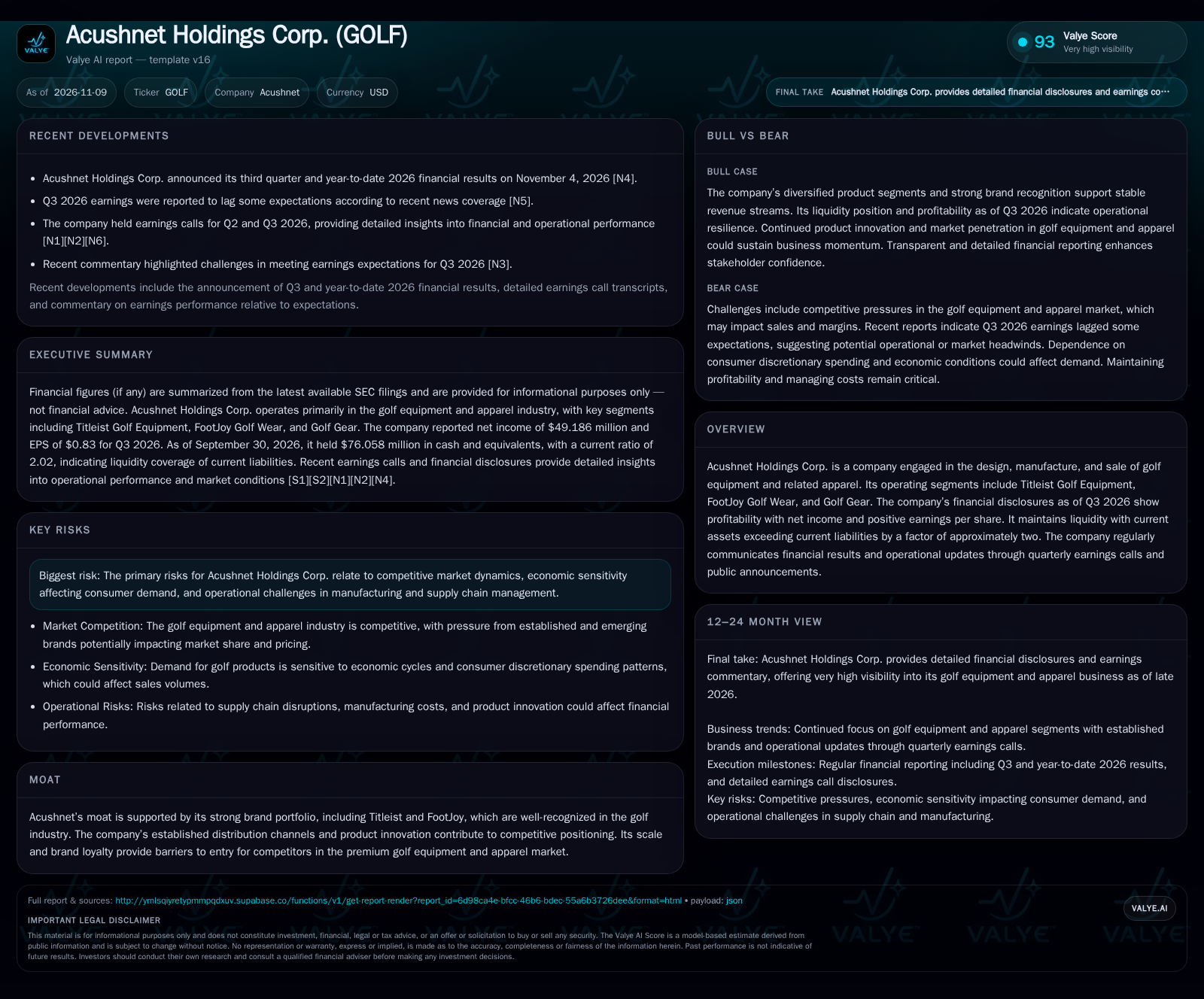
Acushnet remains profitable and liquid as of Q3 2026, with $49.2 million in net income and a 2.02 current ratio, but recent earnings missed some expectations. The company’s performance now hinges on its ability to defend premium brand positions, manage cost and supply chain headwinds, and adapt to shifts in discretionary consumer spending within the global golf market. Brand strength underpins its moat, but operational execution and market conditions will shape future outcomes. [S2] [N5]
Acushnet Holdings Corp., the parent behind golf stalwarts Titleist and FootJoy, posted a profitable Q3 2026 but fell short of some market expectations. With $49.2 million in net income and a robust current ratio, the company demonstrates financial health, yet faces increasing scrutiny as the golf equipment and apparel space contends with economic uncertainty and shifting consumer tastes. The coming quarters will test Acushnet’s ability to maintain pricing power, innovate across its product lines, and defend its coveted brand positions against both established and emerging competitors.
Recent Financials and Brand Anchors: Where Acushnet Stands at Q3 2026
Acushnet posted net income of $49.186 million for Q3 2026, translating to $0.83 per share, and reported $76.058 million in cash and equivalents. The company reported cash and liquidity metrics for the period; these figures do not by themselves establish operating runway, investment capacity, financial flexibility, or financing capacity. Despite this reported balance sheet position, Q3 earnings lagged some analyst expectations—a signal that either volume, pricing, or margin dynamics may have become more challenging in recent months. The company’s business remains anchored by the globally recognized Titleist and FootJoy brands, spanning golf balls, clubs, shoes, and apparel. [S2] [N5]
How Golf Economics Shape Acushnet’s Profit Engine
Acushnet’s revenue streams are built on the sale of premium golf equipment (notably balls and clubs under Titleist) and apparel/footwear (primarily FootJoy). The business is characterized by high product development and marketing costs, with gross margins highly sensitive to mix (premium vs. value SKUs), input costs (materials, logistics), and sell-through velocity at retail. Pricing power historically derives from brand leadership, tour endorsement, and perceived product innovation; however, this can be eroded if consumer demand softens or if competitors successfully introduce compelling alternatives.
Operating leverage is meaningful: fixed costs in R&D, tooling, and marketing mean that incremental volume can drive outsized margin gains in strong cycles—but also expose the business to downside if volumes contract. Capital requirements are moderate for manufacturing and inventory, but less so than for capital-intensive industries.
The interplay between product innovation cycles and consumer adoption rates is critical to sustaining Acushnet’s revenue growth and margin profile. Given the premium positioning of Titleist and FootJoy, the company must continuously invest in R&D to introduce performance-enhancing features that justify price premiums. However, the timing of these innovations relative to market receptivity can create lumpy revenue patterns, especially if new products fail to resonate quickly. Additionally, shifts in raw material costs—such as synthetic polymers for golf balls or specialized fabrics for footwear—can disproportionately impact margins if Acushnet cannot adjust pricing promptly or improve operational efficiencies. This dynamic underscores the importance of agile supply chain management and flexible pricing strategies to navigate cost volatility without sacrificing brand integrity.
Defending the Premium Tee: Moat Strength and Market Pressures
Acushnet’s core moat is rooted in brand equity—Titleist is synonymous with premium golf balls and enjoys deep loyalty among professionals and dedicated amateurs, while FootJoy is a heritage leader in golf footwear. These brands enable above-average pricing and shelf space, reinforced by long-standing distribution relationships and tour visibility. Still, the company operates in a category where brand switching—though rare at the top end—can accelerate if consumer preferences shift or if new technologies emerge.
Competitive threats come from both global incumbents (e.g., other major golf equipment conglomerates) and smaller innovators targeting niche or value segments. Substitutes include lower-priced private-label equipment and apparel, as well as used or refurbished gear. The risk of commoditization is present if Acushnet’s innovation cadence slows or if price-sensitive consumers trade down during economic downturns. Apparel and footwear are particularly susceptible to fashion and weather-driven volatility, and these segments often face more price competition than core golf balls and clubs.
Acushnet’s moat, while robust, is not impervious to disruption from technological innovation outside traditional golf equipment paradigms. For instance, advancements in data analytics and wearable technology could redefine consumer expectations around performance feedback and customization. If competitors integrate such technologies more rapidly or effectively, Acushnet risks losing relevance among tech-savvy golfers, particularly younger demographics. Moreover, the rise of direct-to-consumer brands leveraging digital platforms could erode traditional distribution advantages by offering personalized experiences and competitive pricing. Therefore, maintaining the premium brand cachet requires not only product excellence but also strategic investments in digital engagement and customer experience enhancements that align with evolving consumer behaviors.
What Could Drive a Positive Surprise for Acushnet?
A plausible upside scenario would see Acushnet leveraging its brand strength to grow share in both core and adjacent categories, supported by successful new product launches and effective marketing. If golf participation rates remain robust—driven by demographic tailwinds, global expansion, or increased interest from younger consumers—the company could see sustained volume growth, allowing it to capitalize on operating leverage.
Upside could also come from improved supply chain efficiency or stabilization in input costs, boosting gross margins. Confirmation would come from above-expectation sales growth, margin expansion in quarterly reporting, and commentary on successful product launches or market share gains in earnings calls. Additional evidence would include positive channel feedback, strong sell-through of new SKUs, and continued premium pricing relative to peers.
In scenarios where Acushnet successfully capitalizes on emerging market segments—such as growing female participation or increased interest in golf simulators and indoor play—the company could diversify its revenue base and reduce cyclicality exposure. Tailoring product lines and marketing efforts to these niches may unlock incremental growth opportunities beyond the core male-dominated player base. Furthermore, strategic partnerships or collaborations with technology firms could accelerate innovation cycles and create differentiated offerings that competitors find difficult to replicate. If such initiatives lead to meaningful increases in customer lifetime value and brand loyalty, Acushnet could enhance its pricing power and margin resilience, thereby outperforming consensus expectations.
If Acushnet Holds Its Ground: A Plausible Middle Outcome
The most likely path is that Acushnet continues to generate stable, modestly growing earnings while defending its leading market positions. Revenue growth may track broader golf participation trends and consumer discretionary spending, with periodic product refreshes sustaining brand relevance. Margin performance could be mixed: premium segments may maintain pricing, but apparel and non-core gear could face pressure if consumers become more price sensitive.
Confirmation would come from continued profitability, steady EPS, and stable gross margins in future quarters. Watch for management guidance that reiterates mid-single-digit growth and disciplined cost control. A base case would likely show resilience in golf balls and clubs but more volatility in apparel and accessories, with incremental margin improvement dependent on cost discipline and supply chain management.
Should Acushnet maintain its current trajectory without significant market share shifts, the company’s financial performance will likely reflect broader macroeconomic conditions impacting discretionary spending. In this environment, cost discipline and operational efficiency become paramount to offset potential topline softness. Incremental improvements in supply chain agility—such as nearshoring or inventory optimization—could mitigate margin pressures even if volume growth remains modest. Additionally, sustaining consumer engagement through targeted marketing and incremental product enhancements can preserve brand relevance without necessitating large capital outlays.
How Adverse Trends Could Undercut Acushnet’s Performance
A negative scenario would see a combination of declining consumer demand—perhaps triggered by a broader economic slowdown—and intensifying price competition, forcing Acushnet to discount or cede share to rivals. If golf participation contracts or if customers delay equipment and apparel purchases, volumes could fall, exposing the company’s fixed cost base and compressing margins.
Operationally, persistent supply chain issues or spikes in input costs could further erode profitability, especially if the company is unable to pass through costs to consumers. Evidence for this scenario would include revenue or EPS misses in successive quarters, negative revisions to guidance, inventory build-ups, or management commentary highlighting market share losses, margin compression, or promotional activity increases.
What Will Determine Whether Acushnet’s Moat Holds in 2027?
Quarterly sales growth by segment (Titleist equipment, FootJoy apparel, Golf Gear) would help clarify where demand is holding firm or weakening.
Gross margin trends, especially in the face of input cost or supply chain volatility, will signal pricing power and cost control.
Sell-through rates and channel inventory levels—if disclosed—would provide early warning of demand shifts or overstock risk.
New product launch cadence and early adoption rates, particularly for flagship equipment SKUs, will indicate continued brand relevance.
Market share changes in premium golf balls and clubs, as tracked by third-party data or management disclosure, would show competitive strength or vulnerability.
Apparel and footwear growth versus industry benchmarks will reveal if FootJoy can defend share amid fashion and weather-driven volatility.
Management commentary on discretionary consumer trends and international market expansion could reshape the growth narrative.
Inventory and working capital metrics, especially if they rise disproportionately to sales, may signal demand softening or execution issues.
Disclaimer: This is research-only, informational analysis and not investment advice. It may include AI-generated interpretation and general industry context. Always verify important details using primary sources.

Comments