
Zevia 2026: Brand-Led Differentiation and the Realities of a Competitive Zero-Sugar Beverage Market
Zevia sharpens its focus on core soda and energy drinks, doubling down on marketing and sustainability as it contends with activist pressure, discontinued tea sales, and persistent losses. The question is whether premium positioning and operational discipline can overcome scale-driven challenges in a crowded, fast-evolving beverage segment.
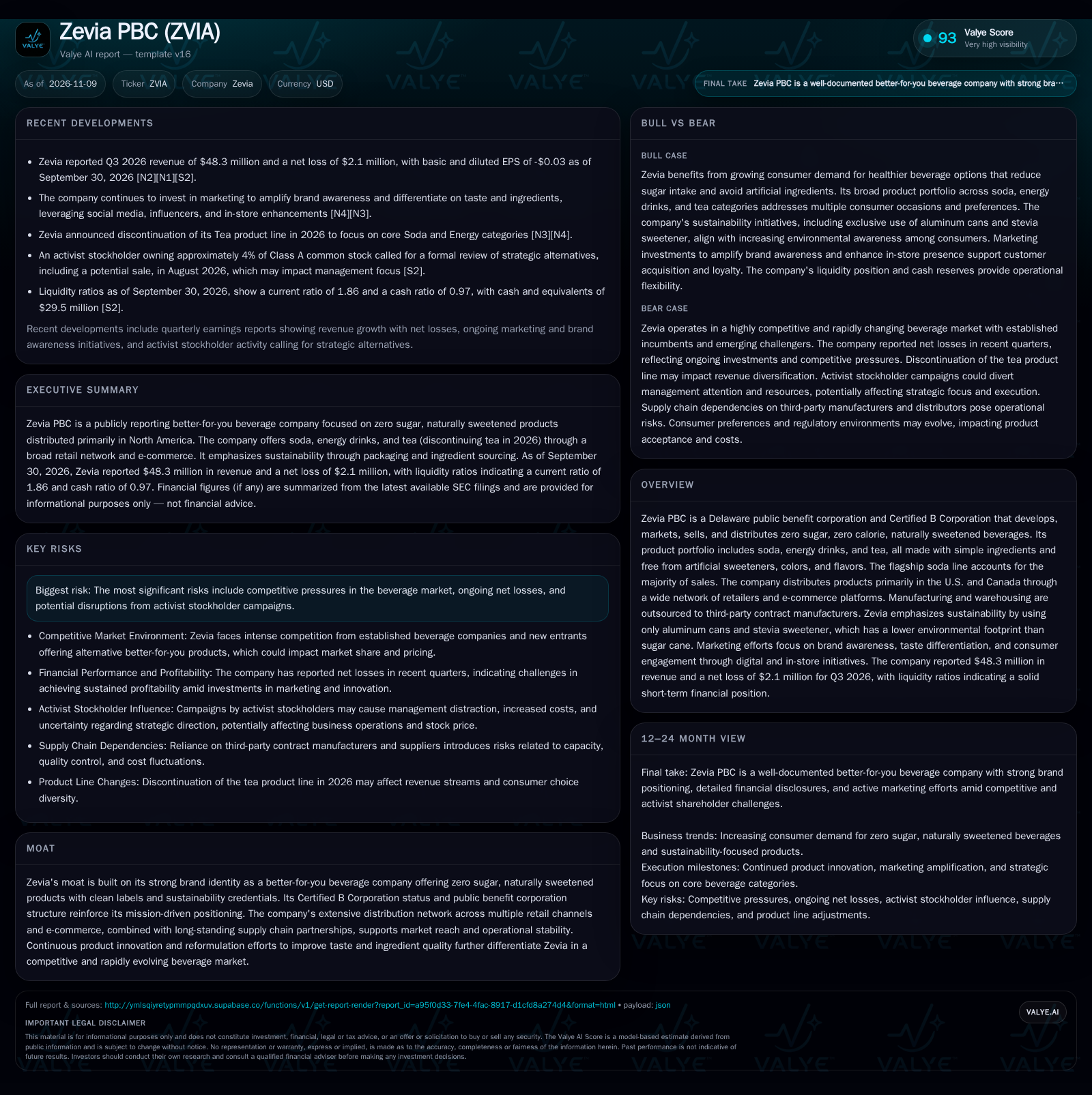
Zevia remains a mission-driven contender in the zero-sugar beverage market, reporting $48.3 million in Q3 2026 revenue and a net loss of $2.1 million as it exits the tea segment and intensifies marketing for its flagship soda and energy drinks. With activist shareholders pressing for strategic alternatives and ongoing losses highlighting scale and margin pressures, Zevia’s future hinges on its ability to translate brand equity and sustainability into profitable, defensible growth amid fierce category competition and shifting consumer preferences. [S2] [N2] [N1] [N3] [N4]
Zevia’s journey as a public benefit corporation and Certified B Corp has been defined by its commitment to zero-sugar, clean-label beverages and a sustainability-first ethos. In 2026, the company is doubling down on its core soda and energy drink lines, discontinuing tea and ramping up marketing in a bid to stand out in a fiercely competitive space dominated by both legacy giants and fast-moving upstarts. With $48.3 million in Q3 revenue offset by continued losses and mounting activist pressure to consider strategic alternatives, Zevia’s next chapter will test whether brand differentiation, operational focus, and consumer trends can drive a profitable and defensible business model—or whether the realities of scale and competition will force a strategic reset. [S2] [N2] [N1] [N4]
Core Focus, Activist Pressure, and Financial Realities in 2026
Zevia reported Q3 2026 revenue of $48.3 million and a net loss of $2.1 million, with basic and diluted EPS of -$0.03. This loss continues a trend of negative earnings, underscoring ongoing challenges with scale, input costs, and marketing investment. [S2] [N2] [N1]
The company is discontinuing its tea line in 2026, sharpening its focus on core soda (about 95% of net sales) and energy drinks. This move reflects a desire to concentrate resources on categories with stronger velocity and brand resonance, but it also reduces product diversification. [N3] [N4]
An activist shareholder holding roughly 4% of Zevia’s Class A common stock called for a review of strategic alternatives, including a potential sale, in August 2026. This external pressure introduces uncertainty and could influence management’s priorities and willingness to invest for long-term growth. [S2]
Zevia’s cash and equivalents stood at $29.5 million with a current ratio of 1.86 as of September 30, 2026. While these figures suggest reported liquidity position in the near term, persistent losses highlight the importance of achieving operational efficiency and sustainable margin improvement. [S2]
How Zevia’s Model Converts Brand and Distribution into Revenue (and Where It Struggles)
Zevia’s economics are anchored by its flagship soda line, which accounts for about 95% of revenue. The company’s value proposition—zero sugar, natural sweeteners, clean labels, and sustainability—enables premium shelf placement and appeals to health- and eco-conscious consumers. However, the beverage category’s notoriously high slotting fees, promotional intensity, and distribution costs mean that even rapidly growing brands often struggle to achieve scale-driven margin leverage.
Pricing power is limited by the presence of both entrenched incumbents and a proliferation of challenger brands, especially in the natural and zero-sugar segments. Zevia’s reliance on third-party contract manufacturers keeps fixed capital needs low, but limits margin expansion opportunities that might come from vertically integrated production or proprietary bottling assets.
Variable costs—including raw materials (aluminum, stevia, flavors), logistics, and marketing—remain significant. Recent increases in marketing spend are designed to drive trial and repeat purchase, but may pressure near-term profitability, especially as Zevia competes for shelf space and consumer mindshare against better-funded rivals.
The discontinuation of the tea line may reduce complexity and improve focus, but also concentrates risk in the soda and energy categories. Achieving positive operating leverage will likely require either outsized volume growth within these core categories or successful premiumization that sticks in a competitive environment.
Brand Identity and Distribution Breadth vs. Scale and Category Entrenchment
Zevia’s competitive position is built on its distinctive zero-sugar, natural-sweetener, and sustainability credentials, reinforced by its Certified B Corporation and public benefit corporation status. This brand identity sets it apart in a crowded better-for-you beverage market, but the moat is relatively narrow when compared to the distribution muscle, marketing budgets, and category breadth of global beverage giants.
The company’s presence in over 39,000 retail locations across the U.S. and Canada is a meaningful achievement, providing access and visibility. However, shelf space is fiercely contested, and retailer promotional slots often favor category leaders or those willing to invest heavily in trade spend. Zevia’s outsourced production model enables flexibility but may limit speed to market for new product innovation compared to vertically integrated peers.
Competitive threats come not only from legacy CPG players expanding their zero-sugar portfolios, but also from fast-scaling challenger brands leveraging direct-to-consumer (DTC) channels, functional beverage trends, and influencer-driven marketing. Zevia’s sustainability narrative and ingredient simplicity resonate with a specific consumer segment, but the risk is that these benefits are quickly matched or neutralized by competitors with greater scale.
A Playbook for Profitable Growth: Brand Premiumization Meets Operational Discipline
The most constructive scenario for Zevia is one where intensified marketing and clear brand messaging drive above-category growth in core soda and energy drinks, translating into higher velocities and improved shelf economics. If Zevia can leverage its sustainability and clean-label positioning to command a price premium while reducing promotional spend per unit sold, gross margins could expand.
Operational focus—bolstered by the discontinuation of underperforming lines like tea—may allow the company to streamline SKUs, optimize supply chain relationships, and negotiate better terms with contract manufacturers. In this scenario, positive operating leverage emerges as fixed SG&A is spread over a larger revenue base.
Evidence for this scenario would include a sustained increase in same-store sales growth for flagship products, improvement in gross margin percentage, and a narrowing of net losses quarter over quarter. Confirmation would also come from retailer and distributor feedback indicating increased category relevance and from metrics such as repeat purchase rates and higher average order values (if disclosed).
Incremental Progress Amid Margin Pressure and Strategic Uncertainty
The most plausible trajectory for Zevia is continued incremental revenue growth in core soda and energy drinks, offset by ongoing margin pressure and limited scale-driven cost absorption. The company’s marketing investments may yield modest velocity gains, but competitive discounting and promotional demands from retailers could keep gross margins under pressure.
Discontinuation of tea simplifies operations but increases concentration risk.
The activist shareholder campaign introduces uncertainty: management may pursue cost-cutting, portfolio rationalization, or even explore strategic alternatives, but absent a clear path to profitability or a step-change in brand momentum, the outcome is likely to be a slow grind rather than a dramatic turnaround. Confirmation of this scenario would include continued modest revenue growth, stable or only slightly improving margins, and ongoing activist engagement. Falsification would require either a return to profitability or a material strategic transaction.
Margin Compression, Strategic Drift, and Erosion of Brand Differentiation
The adverse scenario for Zevia is one in which increased marketing spend fails to drive sufficient revenue growth or pricing power, resulting in further margin compression. If competitors accelerate their own clean-label, zero-sugar offerings—potentially at lower price points or with greater promotional support—Zevia’s differentiation could erode, leading to loss of shelf space or forced price discounting.
Operational complexity, even with the discontinuation of tea, may persist if core products do not scale fast enough to offset fixed costs.
Activist pressure could result in management distraction, hasty strategic decisions, or a sale under less-than-ideal conditions. Signs confirming this scenario would include declining or flat revenues, shrinking gross margins, accelerating cash burn, loss of key retail listings, and management turnover or abrupt strategic shifts.
Milestones That Will Determine Whether Zevia’s Brand and Focus Translate to Profitable Growth
Quarterly gross margin percentage: Sustained improvement would suggest better pricing power or cost control; further compression would signal competitive or input cost headwinds.
Same-store sales growth in core soda and energy categories (if disclosed): Positive momentum here would validate marketing and brand investments.
Sequential cash and equivalents balance: Monitoring the pace of cash burn will indicate whether operational discipline is improving or if external financing may be needed.
Distribution footprint changes: Gains or losses in retail doors, especially among major chains, would provide early warning of competitive or execution issues.
Repeat purchase rates and customer retention (if disclosed): Increases would suggest that Zevia’s brand and product experience are resonating beyond initial trial.
Impact of activist activity: Evidence of management distraction, strategic reviews, or changes in board composition could foreshadow near-term volatility.
Product innovation velocity: Launches or reformulations in core categories could refresh growth, while stagnation would raise concerns about relevance.
Disclaimer: This is research-only, informational analysis and not investment advice. It may include AI-generated interpretation and general industry context. Always verify important details using primary sources.

Comments