
Phibro Animal Health 2026: Portfolio Expansion, Manufacturing Realignment, and the Stakes of Global Animal Protein Demand
Phibro Animal Health’s acquisition of Zoetis’s medicated feed additive portfolio and strategic plant consolidation mark a pivotal phase for the company as it leverages global protein consumption trends, but faces execution risks from integration, operational shifts, and geopolitical instability.
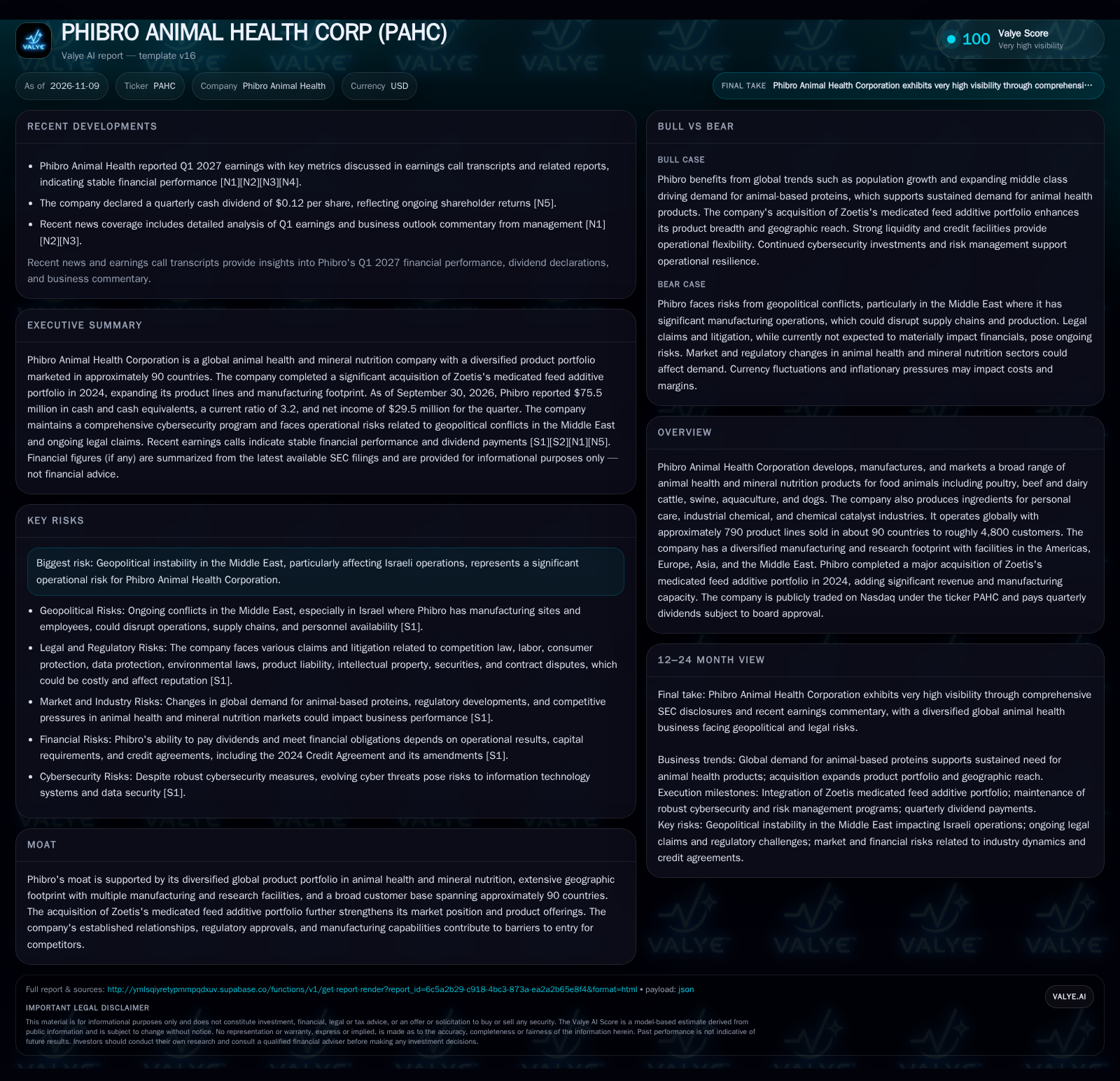
Phibro Animal Health has significantly expanded its product portfolio and manufacturing capacity through the acquisition of Zoetis’s medicated feed additive business, funded via increased credit facilities. The company is realigning its operational footprint, including the closure of a major US plant, while maintaining strong sales in core markets. However, its heavy exposure to global supply chains and geopolitical risks—especially in the Middle East—present ongoing challenges.
Phibro Animal Health is navigating a transformative period following its acquisition of Zoetis’s medicated feed additive portfolio, which bolsters its position in the global animal health market and adds substantial manufacturing capacity. The company is simultaneously consolidating its US operations by closing the Chicago Heights facility, aiming to optimize its manufacturing network. While these moves position Phibro to benefit from rising global demand for animal-based proteins, they also introduce execution risks tied to integration, operational reorganization, and geopolitical instability—especially in Israel, a key hub for the company. The next phase will test Phibro’s ability to translate its expanded scale and footprint into sustainable margin growth and operational resilience.
Recent Expansion and Operational Shifts Shape Phibro’s Near-Term Outlook
Phibro Animal Health’s acquisition of Zoetis’s medicated feed additive portfolio in April 2024 for $297.5 million stands as the most consequential recent development. The acquired portfolio contributed $358.2 million to net sales in fiscal 2026 and added six manufacturing sites across the US, Italy, and China, materially increasing Phibro’s global production capacity and revenue base [S1].
To fund this acquisition and provide operating flexibility, Phibro amended its credit agreement in April 2026, raising revolving credit commitments from $310 million to $435 million [S1].
In August 2026, management announced the closure of its Chicago Heights, Illinois manufacturing facility, with production to be relocated to other sites and third-party contract manufacturers by mid-2027. This realignment is expected to incur about $5 million in one-time severance and transition costs [S2].
Israeli operations remain significant, comprising 18% of consolidated assets and 16% of net sales for the twelve months ended June 30, 2026, but are exposed to the risks of ongoing regional conflict [S1].
Portfolio Leverage and Manufacturing Realignment: Impacts on Cost Structure and Margin Potential
Phibro’s revenue is primarily derived from selling a broad range of animal health and mineral nutrition products to about 4,800 customers in some 90 countries, resulting in high geographic and product-line diversification [S1]. The acquisition of Zoetis’s medicated feed additive business sharply increases the company’s scale in a segment that typically features high volume but moderate margin, as customers—integrated protein producers and feed mills—are generally price-sensitive and operate on thin margins themselves.
The plant consolidation strategy, illustrated by the closure of Chicago Heights, may enhance operating leverage if the company successfully shifts production to more modern, lower-cost sites or contract manufacturers. However, transition costs, potential supply chain disruptions, and the risk of underutilization at acquired or existing facilities could weigh on margins in the near term.
Fixed costs in manufacturing are substantial, given the global network of owned and leased plants, so scale economies are critical. Phibro’s broadened product base post-acquisition could allow for better absorption of overhead and improved asset utilization, but only if integration and demand ramp-up are well managed.
On the funding side, the increased credit facility provides flexibility to manage working capital and integration costs, but also raises debt service obligations, which could pressure net income if margin expansion does not materialize.
Scale, Breadth, and Regulatory Hurdles as Competitive Levers—But Not Moat Guarantees
Phibro’s competitive position is anchored in its wide-ranging product portfolio, global manufacturing footprint, and established regulatory approvals—critical in animal health, where product registration and compliance requirements create barriers to entry. The Zoetis portfolio acquisition expands Phibro’s reach and may strengthen its relationships with large feed producers and integrators, potentially increasing switching costs for customers reliant on complex, multi-product supply contracts.
However, the animal health and feed additive markets remain competitive, with several global and regional players offering similar products. Price competition is intense, especially in commoditized feed additive categories. Phibro’s ability to differentiate may hinge on product innovation, service quality, and supply chain reliability rather than price leadership alone.
The company’s global platform allows for risk diversification but also exposes it to regional regulatory changes, disease outbreaks, and shifting protein consumption trends. The acquisition may bolster its position in certain markets, but integration risks and the challenge of managing a larger, more complex supply chain could erode any temporary advantage.
Integration Success and Protein Demand Tailwinds Unlock Margin Expansion
If Phibro executes a smooth integration of the Zoetis portfolio—capturing cross-selling opportunities, optimizing manufacturing across its expanded plant network, and leveraging its broader customer base—the company could realize meaningful operating leverage and margin improvement. A successful transition from the Chicago Heights facility, with minimal supply chain disruption and effective cost management, would further support profitability.
The structural demand drivers—global population growth and rising middle-class protein consumption—remain robust, underpinning multi-year volume growth for animal health products [S1]. Should Phibro also achieve product innovation or regulatory wins (e.g., new approvals or exclusive formulations), it could further differentiate itself and command premium pricing in select niches.
Evidence for this scenario would include sustained revenue growth from the acquired portfolio, margin improvement despite integration costs, and increased operating income from scale efficiencies. Confirmation would also come from customer retention or expansion in key markets, and successful ramp-up of production at alternative sites post-Chicago Heights closure.
Incremental Gains Amid Integration and Volatility
The most plausible outcome is that Phibro delivers stable or moderately improving revenues as the Zoetis acquisition is absorbed and the plant network is rationalized. Integration costs and operational disruptions from the Chicago Heights closure may temporarily compress margins, offsetting some of the scale benefits in the near term.
Phibro’s global diversification and established customer base should help buffer the impact of regional volatility, but geopolitical risks (particularly in Israel) and competitive pricing pressures remain active headwinds. The company is likely to maintain its ability to serve large, globally distributed customers, but will need to demonstrate that the expanded portfolio translates into higher per-customer revenue or improved retention.
Falsification would involve a material decline in sales or margins attributable to integration challenges, supply chain disruptions, or loss of major customers.
Execution Missteps and Geopolitical Shocks Threaten Profitability
A negative outcome could arise if Phibro struggles to integrate the Zoetis acquisition, leading to operational inefficiencies, underutilized assets, or unexpected costs. Production or supply chain disruptions linked to the closure of Chicago Heights, or difficulties ramping up alternative sites, could result in lost sales or margin erosion.
Heightened geopolitical instability—especially a material escalation in Middle East conflict disrupting Israeli operations, which account for a meaningful share of assets and sales—could impair manufacturing, delay shipments, or force costly reconfigurations.
Competitive dynamics could also worsen if rivals aggressively cut prices or launch substitute products, eroding Phibro’s market share or compressing margins further. Legal or regulatory issues, while currently not material, could escalate and compound cost pressures.
Downside evidence would include declining or volatile revenues, a spike in restructuring and integration expenses, negative operating income, or disclosures of significant operational interruptions in key geographies.
Milestones That Will Define Phibro’s Integration and Margin Trajectory
Sustained net sales growth attributable to the Zoetis portfolio, particularly in fiscal 2027 and beyond, would help confirm successful integration and demand capture.
Gross margin and operating margin trends over the next four quarters—especially relative to integration and restructuring costs—will indicate whether scale and consolidation are translating into real efficiency gains.
Progress on the Chicago Heights closure, including cost realization and successful transfer of production to other sites or third-party manufacturers, should be tracked closely through company updates or, if disclosed, capacity utilization metrics.
Geopolitical developments affecting Israeli operations—any indication of production interruptions, supply chain delays, or asset impairments—would be critical to monitor given the concentration of assets and sales exposure.
Leverage and interest expense levels post-acquisition, as seen in upcoming quarterly filings, will show whether the expanded credit facility is manageable within operating cash flows.
Customer retention and growth in core animal health and feed additive segments—if disclosed—would provide direct evidence of competitive positioning post-acquisition.
Any material litigation or regulatory action, especially in major markets, would test the resilience of the company’s legal and compliance risk management.
If disclosed, updates on product innovation, regulatory approvals, or new market entries could signal incremental upside potential.
Disclaimer: This is research-only, informational analysis and not investment advice. It may include AI-generated interpretation and general industry context. Always verify important details using primary sources.

Comments