
Allient Inc. 2026: Integration Ambitions, Operational Streamlining, and the Stakes of Fragmented Motion Markets
With its strategic focus on integrating motion, controls, and power technologies, Allient Inc. is leveraging acquisitions and operational realignment to target diversified industrial, defense, and technology sectors. Rising backlog, recent earnings outperformance, and broad customer exposure highlight momentum, but fragmented competition, supply chain risk, and inflationary pressures test the durability of its growth strategy.
Allient Inc. is executing an integration-driven strategy in precision motion systems, with recent acquisitions and operational streamlining aimed at expanding its footprint in high-growth markets like data centers and defense. Financial momentum is visible in a growing backlog and Q3 2026 results that exceeded estimates, but persistent supply chain, inflation, and competitive risks shape the outlook.
Allient Inc., a global designer and manufacturer of precision controlled motion components, is actively reshaping its business through a blend of strategic acquisitions, operational streamlining, and a sharpened focus on integrated technology platforms. Recent outperformance in earnings and revenue—alongside a robust and rising backlog—signals clear momentum in key markets such as industrial automation and defense. Yet, the company’s ambitions are tested by persistent supply chain vulnerabilities, inflationary pressures, and the realities of competing in a fragmented landscape where technological differentiation and customer responsiveness are paramount. The question for investors is whether Allient’s integration strategy and operational initiatives can deliver durable earnings power amid ongoing external and industry-specific headwinds.
Recent Earnings Strength and Backlog Momentum Reshape Near-Term Expectations
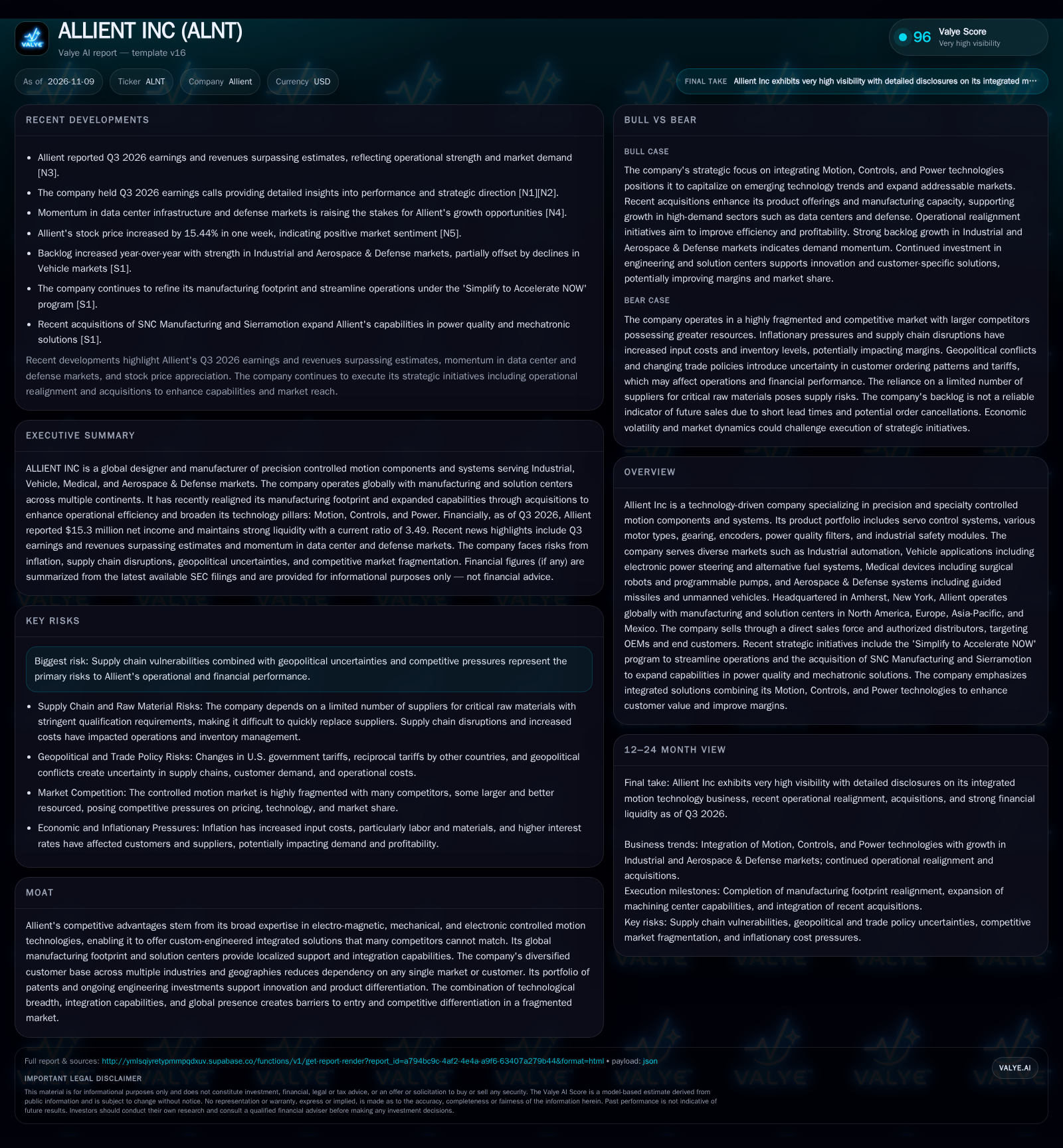
Allient reported Q3 2026 earnings and revenues that surpassed market estimates, reflecting both operational execution and demand resilience in core segments [N3]. This recent performance is reinforced by a growing backlog, which stood at $232.9 million at the end of 2025, with notable year-over-year increases in the Industrial and Aerospace & Defense verticals, partially offset by declines in Vehicle markets [S1]. The company’s manufacturing footprint is being actively realigned under the 'Simplify to Accelerate NOW' initiative, aimed at streamlining operations and boosting profitability [S1]. Recent acquisitions—including SNC Manufacturing and Sierramotion—have expanded Allient’s capabilities in power quality and mechatronic solutions, broadening its addressable market and deepening its technological stack [S1]. These developments collectively raise the stakes for Allient’s ability to translate operational and strategic moves into sustained growth and margin improvement.
How Allient’s Integrated Solutions Could Shift the Margin Equation
Allient’s business model is centered on designing and manufacturing high-precision motion components and integrated systems, serving OEMs and end customers across industrial, vehicle, medical, and aerospace & defense markets. Revenue is generated through a mix of direct sales and distributor channels, with solution centers providing local integration and support. The company’s product set—from servo control systems and motors to encoders and safety modules—enables both component sales and higher-value integrated solutions.
The economics of this model are shaped by a balance of fixed engineering and manufacturing overhead versus variable costs of materials and labor. Recent investments in engineering and development—approximately 7-8% of sales—signal a sustained push for innovation, which could support premium pricing and defend margins if successful. The integration of Motion, Controls, and Power technologies aims to capture a larger share of customer spend per project and embed Allient more deeply in customer workflows, potentially raising switching costs and supporting recurring revenue if service or support contracts are attached.
The company’s operational realignment under the 'Simplify to Accelerate NOW' program is designed to lower unit costs and improve asset utilization. If successful, this should enhance operating leverage, especially as volumes rise in higher-growth segments. However, input costs remain exposed to inflation and supply chain volatility, which could compress margins if not offset by price increases or efficiency gains.
Fragmented Market Structure and the Search for Defensible Differentiation
Allient competes in a highly fragmented controlled motion market, facing both specialized peers and larger, better-capitalized conglomerates. The primary axes of competition include technological capability, reliability, quality, responsiveness, delivery speed, and price. Allient’s broad product portfolio, global manufacturing footprint, and ongoing engineering investment offer some differentiation, particularly in custom-engineered integrated solutions that require cross-domain expertise.
Recent acquisitions have expanded the technological breadth, positioning Allient to address new market niches (e.g., data centers, advanced robotics, energy infrastructure) where integrated solutions may command higher margins and create stickier customer relationships. A diversified customer base—with no single customer accounting for over 10% of sales in 2024 or 2025—reduces concentration risk and provides resilience against demand shocks in any single vertical [S1].
However, market fragmentation means price competition is intense, and larger competitors may have scale advantages in procurement, R&D, or global distribution. The durability of Allient’s differentiation will depend on its ability to sustain innovation, protect intellectual property, and deliver integrated solutions that competitors cannot easily replicate or undercut.
Integrated Platform Gains Take Hold: Margin Expansion via Solution Selling
If Allient’s strategy to deepen integration across its Motion, Controls, and Power pillars succeeds, the company could shift its revenue mix toward more complex, higher-margin projects. Evidence of this would include continued expansion of the backlog in Industrial and Aerospace & Defense segments, rising revenue per customer, and improved gross and operating margins as solution-oriented sales displace lower-value component sales.
Confirmation of this scenario would also require successful integration of recent acquisitions, visible in cross-selling of SNC and Sierramotion capabilities into Allient’s broader customer base, and a measurable reduction in cost structure from the operational streamlining program. Additional signals would be the introduction of new, patented products, growing engineering expenditure as a proportion of sales (if efficiently deployed), and a stable or rising share of business in markets with higher technology adoption curves such as data centers, robotics, and defense.
Falsification would occur if integration efforts stall—evidenced by stagnant or shrinking margins, acquisition-related disruption, or if backlog growth slows in target segments despite ongoing investment.
Broad Diversification Offsets Fragmentation, But Margin Gains Remain Incremental
The most plausible trajectory is that Allient continues to grow at a moderate pace, leveraging its diversified exposure across industrial, medical, vehicle, and defense markets. The company’s backlog and order flow may remain healthy in Industrial and Aerospace & Defense, offsetting cyclical or structural headwinds in Vehicle markets. Operational realignment and recent acquisitions provide some incremental efficiency and cross-selling opportunities, but margin expansion is gradual due to persistent input cost pressures and competitive pricing dynamics.
Confirmation of this scenario would come from steady revenue growth, stable or modestly improving margins, and continued broad customer diversification. Engineering investment remains at current levels, supporting incremental product enhancements rather than breakthrough innovation. Falsification would be signaled by a sharp contraction in backlog, margin erosion not matched by cost reductions, or the emergence of significant integration challenges from recent acquisitions.
Supply Chain Shocks and Inflation Erode Strategic Gains
The principal risk is that supply chain disruptions and inflationary input costs outpace Allient’s ability to pass on price increases or realize operational efficiencies. This could lead to margin compression even as revenues grow or remain stable. An additional risk is that geopolitical shocks or trade policy changes disrupt customer ordering patterns or raise tariffs, especially for globally sourced components.
Competitive pressures in a fragmented market could intensify if larger players engage in aggressive pricing or invest heavily in new technologies, eroding Allient’s differentiation. Integration missteps—such as failing to realize synergies from recent acquisitions or experiencing operational friction during the manufacturing realignment—could further weigh on profitability.
Downside confirmation would include declining gross and operating margins, rising inventory and working capital needs, order cancellations or backlog contraction, and negative surprises on earnings calls tied to supply chain, inflation, or integration setbacks.
Evidence That Will Test Allient’s Integration Ambitions and Margin Progression
Backlog growth and composition by market segment—especially continued strength in Industrial and Aerospace & Defense—will be critical for assessing demand momentum.
Gross and operating margin trends, particularly any improvement attributable to operational streamlining or solution-oriented sales, will reveal whether integration is driving profitability.
The successful integration of SNC Manufacturing and Sierramotion, visible through new product launches or cross-segment revenue synergies, would support the upside case.
Engineering and development expenditure as a share of sales—if disclosed—will help gauge the company’s ongoing innovation capacity and potential for technology-driven differentiation.
Inventory turnover and working capital metrics, if available, would provide early signals of supply chain normalization or stress.
Customer diversification metrics, including revenue concentration, will indicate resilience against demand shocks in any single sector.
Updates on the progress and financial impact of the 'Simplify to Accelerate NOW' program, especially cost savings or asset utilization improvements, will be key operational milestones.
Any commentary or disclosure on pricing power—such as the ability to pass through input cost increases—would clarify margin resilience in an inflationary environment.
Disclaimer: This is research-only, informational analysis and not investment advice. It may include AI-generated interpretation and general industry context. Always verify important details using primary sources.

Comments