
MSG Entertainment 2026: Iconic Venues, Profit Recovery, and the Stakes of Liquidity Strain
The company’s business model leverages ownership and operation of iconic venues in New York and Chicago, generating income from ticket sales, suite licenses, concessions, and sponsorships.
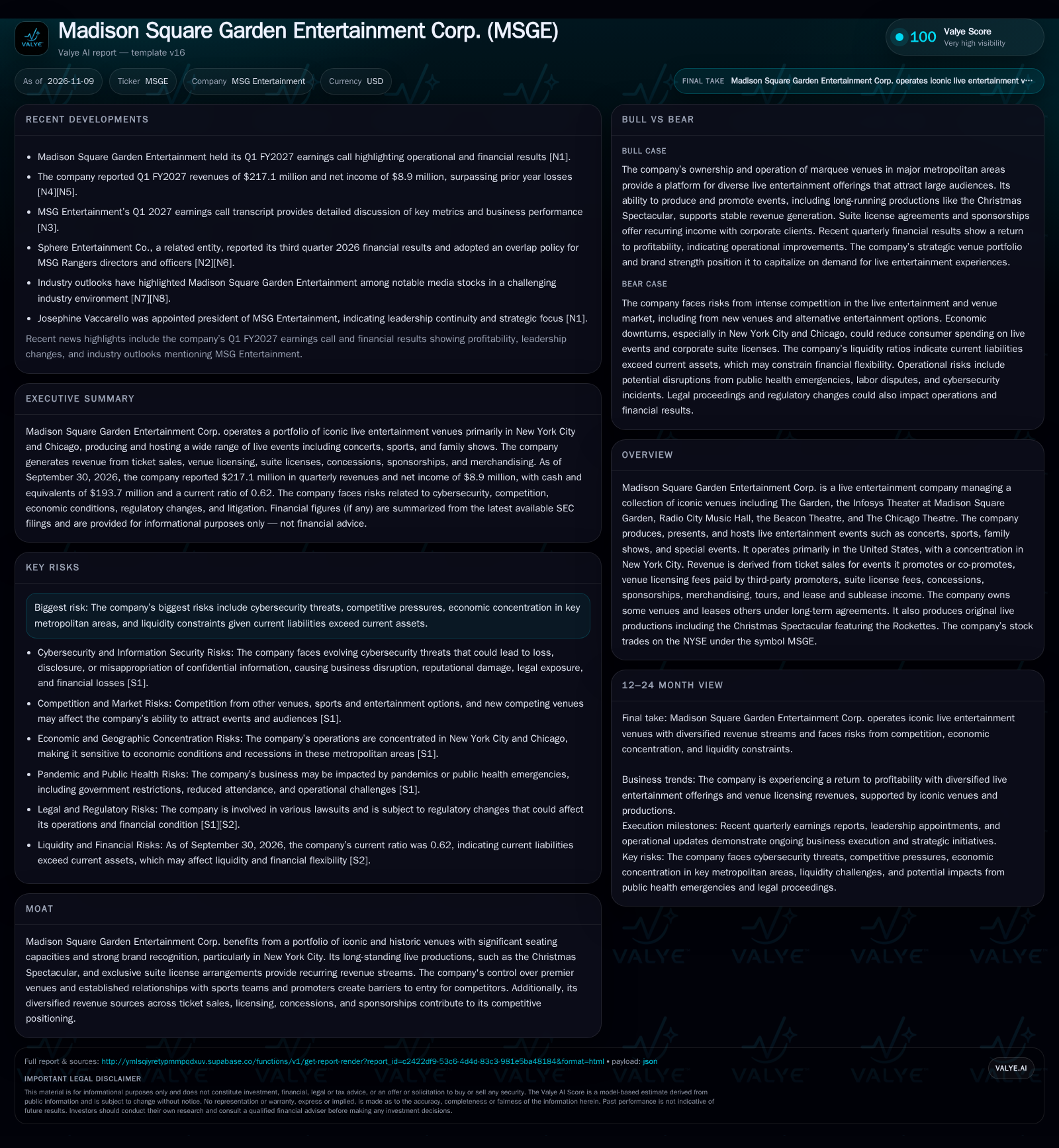
The company’s business model leverages ownership and operation of iconic venues in New York and Chicago, generating income from ticket sales, suite licenses, concessions, and sponsorships. While brand and location provide barriers to entry, high fixed costs and dependence on discretionary spending in two cities expose MSGE to macro shocks. The next phase hinges on sustaining event volume, optimizing venue utilization, and managing potential financial flexibility amidst an evolving entertainment landscape. [S1] [S2] [N4] [N5]
Madison Square Garden Entertainment Corp. (MSGE) stands at a crossroads in late 2026, having achieved a notable return to profitability with Q1 revenues of $217.1 million and net income of $8.9 million. The company’s unique value proposition lies in its stewardship of legendary venues—The Garden, Radio City Music Hall, and others—that remain cultural touchstones and magnets for high-profile events. Yet, as management touts operational improvements, the balance sheet reveals a persistent vulnerability: current liabilities far exceed current assets, raising the stakes for flawless execution in a business defined by high fixed costs, cyclical demand, and fierce competition. The question is whether MSGE’s brand, pricing power, and event pipeline can consistently offset these structural pressures—or if a downturn in its core markets could test the limits of its potential financial flexibility. [S1] [S2] [N4] [N5]
Profitability Returns, But Liquidity Remains Tight
Madison Square Garden Entertainment reported Q1 FY2027 revenues of $217.1 million and net income of $8.9 million, reversing a prior year loss [S2] [N4] [N5]. This swing to profitability signals operational momentum, likely driven by increased event volume and improved cost controls. However, as of September 30, 2026, the company’s current assets stood at $445.7 million against current liabilities of $713.5 million, yielding a current ratio of 0.62 and a cash ratio of 0.27 [S2]. These metrics indicate that short-term obligations significantly outstrip readily available resources, highlighting ongoing liquidity constraints despite the improved income statement. Long-term debt stood at $533.2 million, while equity declined to $11.9 million, reflecting pressures from treasury stock activity and retained earnings [S2]. In sum, MSGE’s operational comeback is shadowed by a balance sheet that leaves little margin for error if market conditions deteriorate.
How MSG Entertainment Monetizes Its Venue Portfolio
MSG Entertainment’s core economics are built on the ownership and operation of iconic venues, primarily in New York City and Chicago, with capacities ranging from 2,800 to 21,000 seats [S1]. Revenue streams are diversified across ticket sales for self-promoted and co-promoted events, venue licensing fees from third-party promoters, suite licenses (often multi-year with escalators), concessions, sponsorships, merchandising, tours, and lease/sublease income [S1]. The suite license business, particularly at The Garden, provides a measure of recurring revenue, but is closely tied to corporate health and the willingness of companies to commit to multi-year agreements. Event-driven revenue—tickets, concessions, and merchandise—introduces variability, as topline performance is sensitive to event volume, pricing, and consumer discretionary spending. Fixed costs are substantial, given venue maintenance, lease obligations, and labor, creating high operating leverage: incremental increases in event volume or pricing can disproportionately benefit margins, but periods of low utilization quickly erode profitability. Capital needs are ongoing for venue refurbishment, technology upgrades, and regulatory compliance, making cash flow management critical. In this structure, steady event throughput and premium pricing are essential to cover fixed costs and service debt.
Iconic Venues Offer Barriers, but Substitution and Competition Loom
MSG Entertainment’s competitive moat is anchored by the scarcity and cultural resonance of its venues—The Garden and Radio City Music Hall, in particular, are globally recognized brands with limited direct substitutes in their markets [S1]. This confers pricing power for marquee events and attracts both performers and sponsors seeking prestige. However, the company faces persistent competitive threats from alternative venues, new arena developments, and a proliferation of entertainment options, including digital and streaming experiences. While the physical location and history of MSG venues are difficult to replicate, substitution risk is real: both artists and consumers have more choices than ever, and event promoters may shift bookings to newer or more cost-effective spaces if terms are more attractive. The geographic concentration in NYC and Chicago amplifies sensitivity to local economic downturns and demographic shifts. Additionally, venue operators must contend with labor negotiations, regulatory changes, and the risk of public health disruptions. In this environment, sustaining a differentiated experience and maximizing venue utilization are critical to defending market share and margin.
Premium Event Volume and Sponsorship Growth Drive Margin Expansion
A favorable scenario for MSG Entertainment would see sustained high event volume, successful pricing of premium tickets and suites, and continued growth in sponsorship and licensing revenue. The company’s ability to secure exclusive or blockbuster events—concerts, sports, or special productions—could further enhance venue utilization and allow for incremental pricing power. Growth in multi-year suite licenses, particularly with blue-chip corporate clients, would provide recurring revenue and greater visibility. If consumer demand for live experiences remains robust, and the company capitalizes on its brand to attract top-tier acts, operating leverage could drive margins higher. A supportive macroeconomic backdrop in NYC and Chicago, coupled with successful cost containment and minimal event disruption, would reinforce this positive trajectory. Confirmation would come from consecutive quarters of rising revenue and net income, improved cash flow from operations, and stabilization or improvement in the current ratio as liabilities are paid down or refinanced.
Venue Utilization and Cost Discipline Sustain Modest Profitability
The most plausible path for MSG Entertainment is one of steady, if unspectacular, profitability driven by ongoing demand for live events at its flagship venues. The company maintains a stable cadence of concerts, sports events, and recurring productions like the Christmas Spectacular, supporting a diversified revenue mix. Corporate suite licenses remain largely intact, but new signings are sensitive to broader economic sentiment. Fixed costs remain high, but management maintains sufficient cost discipline to avoid significant margin erosion. Liquidity remains a challenge, but the company manages short-term obligations through cash flow and ongoing debt service, without requiring distressed asset sales or dilutive equity issuance. Confirmation would be continued positive net income, stable or slightly improved liquidity ratios, and consistent event booking activity. Signs of pressure would include increased reliance on short-term financing or a shrinking event calendar.
Economic Shock or Event Disruption Tests Financial Resilience
A negative scenario materializes if a macroeconomic downturn in New York or Chicago sharply curtails discretionary spending, leading to lower ticket sales, declining suite renewals, and reduced sponsorship appetite. Alternatively, an exogenous shock such as a public health emergency, major labor dispute, or cybersecurity incident could force event cancellations or erode consumer confidence. With high fixed costs and reported liquidity position, even a temporary dip in event volume could quickly swing the company back to net losses. In this scenario, MSGE may be forced to draw on credit lines, renegotiate lease or debt terms, or consider asset sales to shore up liquidity. Confirming evidence would include a sudden drop in quarterly revenues, negative operating cash flow, further deterioration in the current ratio, or announcements of event cancellations, layoffs, or restructuring measures.
What Will Determine MSG Entertainment’s Staying Power in Live Events?
Sustained quarterly revenue growth and net income, particularly evidence of margin expansion or stabilization if disclosed, will signal the effectiveness of venue utilization and pricing strategies.
Volume and mix of events hosted at key venues—if disclosed, a useful metric would be event days per quarter at The Garden and Radio City Music Hall.
Corporate suite license renewal rates and new signings, especially among major corporate clients, will indicate the resilience of recurring revenue streams.
Sponsorship and advertising revenue trends, including the signing of new high-profile partners or the renewal of existing deals, would provide additional evidence of brand strength.
Announcements regarding major venue refurbishments, technology upgrades, or new event partnerships could signal capital allocation priorities and management’s growth orientation.
Any reported disruptions such as labor disputes, cybersecurity incidents, or regulatory/legal setbacks would directly impact operational stability and financial outlook.
Macroeconomic indicators in New York City and Chicago—such as consumer confidence, tourism trends, and corporate spending—will provide important context for demand-side risks and opportunities.
Disclaimer: This is research-only, informational analysis and not investment advice. It may include AI-generated interpretation and general industry context. Always verify important details using primary sources.

Comments