
Cognition Therapeutics: Clinical Progress, Regulatory Milestones, and the Stakes of Market Survival in Neurodegeneration
Cognition Therapeutics advances its lead candidate Zervimesine into FDA-aligned Phase 3 trials for dementia with Lewy bodies, while narrowing losses and maintaining liquidity. The company now faces a critical period: execution risk in late-stage clinical development, Nasdaq listing compliance, and the imperative to secure capital for long-term survival in a competitive neurodegenerative disease landscape.
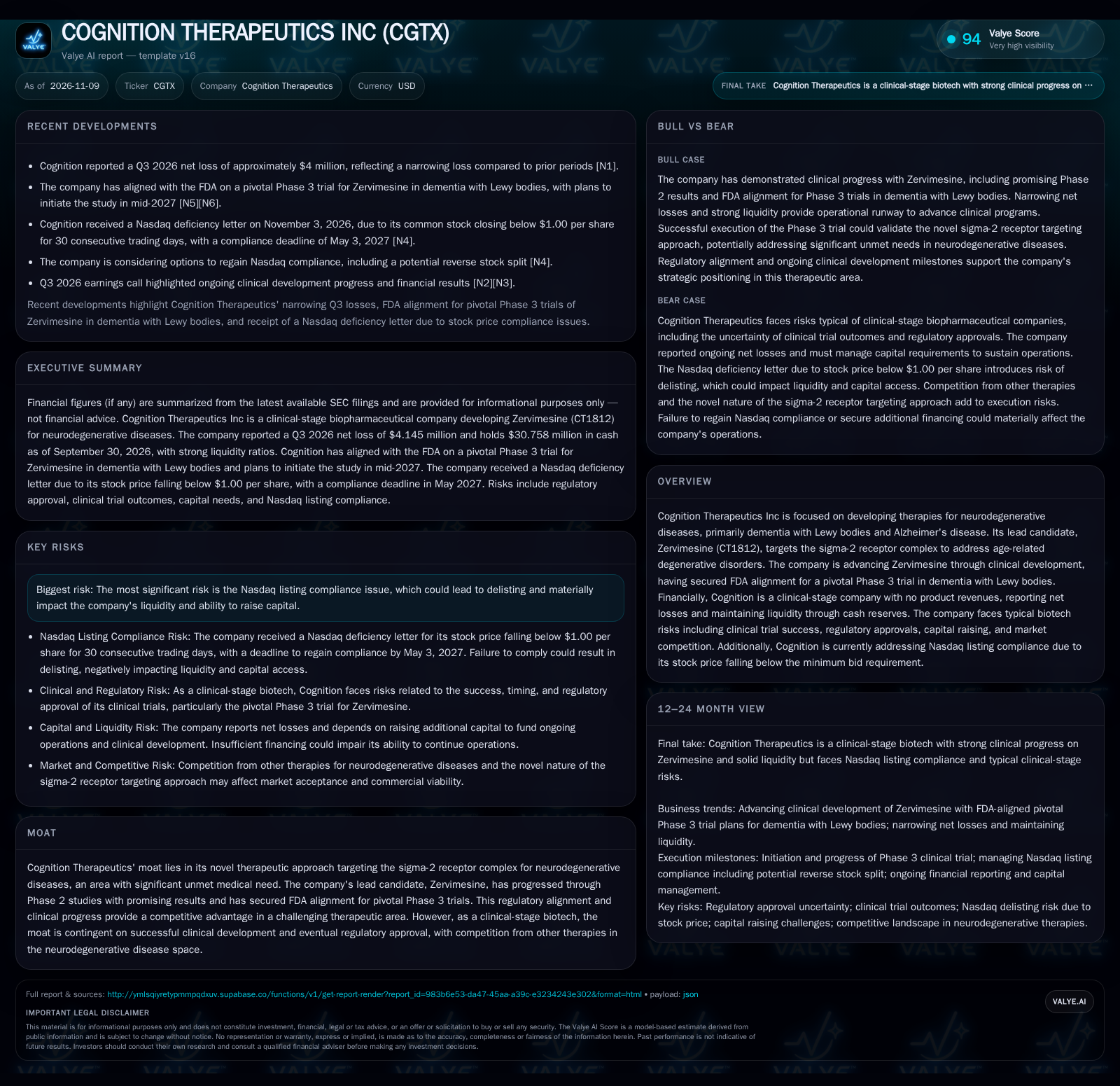
Cognition Therapeutics is entering a pivotal stage, having secured FDA alignment for a Phase 3 trial of Zervimesine in dementia with Lewy bodies. With a narrowed Q3 2026 loss and strong cash ratios, the company has operational runway but must address a Nasdaq listing deficiency and looming capital needs. Success hinges on clinical trial outcomes, regulatory approval, and maintaining access to capital in a high-risk, competitive field. [N1] [N4] [N5]
Cognition Therapeutics stands at a critical juncture in its bid to bring a novel neurodegenerative therapy to market. With Zervimesine, its lead candidate for dementia with Lewy bodies, now cleared for a pivotal Phase 3 trial after FDA alignment, the company has achieved a major regulatory milestone. The next 12–24 months will determine whether Cognition can convert scientific and regulatory progress into durable business value.
Regulatory Alignment and Financial Position Define the Near-Term Landscape
Cognition Therapeutics has secured FDA alignment to initiate a pivotal Phase 3 trial of its lead candidate, Zervimesine (CT1812), for dementia with Lewy bodies (DLB), with the trial expected to begin in mid-2027 [N5] [N6]. This regulatory milestone marks a transition from proof-of-concept to registrational development, placing the company at the threshold of potentially value-creating clinical data.
For the quarter ended September 30, 2026, Cognition reported a net loss of $4.145 million, a figure that reflects a narrowing loss trend compared to prior periods, attributed to ongoing cost management [N1] [N2]. As of the same date, the company reported $30.758 million in cash and cash equivalents, with a current ratio of 6.68 and a cash ratio of 6, indicating significant liquidity for a clinical-stage biotech [S2].
Despite these operational positives, Cognition received a Nasdaq deficiency letter on November 3, 2026, after its common stock closed below $1.00 per share for 30 consecutive trading days. The company has until May 3, 2027, to regain compliance or risk delisting—an event that would materially impact its ability to access capital and maintain investor visibility [N4].
The Economics of Clinical-Stage Neurodegeneration: Costs, Funding, and Value Creation
The narrowing Q3 2026 net loss suggests disciplined cost control, but the company's financial model remains highly dependent on external financing until a product is approved and commercialized [N1] [S2].
The primary economic lever is the progression of Zervimesine through late-stage clinical trials. Phase 3 trials in neurodegeneration are capital-intensive, often running to tens of millions of dollars, with costs driven by patient recruitment, site management, long-term follow-up, and regulatory compliance.
If Zervimesine is ultimately approved, revenue potential would be dictated by pricing (which in neurodegeneration can be high due to unmet need), patient population size, and market penetration. However, significant commercial costs—such as salesforce buildout, market access, and post-marketing commitments—would follow. Operating leverage could be substantial if the drug succeeds, but the fixed cost base will likely rise sharply in anticipation of launch.
Novelty Versus Scale: Cognition’s Place in the Neurodegenerative Therapeutics Arena
Cognition’s main potential advantage is its novel approach: Zervimesine targets the sigma-2 receptor complex, a mechanism distinct from the amyloid and tau approaches that have dominated Alzheimer’s and related disorder pipelines. This differentiation could provide a clinical and commercial edge if efficacy is demonstrated in Phase 3.
However, the neurodegenerative disease space is crowded with both large pharmaceutical incumbents and emerging biotechs, many with greater resources, commercial infrastructure, and pipeline breadth. The market is also characterized by high rates of late-stage clinical failure and regulatory unpredictability. Competing therapies, including monoclonal antibodies and small molecules targeting other pathways, pose both competitive and scientific risks.
If Zervimesine’s safety and efficacy profile proves superior or complementary to existing therapies, Cognition could carve out a defensible position, especially given the significant unmet need in DLB. Still, the company’s lack of commercial infrastructure and reliance on a single lead asset heighten execution risk and limit negotiating leverage with potential partners or acquirers.
How a Successful Phase 3 Could Transform Cognition’s Fortunes
A favorable scenario unfolds if the pivotal Phase 3 trial of Zervimesine delivers robust efficacy and safety data, leading to regulatory approval for DLB. In this case, Cognition would be positioned as a first- or best-in-class entrant in a high-unmet-need indication. The company could then pursue one of several value-creating paths: independent commercialization (likely requiring substantial capital and rapid scaling), a strategic partnership with a larger pharma, or outright acquisition.
Confirmation of the upside scenario would require: positive, statistically significant Phase 3 trial results; timely recruitment and trial execution; regulatory acceptance of the data package; and evidence of commercial interest (such as partnership deals or in-licensing discussions). Additional signals could include successful capital raises at favorable terms and sustained recovery of the company’s stock price above Nasdaq compliance thresholds.
Falsification would occur if the Phase 3 trial fails to demonstrate efficacy, encounters major safety issues, or experiences significant delays, or if the company is unable to secure sufficient capital to complete the trial.
Progressing Through Clinical Development While Managing Capital and Listing Risks
The most plausible scenario is that Cognition advances Zervimesine into Phase 3 as planned, but faces typical clinical-stage challenges: patient recruitment delays, incremental capital raises, and persistent uncertainty regarding trial outcomes. The company may need to execute a reverse stock split to regain Nasdaq compliance, which could stabilize its listing but not fundamentally alter operational risks.
Execution milestones—such as trial initiation, interim analyses, and safety updates—become critical for maintaining investor interest and negotiating future financings. Value inflection is deferred until late-stage data readouts.
Confirmation would come from steady clinical progress, successful Nasdaq compliance remediation, and manageable dilution from capital raises. Falsification could result from major trial setbacks, inability to access capital on reasonable terms, or delisting from Nasdaq, which would complicate future funding and erode investor confidence.
Failure to Regain Listing or Clinical Setbacks Could Imperil the Business
The adverse scenario centers on two interlinked risks: clinical failure and capital market disruption. If Zervimesine’s Phase 3 trial is delayed, fails to meet efficacy endpoints, or generates adverse safety signals, Cognition would lose its primary value driver. Concurrently, if the company is unable to regain Nasdaq compliance—whether due to persistent share price weakness or shareholder resistance to a reverse split—it could be delisted, sharply reducing its access to capital and institutional investors.
In such a scenario, Cognition could face a downward spiral: diminished investor confidence, inability to raise needed funds, forced cost cuts, or even strategic alternatives such as asset sales or liquidation. The company’s strong current liquidity would provide only a temporary buffer in the absence of new capital or positive clinical catalysts.
Confirmation of the downside would include: missed regulatory or trial milestones, negative or inconclusive clinical data, failed capital raises, and formal Nasdaq delisting. Falsification would require averting these outcomes through successful execution and capital access.
Milestones and Metrics That Will Define Cognition’s Next Chapter
Actual initiation date and pace of enrollment for the pivotal Phase 3 Zervimesine trial in dementia with Lewy bodies.
Interim safety and efficacy updates from the Phase 3 program, if disclosed.
Details of any partnership, licensing, or collaboration deals for Zervimesine or pipeline assets.
Nasdaq compliance developments, including board decisions regarding a potential reverse stock split and sustained share price recovery.
Quarterly cash burn rate and runway projections in the context of anticipated Phase 3 costs.
Any announced capital raises, including terms, dilution, and investor mix.
Regulatory feedback or guidance from the FDA during the course of the Phase 3 trial.
Emergence of new clinical data or approvals from competitors targeting dementia with Lewy bodies or related neurodegenerative indications.
Disclaimer: This is research-only, informational analysis and not investment advice. It may include AI-generated interpretation and general industry context. Always verify important details using primary sources.

Comments