
BeOne Medicines 2026: Scale, Capital, and the Frictions of Global Pharma Ambition
With robust Q3 earnings, a $5.78 billion cash position, and a nearly 12,000-strong workforce, BeOne Medicines stands as a global pharmaceutical contender.
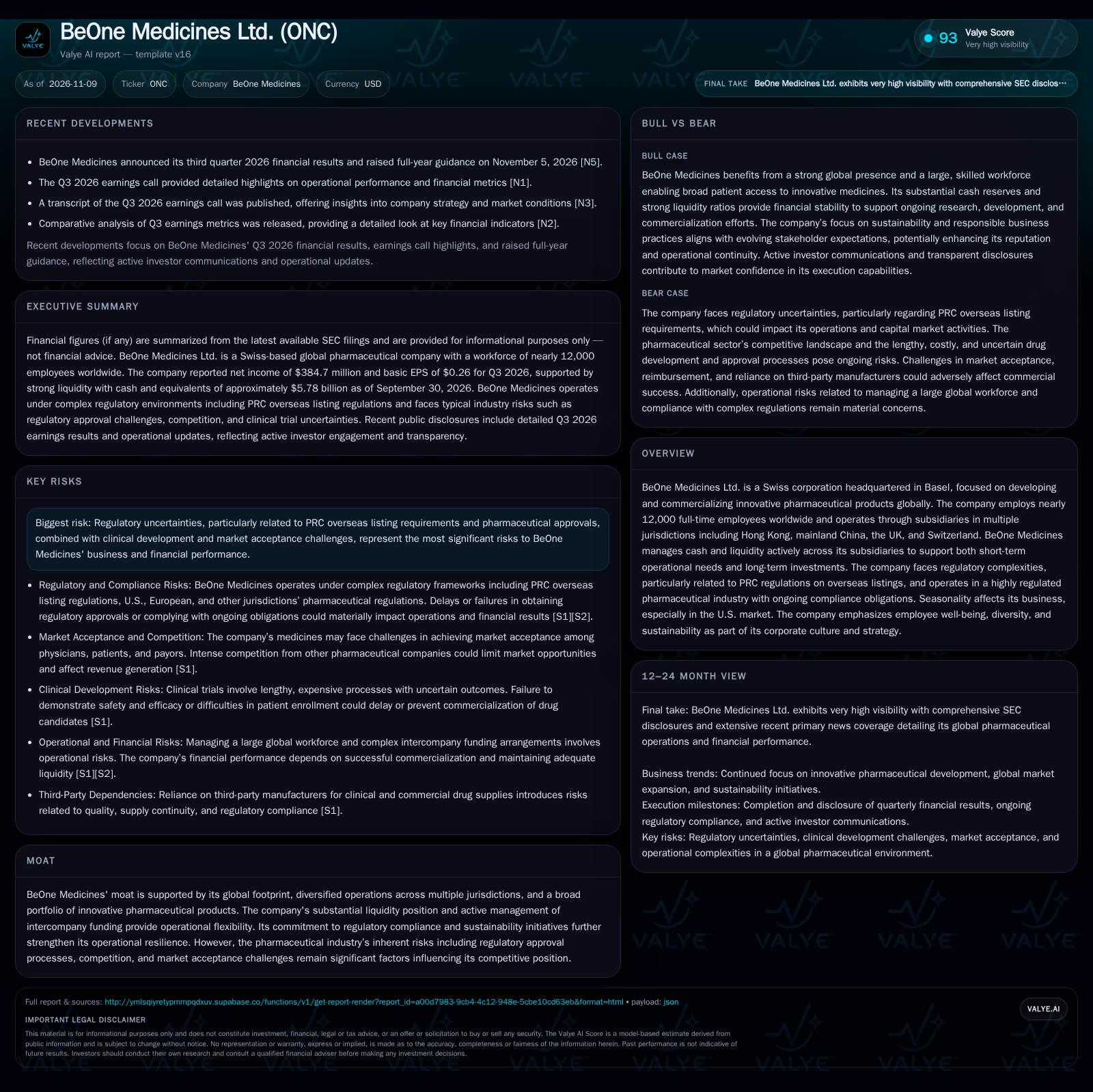
BeOne Medicines reported Q3 2026 net income of $384.7 million, basic EPS of $0.26, and holds $5.78 billion in cash and equivalents, underlining its financial strength [S2]. The company raised full-year guidance, but faces persistent regulatory, clinical, and adoption risks across major markets [N5]. Its global reach and operational breadth offer scale advantages, but also compound execution complexity and exposure to shifting compliance regimes [S1] [S2].
BeOne Medicines Ltd., headquartered in Basel, Switzerland, is emerging as a formidable player in the global pharmaceutical sector. The company’s latest quarter showcased net income of $384.7 million and a cash war chest of $5.78 billion, supporting a growing portfolio of innovative medicines and a multinational workforce approaching 12,000 employees [S2]. Management’s decision to raise full-year guidance signals confidence in operational momentum, but the company’s future is intertwined with its ability to navigate regulatory bottlenecks, deliver successful clinical outcomes, and achieve broad market adoption amid fierce industry competition [N5] [S1].
Q3 Results, Cash Reserves, and Guidance Upgrade: What’s Changed for BeOne Medicines
BeOne Medicines reported net income of $384.7 million and basic earnings per share of $0.26 for the third quarter of 2026 [S2]. The company reported cash and liquidity metrics for the period; these figures do not by themselves establish operating runway, investment capacity, financial flexibility, or financing capacity. [S2] The company raised its full-year guidance following the Q3 results, a signal of management’s near-term confidence in operational execution [N5]. These developments matter because they provide BeOne Medicines with the capital flexibility to fund R&D, navigate regulatory processes, and potentially withstand market or clinical setbacks. At the same time, the combination of global operations and regulatory risk—especially around PRC listing rules—introduces unique executional challenges that could affect the realization of these advantages [S1].
How Scale and Liquidity Shape the Economics of a Global Pharma Platform
BeOne Medicines generates revenue through the development and commercialization of pharmaceutical products. Its business model relies on a pipeline of innovative medicines, with revenue driven by successful regulatory approvals, reimbursement negotiations, and uptake by healthcare systems and prescribers. The company’s cost structure is characterized by high fixed costs (R&D, regulatory compliance, and global infrastructure) and variable costs related to manufacturing, distribution, and marketing. Operating leverage is pronounced: as new medicines move from R&D to market, incremental sales can have a disproportionately positive impact on margins, provided pricing and volume dynamics are favorable.
With $5.78 billion in cash and a large asset base, BeOne Medicines has the financial bandwidth to invest aggressively in clinical development, business development (such as in-licensing or acquisitions), and global commercialization [S2]. However, the capital intensity of drug development means that large cash reserves can be rapidly consumed by failed trials or regulatory setbacks. The company’s global presence also subjects it to currency and pricing pressures, procurement negotiations, and regional reimbursement environments, which can materially affect realized margins and working capital needs. If BeOne Medicines can efficiently translate R&D into approved therapies with strong market uptake, its scale could deliver outsized returns. If not, the high fixed-cost base could quickly become a drag.
Global Reach as an Advantage—and a Source of Strategic Friction
BeOne Medicines’ global footprint—across Europe, the U.S., China, and Hong Kong—positions it to access broad patient populations and diversify market risk [S1]. This scale can offer advantages in negotiating with payors, sourcing talent, and spreading R&D investments across multiple jurisdictions. However, it also introduces operational complexity, as the company must comply with differing regulatory regimes, manage intercompany funding, and adapt to local market dynamics.
The pharmaceutical industry is characterized by intense competition, both from multinational incumbents and regionally focused challengers. Barriers to entry are high due to the cost and duration of clinical development, but differentiation rests on the ability to bring truly innovative medicines to market and secure reimbursement at premium price points. BeOne Medicines’ competitive position will hinge on the strength and exclusivity of its pipeline, its ability to navigate regulatory hurdles (notably PRC listing and compliance requirements), and its execution in commercializing therapies in key markets. Substitution risk is significant: if a competitor launches a superior therapy or generic competition emerges post-patent expiry, market share and pricing power could erode quickly.
When R&D and Regulatory Execution Converge: The Path to Outperformance
The most favorable scenario for BeOne Medicines involves the successful progression of multiple innovative therapies through late-stage clinical development, followed by timely regulatory approvals and rapid market adoption. In this case, the company could leverage its reported cash position to accelerate launches, expand into new indications or geographies, and potentially pursue opportunistic M&A or licensing. Operating leverage would manifest as revenue growth outpaces fixed-cost increases, driving margin expansion and improved return on invested capital.
Evidence supporting this scenario would include: a string of positive clinical trial results, regulatory approvals in major markets (especially the U.S., EU, and China), rapid uptake and formulary inclusion for new launches, and upward revisions to earnings guidance or long-term margin targets. Conversely, a lack of late-stage pipeline progress, regulatory delays, or tepid launch uptake would undermine this pathway.
Sustaining Growth Amid Regulatory Complexity and Market Frictions
The most plausible forward path for BeOne Medicines is one of continued, but variable, growth—reflecting a mix of successful product launches, ongoing regulatory engagement, and periodic setbacks typical of large pharma.
Signs of pipeline attrition, margin compression, or regulatory headwinds—such as delays tied to PRC overseas listing rules—would signal downside risk to this scenario.
How Regulatory and Clinical Headwinds Could Derail Momentum
In a less favorable scenario, BeOne Medicines could face a confluence of regulatory setbacks (such as adverse changes in PRC listing requirements or delayed drug approvals), clinical trial failures, and slow market adoption for key therapies. The resulting revenue shortfall would erode the company’s ability to sustain its R&D engine and global operations, with the high fixed-cost structure amplifying the impact on profitability.
This scenario could be confirmed by a series of negative regulatory outcomes, major clinical trial disappointments, downward earnings revisions, or a marked decline in cash reserves due to unproductive R&D spend. External shocks—such as a regulatory shift in a core market or the entry of a disruptive competitor—could further exacerbate downside risks.
What Will Reveal Whether BeOne Medicines Can Convert Scale Into Sustainable Growth
Progress on late-stage clinical trials, including readouts and regulatory submissions, would provide critical insight into future revenue drivers.
Regulatory outcomes in the U.S., EU, and—especially—China, including clarity on PRC overseas listing requirements, would materially affect operational flexibility and capital market access.
If disclosed, new product launch metrics (such as initial uptake, formulary wins, and market share in key indications) would help test commercial execution.
Trends in gross and operating margins, particularly in the context of new launches or major reimbursement decisions, would indicate the ability to capture operating leverage.
Developments in the company’s intercompany funding mechanics or shifts in cash transfer restrictions, especially between China/Hong Kong and Switzerland/UK, could signal emerging liquidity or operational constraints.
Changes in guidance—both upward and downward—would reflect management’s evolving confidence in pipeline progress and commercial momentum.
Any large, unexpected swings in cash balances or current assets relative to liabilities would warrant scrutiny for signs of operational stress or aggressive investment posture.
Disclosures around third-party manufacturing dependencies, including supply disruptions or compliance issues, would be important given the company’s reliance on external partners.
Disclaimer: This is research-only, informational analysis and not investment advice. It may include AI-generated interpretation and general industry context. Always verify important details using primary sources.

Comments