
Eve Holding’s eVTOL Vision: Funding, Execution, and Scaling Urban Air Mobility
Eve Holding’s reported liquidity position, ongoing R&D investments, and firm eVTOL aircraft orders highlight active progress in the urban air mobility sector. The company’s future will hinge on its ability to convert development momentum and strategic partnerships into certified products and commercial scale—amid intense competition and uncertain adoption curves.
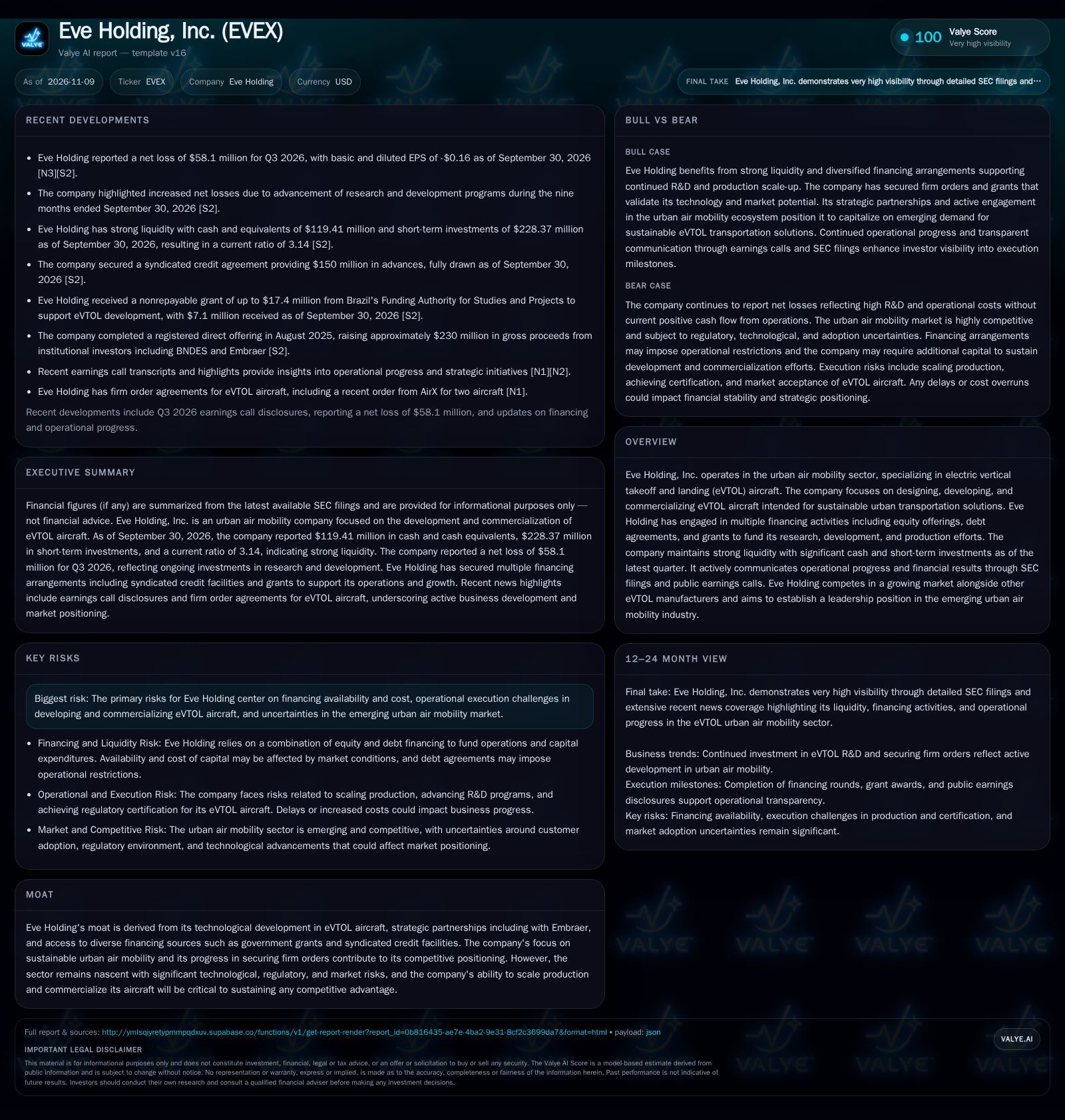
Eve Holding, positioned in the competitive eVTOL space, maintains reported liquidity position with $347.8 million in cash and short-term investments as of September 30, 2026, and continues to invest heavily in R&D, reflected in a Q3 net loss of $58.1 million. The company has secured multiple financing arrangements and a nonrepayable Brazilian grant, as well as firm orders for its aircraft. The core challenge is translating technical progress and funding into successful certification, production, and early market capture against well-financed peers. Execution risks and market adoption remain critical watchpoints. [S2] [N2]
Eve Holding, Inc. is pursuing a high-stakes bet on the future of urban transportation through its development of electric vertical takeoff and landing (eVTOL) aircraft. With over $347 million in liquid assets and a series of recent financing wins, the company is well-funded for the near term. However, Eve must now bridge the gap between technical progress and commercial viability in a sector marked by regulatory hurdles, uncertain adoption rates, and aggressive competition from both startups and aerospace incumbents. The company's next act—achieving certification, ramping production, and capturing early market share—will determine whether its current momentum can translate into lasting leadership in urban air mobility.
Capital and Operational Advances Poised to Propel Commercial Expansion
Eve Holding closed the third quarter of 2026 with $119.41 million in cash and cash equivalents and $228.37 million in short-term investments, resulting in $347.78 million in liquid assets and a current ratio of 3.14. This liquidity profile reflects the company's recent success in raising capital through a $230 million direct offering (August 2025), a fully drawn $150 million syndicated credit agreement (January 2026), and a nonrepayable Brazilian government grant supporting eVTOL R&D. While these funds provide a substantial runway, Eve reported a net loss of $58.1 million in Q3 2026, driven by continued investment in research and development. The company has also disclosed firm order agreements, including a recent two-aircraft order from AirX, indicating some early market engagement. These developments collectively support Eve's ongoing transition from R&D to the pre-commercialization phase, but also spotlight the need for execution against a backdrop of high cash burn and operational risk. [S2] [N2]
Examining Unit Economics and Cost Challenges in eVTOL Scaling
Eve Holding’s business model is built around the design, certification, and eventual production of eVTOL aircraft for urban air mobility. In the pre-revenue phase, the company’s cost structure is dominated by R&D, certification activities, and capital expenditures related to prototyping and early manufacturing investments. The fixed-cost base is substantial, as is typical for aerospace ventures, with marginal costs expected to decline only after production scale is achieved.
Future revenue streams may come from direct sales of aircraft, leasing models, or participation in urban air mobility service platforms—each with distinct margin and capital intensity implications. If aircraft are sold outright, Eve faces the challenge of recouping high upfront development and tooling costs through volume, with pricing power constrained by competition and customer sensitivity to total cost of ownership. If Eve pursues recurring revenue via leasing or service models, it will need even more capital to finance fleets and absorb utilization risk, but may achieve higher long-term margins and customer lock-in. The company’s access to grants, credit facilities, and strategic partnerships (notably with Embraer) helps mitigate some funding pressure, but sustained negative cash flow means additional capital raises are likely unless commercial deliveries ramp quickly.
Eve’s Positioning Through Partnerships and Product Distinction in a Competitive Market
Eve Holding operates in a rapidly evolving market alongside well-capitalized eVTOL developers such as Archer Aviation and Joby Aviation, as well as established aerospace OEMs exploring urban air mobility. Its competitive strengths include the backing of Embraer—providing technical expertise, supply chain access, and credibility with regulators and customers—and a diversified financing base spanning government, development banks, and institutional investors.
However, the sector’s barriers to entry are high but not absolute: certification timelines, regulatory relationships, and integration with urban infrastructure are critical, and no player has yet achieved meaningful commercial scale. Eve’s ability to secure firm orders and publicize operational milestones supports its positioning, but the ultimate differentiators will be certification success, reliability in early deployments, and cost-effective production. The risk remains that rivals with deeper pockets or faster execution could leapfrog Eve if it encounters delays or unexpected technical challenges.
Conditions for Eve to Pioneer Urban Air Mobility’s Commercial Success
A bullish scenario for Eve Holding assumes successful aircraft certification, timely ramp-up of production, and strong conversion of firm orders into deliveries and initial service deployments. If Eve leverages its Embraer partnership to resolve regulatory hurdles and demonstrate superior reliability and operational economics, it could become an early leader in key launch markets. Additional upside could come from expanding order pipelines beyond initial anchor customers and securing recurring revenue via fleet leases or service contracts.
Key confirming evidence would include certification approvals, publicized delivery milestones, repeat or expanded orders from launch customers, and early signs of positive unit economics (e.g., cost per aircraft declining with scale, initial margins on deliveries, or early service revenue traction if disclosed). Announcements of additional strategic partnerships with infrastructure or mobility operators would further validate the scenario.
Projected Path: Steady Progress Within a Shifting Market Landscape
The most plausible outcome is that Eve Holding continues to advance through certification and pre-production, steadily converting R&D into incremental operational milestones but contending with delays, additional capital needs, and measured order growth. The company is likely to remain pre-revenue or modestly revenue-generating through 2027, with cash burn rates necessitating periodic fundraising. Competition will remain fierce, and regulatory or technical setbacks could slow progress.
This scenario would be confirmed by continued disclosures of net losses tied to R&D, periodic financing events (debt, equity, or grants), and a gradual expansion of firm order agreements—without large-scale deliveries or clear evidence of positive operating margins. If Eve can avoid major setbacks and maintain investor backing, it may reach commercialization in line with sector peers, but without pulling materially ahead.
Potential Pitfalls: Execution, Financing, and Market Adoption Concerns
In an adverse scenario, Eve Holding faces setbacks in certification, technical development, or supply chain ramp-up, leading to cost overruns, missed milestones, and eroding customer confidence. If regulatory agencies delay approvals or require costly redesigns, the company could burn through its cash reserves faster than anticipated, forcing dilutive capital raises or operational cutbacks.
A further risk is that early launch customers delay or cancel orders due to economic headwinds, changing regulatory requirements, or lack of urban infrastructure readiness. If competitors achieve certification or commercial launches first, Eve could lose share of mind and market, making it difficult to recover even if technical issues are resolved. This scenario would be confirmed by negative earnings call commentary, order cancellations, guidance reductions, or reports of significant delays and cost escalations.
Eve’s Key Developments Shaping Its Urban Air Mobility Future
Certification progress and regulatory updates: Announcements of key milestones with aviation authorities would directly impact time to market.
Order book evolution: Growth in firm orders, repeat commitments, or high-profile customer announcements would signal commercial demand.
Delivery and deployment: Evidence of completed deliveries or pilots in live urban environments would validate operational readiness.
Cash burn and financing events: Trends in quarterly net losses, operating cash flow, and new capital raises will shape runway and dilution risk.
Unit cost and margin disclosures (if provided): Updates on manufacturing cost per aircraft and gross margin as production scales would help test long-term economics.
Strategic partnership announcements: New collaborations with infrastructure, technology, or service providers could accelerate ecosystem integration.
Competitive developments: Certification, launch, or order milestones from rival eVTOL manufacturers may alter market positioning and investor sentiment.
Disclaimer: This is research-only, informational analysis and not investment advice. It may include AI-generated interpretation and general industry context. Always verify important details using primary sources.

Comments