
MidCap Financial Investment Corp in 2026: Middle-Market Lending Scale, Apollo Affiliation, and the High-Yield Risk-Reward Equation
MFIC’s merger-driven portfolio scale, floating-rate debt focus, and Apollo affiliation position it to capture income from U.S. middle-market lending—but the risks of speculative credit quality, adviser concentration, and regulatory leverage constraints remain central to the investment thesis.
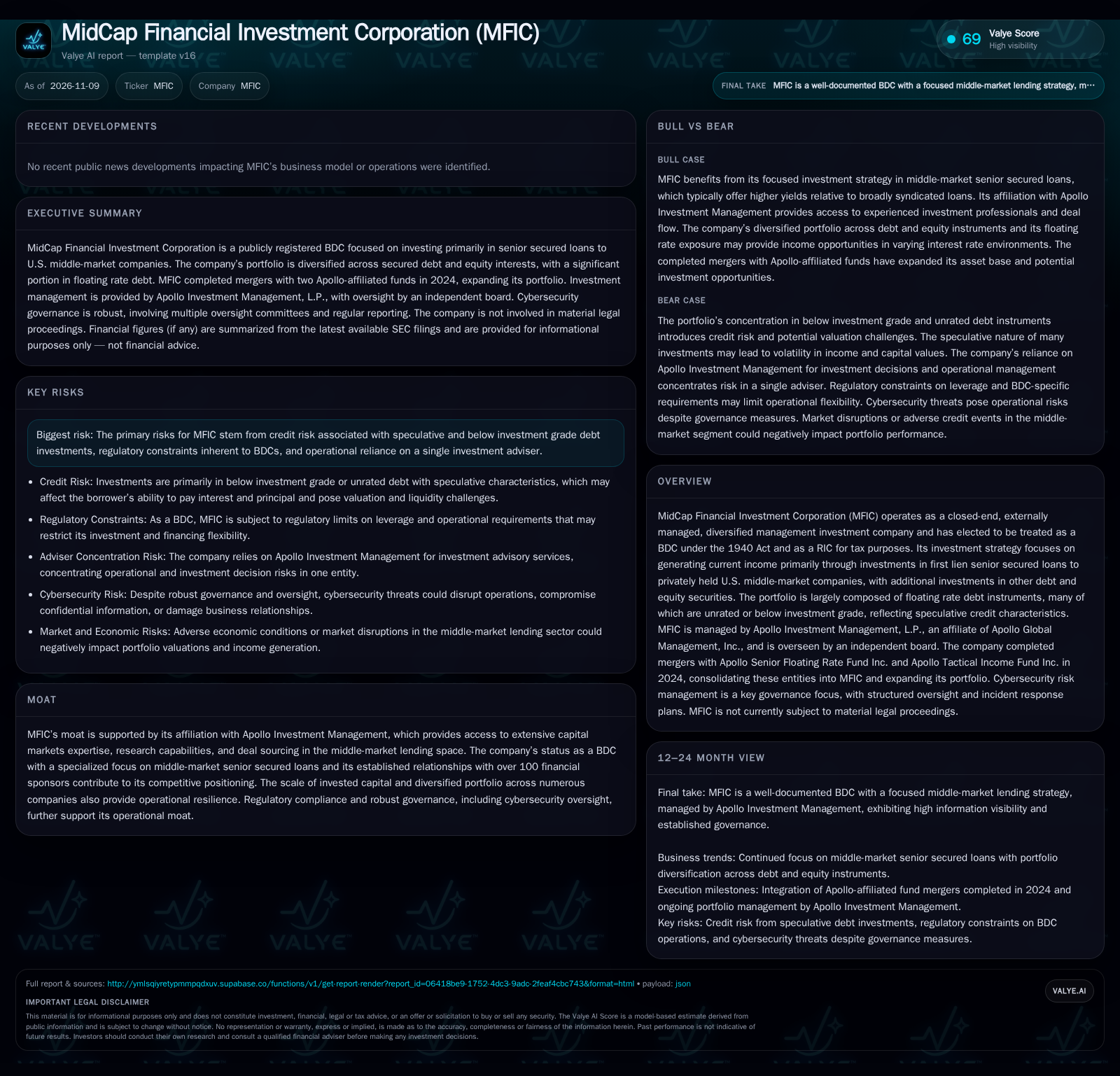
MidCap Financial Investment Corp (MFIC) has consolidated two Apollo-affiliated funds, expanding its floating-rate, senior secured debt portfolio focused on the U.S. middle market. Managed by Apollo Investment Management, MFIC seeks to generate income through higher-yielding, often unrated or below-investment-grade loans. While the company’s scale, sponsor network, and floating-rate profile offer potential advantages in income generation and deal sourcing, persistent credit risk, reliance on a single adviser, and strict BDC leverage limits shape its risk/reward profile and scenario outcomes. [S1] [S2]
MidCap Financial Investment Corp (MFIC) has emerged as a scale player in U.S. middle-market lending following its 2024 consolidation of two Apollo-affiliated floating-rate funds. With a $1.3 billion investment pace in 2025, nearly all in secured, floating-rate loans, MFIC’s income engine is tightly linked to interest rates and private credit market health. Yet, the company’s aggressive risk profile—dominated by unrated and below-investment-grade loans—means that credit events, adviser performance, and regulatory limits could quickly alter its trajectory. The next phase hinges on whether MFIC’s Apollo-driven sourcing and risk management can sustain income and asset quality amid economic uncertainty. [S1] [S2]
Recent Portfolio Expansion and Yield Trends Shape 2026 Outlook
As of December 31, 2025, MFIC’s portfolio consisted of 247 companies, with 95% of investments in secured debt and 100% of direct origination loans structured as floating rate. The company invested $1.3 billion in 2025 across new and existing borrowers but also saw $1.1 billion in repayments or sales, reflecting an active portfolio turnover. Weighted average yields declined year-over-year, with the secured debt portfolio yielding 9.7% at year-end 2025 compared to 10.8% in 2024, and the total portfolio yield at 8.6% versus 9.5% the prior year. MFIC completed mergers with Apollo Senior Floating Rate Fund and Apollo Tactical Income Fund in July 2024, expanding both its asset base and sponsor relationships. Most of the portfolio remains unrated or below investment grade, underscoring credit quality risks. [S1] [S2]
How MFIC Earns: The Economics of Middle-Market Direct Lending
MFIC generates revenue primarily through interest income on directly originated first lien senior secured loans to U.S. middle-market companies. The floating rate nature of these loans ties MFIC’s income potential to prevailing short-term interest rates. In a higher rate environment, this structure can drive increased yields, but falling rates would compress returns. The company’s focus on first lien and secured loans is designed to enhance recovery in default scenarios, but the predominance of below investment grade and unrated debt heightens loss potential during credit downturns.
Operating leverage in MFIC’s model is shaped by the external management agreement with Apollo Investment Management, which collects base and incentive fees. This model can limit MFIC’s ability to flex operating costs downward in adverse environments, as management fees are generally tied to assets rather than performance. Portfolio turnover—$1.1 billion in repayments versus $1.3 billion in new investments in 2025—suggests an ongoing need to source and underwrite new loans to maintain income and asset levels.
Regulatory leverage caps imposed on BDCs constrain balance sheet expansion, potentially limiting the company’s ability to scale assets during market dislocations when lending opportunities may be most attractive. As a RIC, MFIC must also distribute most of its income, limiting retained earnings as a capital buffer.
Apollo Affiliation, Sponsor Network, and the Dynamics of Middle-Market Lending
MFIC’s competitive positioning is anchored in its relationship with Apollo Investment Management, a major player with deep experience in credit markets and a broad sponsor network. This affiliation likely enhances deal sourcing, access to information, and underwriting expertise—critical advantages in a fragmented, relationship-driven middle-market lending landscape.
The completed mergers in 2024 expanded MFIC’s scale and sponsor relationships, potentially improving deal flow and portfolio diversification. However, the middle-market lending space remains crowded, with competition from other BDCs, private debt funds, and traditional banks. The predominance of floating rate loans could provide a relative edge in rising-rate environments, but also exposes MFIC to increased borrower distress when rates climb sharply.
A potential vulnerability is the company’s reliance on a single external adviser: if Apollo’s investment performance or operational integrity falters, MFIC’s outcomes could be negatively affected. Additionally, the low-rated credit profile of the portfolio means MFIC must compete on underwriting skill and portfolio management rather than simply on price.
When Sourcing Strength and Credit Discipline Drive Superior Returns
In a favorable environment, MFIC’s Apollo affiliation and sponsor relationships could allow it to capture attractive risk-adjusted spreads on new loans, replenish the portfolio with high-quality originations, and maintain robust asset yields. If interest rates remain elevated but economic conditions stay benign, floating-rate loans could deliver strong income without a spike in defaults.
Upside would be confirmed by stable or improving non-accrual rates, continued portfolio growth without deterioration in credit quality, and the ability to reinvest repayments at or above current yields. Evidence would include sustained or rising net investment income, growing distributions, and a portfolio mix that maintains high secured debt exposure with manageable credit losses.
A falsification of the upside thesis would involve a rise in non-accruals, significant markdowns, or the inability to redeploy capital at attractive spreads, suggesting either credit slippage or intensifying competitive pressure.
Portfolio Churn and Credit Risk Remain the Core Balancing Act
The most plausible path is that MFIC continues to actively recycle capital as loans are repaid, maintaining a diversified portfolio of mostly floating-rate, first lien senior secured loans. Yields may remain under pressure if competitive dynamics or lower rates persist, but the company’s scale and sponsor relationships should support steady origination volumes.
Credit risk remains elevated due to the speculative nature of much of the portfolio. Modest increases in non-accruals or credit losses are likely, but not to a degree that would destabilize income or capital. MFIC’s externalized cost base and regulatory leverage limits mean it is less able to respond aggressively to market dislocations, but should remain operationally stable barring a severe credit event.
Confirmation of this scenario would be continued portfolio recycling, stable or only gradually rising credit losses, and net investment income tracking in line with historical averages. A sharp increase in non-accruals, a rapid decline in yields, or significant adviser-related disruptions would falsify the base case.
Credit Deterioration and Adviser Reliance as Amplifiers of Downturn Risk
The key adverse scenario centers on a broad deterioration in middle-market credit quality—triggered by an economic downturn, higher-for-longer rates, or sector-specific shocks. Given MFIC’s concentration in below investment grade and unrated debt, even a moderate rise in defaults could lead to outsized income volatility and asset markdowns.
If Apollo’s underwriting or portfolio management falters, or if the adviser is distracted or impaired, the impact on MFIC could be amplified, given the concentrated adviser relationship. Regulatory leverage limits may prevent the company from raising new capital or supporting troubled borrowers, forcing asset sales at depressed prices.
Confirmation of the downside would include a spike in non-accruals, a sharp drop in net investment income or distributions, significant realized or unrealized losses, and signs of adviser turnover or governance stress. A more benign credit environment or evidence of strong credit selection despite economic headwinds would help falsify the downside thesis.
Testing MFIC’s Middle-Market Lending Thesis: Metrics and External Catalysts
Non-accrual rates on the loan portfolio—rising levels would signal credit stress and challenge the income thesis.
Weighted average portfolio yield—declines may indicate increased competition, lower rates, or credit slippage.
Portfolio turnover ratio and new origination volume—track MFIC’s ability to redeploy capital at attractive spreads.
Leverage ratio (if disclosed)—monitor proximity to regulatory caps and potential constraints on asset growth.
Net investment income per share—sustained or rising levels would support distribution stability and asset quality.
Distribution coverage ratio (if disclosed)—to assess the sustainability of dividends relative to income.
Adviser continuity and governance disclosures—any changes in Apollo’s management role or oversight would be material.
Credit ratings migration within the portfolio—upgrades or downgrades would help test underwriting effectiveness.
Disclaimer: This is research-only, informational analysis and not investment advice. It may include AI-generated interpretation and general industry context. Always verify important details using primary sources.

Comments