
Pattern Group 2026: AI-Driven Ecommerce at Scale, Platform Leverage, and the Compliance Cost Equation
Pattern Group’s AI-optimized ecommerce acceleration platform is driving strong net revenue retention and profitability, but the company’s reliance on large-scale data, global marketplace operations, and emerging AI technologies introduces a complex mix of competitive strengths and regulatory risks. The next phase hinges on the economics of inventory-based growth, the defensibility of its platform, and its ability to navigate compliance and operational hurdles.
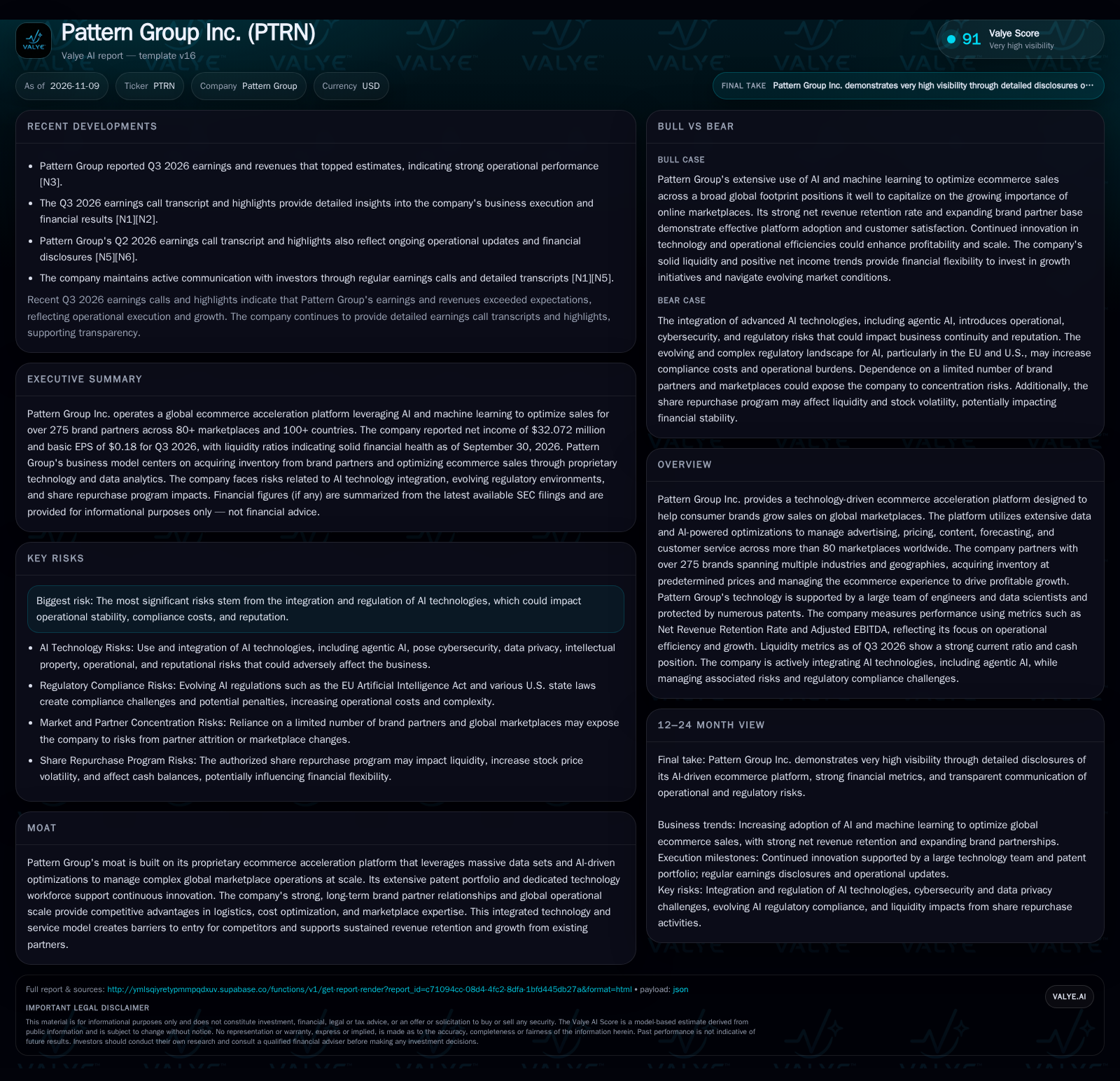
Pattern Group’s proprietary AI-powered platform is helping over 275 brands grow across 80+ ecommerce marketplaces, with strong net revenue retention (127%) and positive EBITDA. Its inventory-based model, global reach, and patent-backed technology create both operating leverage and exposure to compliance and AI-related risks. The company’s next leg of growth will depend on sustaining partner expansion, managing risk as AI regulations evolve, and balancing inventory economics with platform and consulting revenue streams. [S2]
Pattern Group Inc. is emerging as a formidable player in the ecommerce enablement landscape, leveraging its AI-powered platform to help more than 275 brands expand across over 80 marketplaces globally. The company’s blend of proprietary data, machine learning, and inventory-centric sales model has produced robust net revenue retention and profitability metrics. Yet, as Pattern Group deepens its integration of advanced AI and navigates an increasingly complex regulatory environment, the balance between platform-driven scale and risk management will define its ability to sustain competitive differentiation and profitable growth.
Recent Financial Performance and Strategic Milestones Shape the Growth Narrative
Pattern Group ended Q3 2026 with a Net Revenue Retention Rate (NRR) of 127%, reflecting strong expansion and upsell among existing brand partners—a critical indicator of platform stickiness and the company’s ability to drive incremental value from its base. Adjusted EBITDA reached $164.984 million and net income was $88.784 million for the first nine months of 2026, demonstrating that the business model is delivering operating profits at scale. reported liquidity position, with $351.692 million in cash and a current ratio of 2.32 as of September 30, 2026. The company’s technology foundation continues to expand, with over 100 trillion data points powering its optimizations and 44 patents issued or pending, supported by a team of 550 technology professionals. Pattern Group’s March 2026 authorization of a $100 million share repurchase program introduces a variable for future capital allocation and stock liquidity. Collectively, these facts set the stage for a business that has achieved both top-line retention and bottom-line profitability, but faces growing complexity from its technology and regulatory landscape. [S2]
How Pattern Group’s Inventory Model and Platform Economics Could Drive Operating Leverage
Pattern Group’s primary revenue stream comes from acquiring inventory from brand partners at predetermined prices and selling these products on global ecommerce marketplaces. This approach gives Pattern Group control over pricing, marketing, and fulfillment, allowing it to extract value through optimization of demand levers such as advertising, content, and dynamic pricing. The company’s AI and data analytics capabilities may enable higher sales conversion, improved inventory turns, and reduced working capital requirements—if executed efficiently. The scale of operations (80+ marketplaces, 100+ countries) creates opportunity for both volume-based margin expansion and cross-border arbitrage, but also exposes Pattern Group to volatility in product categories, inventory risk, and marketplace terms.
Subscription and consulting fees provide a secondary, likely higher-margin revenue stream, but the majority of revenue is tied to product sales, which are inherently lower-margin and working-capital intensive compared to pure SaaS or agency models. The company’s significant investment in technology and intellectual property is a fixed cost base that, if spread over a growing revenue pool, could yield strong operating leverage. However, the inventory-based model requires disciplined forecasting and supply chain management to avoid overstocking or obsolescence, particularly in fast-moving consumer categories.
The ability to maintain and expand net revenue retention (NRR) is crucial for margin expansion: a rising NRR means more revenue is driven from existing partners without proportional increases in acquisition or fulfillment costs. As Pattern Group integrates advanced AI, there may be incremental costs for compliance, cybersecurity, and ongoing R&D—potentially offset by efficiency gains if automation can reduce manual labor or improve ad spend ROI.
Defensibility in a Crowded Marketplace Enablement Sector
Pattern Group faces a competitive landscape filled with ecommerce enablement platforms, digital agencies, marketplace-focused SaaS providers, and logistics/fulfillment specialists. Its defensibility rests on several pillars: proprietary data scale (100 trillion data points), an integrated AI/ML platform, a meaningful patent portfolio, and a global operational footprint. The deep integration of AI and the breadth of managed marketplaces could create switching frictions for brand partners who would otherwise need to coordinate multiple vendors or build in-house capabilities.
However, the market is not standing still. Large enterprise software vendors, retail logistics players, and new AI-native entrants are all vying for a share of the ecommerce acceleration space. The risks of commoditization are non-trivial: if AI-driven optimization becomes table stakes or if marketplaces themselves internalize more of the value chain, Pattern Group’s margin structure could come under pressure. Furthermore, the company’s inventory-based approach exposes it to risks not faced by pure software or agency competitors, such as inventory write-downs, supply chain disruptions, and working capital constraints.
Its patent portfolio (44 issued/pending) and 550-person technology team suggest a commitment to ongoing innovation, but the company’s long-term moat will likely depend on its ability to deliver measurable sales lift, margin improvement, and global reach for brands—outcomes that are continually challenged by evolving algorithms, policy changes at major marketplaces, and the increasing sophistication of competing platforms.
Sustained NRR Expansion and AI-Driven Operational Gains Power a Virtuous Cycle
If Pattern Group continues to drive net revenue retention above 120% while expanding brand partnerships, the company could achieve a compounding effect: higher-margin revenue from existing partners is layered atop new partner wins, while the fixed cost base of technology and data infrastructure supports improved operating leverage. Successful integration of agentic AI and automation may reduce manual intervention in campaign management, content creation, and customer service—lowering variable costs and improving gross margins.
Evidence confirming this scenario would include continued NRR above 120%, rising gross and operating margins, expansion in consulting/subscription revenue as a share of total, and growth in the number of large, multi-category brand partners. Additionally, improved inventory turnover metrics and reduced days sales outstanding would signal that operational efficiencies are translating into working capital improvements. Expansion into new high-growth categories or geographies, supported by incremental patent grants and technology releases, would further reinforce the flywheel effect.
Inventory-Centric Growth Balanced by Rising Compliance and Execution Demands
The most plausible path is one where Pattern Group maintains NRR in the 120%-130% range and continues to grow its partner base, but faces incrementally higher compliance and operating costs as AI regulations tighten and as the complexity of global operations increases. The core inventory sales model continues to drive the bulk of revenue and working capital needs remain manageable, but margin expansion is gradual as gains from AI-driven automation are offset by rising regulatory, cybersecurity, and R&D expenses.
This scenario would be confirmed by stable or slightly rising operating margins, steady cash conversion cycles, and a consistently high rate of technology investment. If consulting and subscription revenues remain a small but growing share, and if the company successfully navigates new AI and data privacy regulations without major disruptions or penalties, it would support a thesis of durable—if not explosive—growth. Conversely, any signs of material inventory write-downs, partner attrition, or regulatory fines would challenge this balance.
Inventory Risk, Regulatory Shock, or Platform Commoditization Disrupt the Model
The adverse scenario is triggered if one or more of the following materialize: a major regulatory event (such as a fine or restriction due to non-compliance with EU/US AI laws), a significant inventory misstep (leading to write-downs or cash flow strain), or rapid commoditization of platform features that erode pricing power and partner loyalty. In this case, Pattern Group’s fixed costs become a burden rather than a source of leverage, and cash reserves are drawn down to cover losses or unforeseen compliance costs.
Evidence would include a sharp drop in NRR (below 110%), margin compression, an uptick in inventory obsolescence charges, or disclosures of regulatory investigations and penalties. Loss of key brand partners, especially in major categories or geographies, or a sudden spike in working capital needs could also signal a break in the business model’s self-reinforcing cycle. In the most severe case, the company could be forced to slow technology investment or reconsider its capital allocation, including the pace or scope of share repurchases.
Factors That Will Determine the Shape and Sustainability of Pattern Group’s Competitive Edge
Net Revenue Retention Rate (NRR): Sustained performance above 120% would support the thesis of platform stickiness and upsell capacity. A drop below this level could signal partner churn or reduced value delivery.
Gross and Operating Margins: Trends in margin expansion or contraction, particularly as AI-driven efficiencies are realized or offset by compliance costs, will reveal whether operating leverage is materializing.
Revenue Mix Evolution: The proportion of consulting/subscription revenue versus inventory-based sales (if disclosed) would clarify the company’s ability to shift toward higher-margin, less capital-intensive streams.
Inventory Turnover and Working Capital: Improvement in inventory turns and stable or shrinking cash conversion cycles would indicate operational discipline and risk management in the inventory-heavy model.
Brand Partner Expansion: Growth in the number and diversity of partner brands, especially in new categories or geographies, would test the scalability and resilience of the platform.
AI Compliance and Regulatory Costs: Any disclosures of compliance spending, fines, or regulatory investigations would inform the impact of evolving AI laws on Pattern Group’s cost structure and operational flexibility.
Patent Portfolio Growth: The rate of new patent grants or applications would reveal ongoing innovation and potential for defensibility in the face of platform competition.
Share Repurchase Activity: Actual execution of the $100M buyback and its effect on cash balances and volatility could influence future capital allocation decisions and investor perception.
Disclaimer: This is research-only, informational analysis and not investment advice. It may include AI-generated interpretation and general industry context. Always verify important details using primary sources.

Comments