
CAVA in 2026: Scaling Mediterranean Fast-Casual, Navigating Expansion Complexities, and the Pursuit of Durable Economics
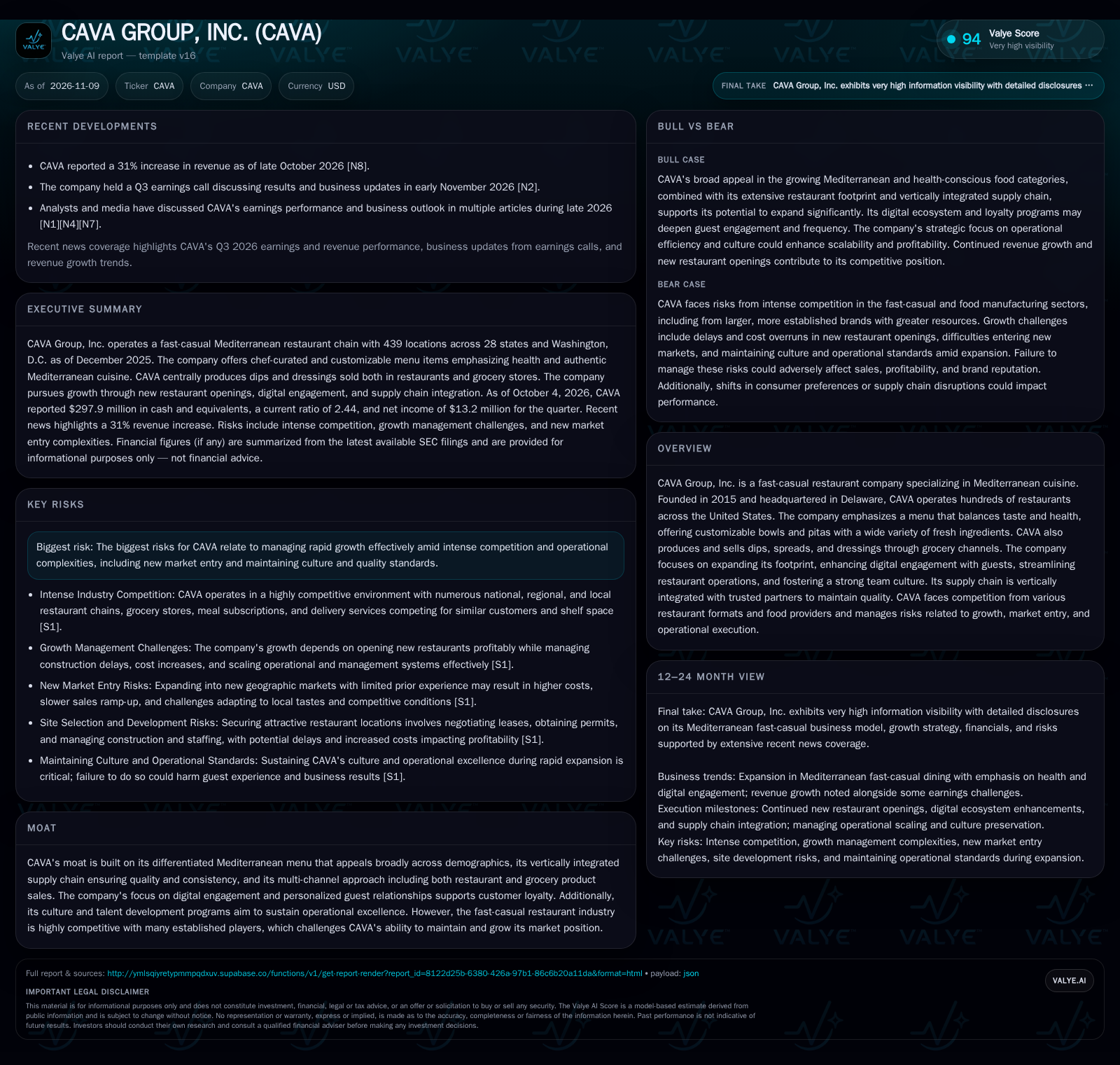
With over 430 locations and 31% revenue growth as of late 2026, CAVA is capitalizing on health-centric dining trends and Mediterranean cuisine’s broad appeal. The company’s vertically integrated supply chain, digital engagement strategy, and multi-channel presence underpin its expansion—but the challenge remains: can operational discipline and culture keep pace with rapid growth in an intensely competitive market?
CAVA Group’s aggressive U.S. expansion, strong revenue momentum, and differentiated Mediterranean offering position it to capture health-focused diners. However, scaling successfully amid competition and operational risks will test the resilience of its business model and culture.
CAVA Group, Inc. stands out in the fast-casual sector by marrying Mediterranean flavors with health-forward menu customization, a strategy that has fueled rapid expansion and notable revenue gains. As of late 2026, the company operates 439 restaurants across 28 states and D.C., posts a 31% year-over-year revenue increase, and maintains a sizable cash position. Yet, with ambitions to more than double its U.S. footprint by 2032, the company faces a critical test: whether its operational discipline, supply chain integration, and culture can scale as quickly and reliably as its top line in a fiercely competitive landscape.
Expansion Momentum and Financial Results Define CAVA’s 2026 Landscape
CAVA operates 439 restaurants in 28 states and Washington, D.C. as of December 2025, underlining its rapid geographic expansion over the past several years [S1]. The company reported a 31% revenue increase as of late October 2026, indicating robust top-line growth and ongoing consumer demand for its Mediterranean-inspired, health-centric menu [N8]. For the quarter ended October 4, 2026, CAVA posted net income of $13.2 million and EPS of $0.11 [S2]. The company holds $297.9 million in cash and equivalents, with a current ratio of 2.44 and a cash ratio of 1.53 [S2]. The company reported cash and liquidity metrics for the period; these figures do not by themselves establish operating runway, investment capacity, financial flexibility, or financing capacity.
CAVA’s stated goal is to exceed 1,000 U.S. restaurants by 2032, aiming to more than double its footprint in six years [S1]. This target, if realized, would entrench CAVA as a national player in the fast-casual dining space and significantly increase its exposure to both operational leverage opportunities and execution risks.
Decoding CAVA’s Multi-Channel Revenue Model and Margin Drivers
CAVA’s business model blends high-throughput fast-casual dining with a growing consumer packaged goods (CPG) presence via dips and spreads sold in grocery stores [S1]. The core restaurant offering emphasizes customizable bowls and pitas, leveraging 38 ingredients and billions of possible combinations, which drives perceived value and appeals to a health-conscious demographic. Menu customization can support higher average ticket sizes and throughput, but also introduces complexity in kitchen operations and supply chain logistics.
Restaurant-level economics in fast-casual typically rely on a mix of fixed costs (rent, labor) and variable costs (food, packaging). As unit count grows, fixed corporate overhead can be spread over a broader base, offering the potential for operating leverage if same-store sales remain strong. However, new store openings—especially in untapped or non-core markets—often require substantial upfront capital for build-out, marketing, and initial staffing. The company’s vertically integrated supply chain, with over 50 trusted partners and centralized production of dips, spreads, and certain dressings, may help control COGS and ensure quality at scale [S1]. If grocery channel sales scale meaningfully, they could offer margin diversification, though CPG typically carries lower gross margins than restaurant sales.
Digital engagement and personalized guest communications—supported by a proprietary digital ecosystem—may drive frequency and loyalty, supporting both top-line growth and more efficient marketing spend. However, the ultimate economics depend on CAVA’s ability to sustain high unit volumes, manage labor and commodity cost inflation, and avoid margin dilution as it enters less mature markets.
How CAVA’s Brand and Supply Chain Stack Up in a Crowded Fast-Casual Arena
CAVA differentiates itself through a Mediterranean menu with broad demographic appeal, a focus on health and wellness, and a multi-channel approach spanning both restaurants and grocery shelves [S1]. Its vertically integrated supply chain supports consistent quality and may create modest procurement advantages, particularly in specialty ingredients and proprietary dips.
Despite these strengths, the U.S. fast-casual sector is intensely competitive, with CAVA facing direct competition from established national and regional chains, as well as indirect rivals such as grocery prepared foods, meal kits, and delivery services [S1]. Larger incumbents may have deeper marketing budgets, more negotiating power with suppliers, and greater brand recognition. Additionally, as Mediterranean cuisine’s popularity grows, the risk of menu imitation and customer churn increases.
CAVA’s digital ecosystem and loyalty initiatives could foster retention, but these features are increasingly table stakes in the industry. The company’s emphasis on culture and employee development aims to sustain guest experience consistency, but rapid expansion often tests the limits of operational discipline and talent pipelines.
What Could Unlock Sustained Outperformance for CAVA?
If CAVA successfully executes on its new restaurant pipeline—opening high-traffic, well-located units while maintaining operational standards—the company could achieve significant operating leverage as fixed costs are spread over a larger base. Strong digital engagement, personalized marketing, and loyalty program expansion might boost visit frequency and average check size, further supporting same-store sales growth.
Expansion of CPG sales in grocery channels could provide an additional revenue stream and extend brand reach beyond the restaurant footprint. If these products achieve broad supermarket distribution and strong velocity, CAVA could build a durable brand platform, analogous to the way some fast-casual brands have parlayed in-restaurant popularity into retail dominance.
Evidence confirming this scenario would include sustained double-digit same-store sales growth, rising restaurant-level margins, increasing digital order mix, and consistent positive net income even as new stores ramp. A meaningful contribution from CPG sales—if disclosed—would further validate the multi-channel thesis.
Scaling Up with Mixed Outcomes: Plausible Trajectory for CAVA
The most plausible path for CAVA involves continued rapid expansion, with the majority of new units performing at or near system average, but a gradual normalization of same-store sales growth as the footprint matures. Restaurant-level margins may face pressure from higher labor costs, commodity inflation, and the operational complexity of managing hundreds of locations across diverse markets.
Digital engagement and supply chain integration may continue to support efficiency and guest retention, but CPG sales likely remain a modest contributor relative to the core restaurant business in the near term. The company’s culture and training initiatives may help mitigate turnover and quality issues, but maintaining consistency across a doubling store base will remain a persistent challenge.
Confirmation of this scenario would be steady, but moderating, revenue growth, stable or slightly compressed margins, and positive but fluctuating net income as new markets ramp and competitive pressures intensify. Occasional store closures or underperforming units may surface as the company tests new geographies and formats.
Where Expansion Could Go Off the Rails: Adverse Outcomes for CAVA
The principal risk is that rapid unit growth outpaces the company’s ability to maintain operational standards, leading to inconsistent guest experiences, higher turnover, and negative brand impact. If site selection falters—resulting in poorly located or cannibalizing restaurants—new units could underperform, dragging down system-wide margins and profitability.
Supply chain disruptions, construction delays, or cost overruns could further erode new store economics. Additionally, if competition intensifies—either from existing fast-casual giants or new Mediterranean entrants—CAVA may be forced into discounting or elevated marketing spend, pressuring margins and potentially stalling same-store sales growth.
Confirmation of a downside scenario would include a marked slowdown in same-store sales, declining restaurant-level margins, rising store closures or impairments, and negative net income or cash burn—particularly if accompanied by elevated turnover or negative guest feedback in new markets.
Milestones That Will Shape CAVA’s Expansion Thesis
Same-store sales growth trends by quarter: Sustained double-digit growth would support the upside case, while a sharp deceleration could signal competitive or execution pressures.
Restaurant-level margin disclosure: If disclosed, tracking margin trends will reveal whether CAVA is achieving operating leverage or facing cost headwinds as it scales.
New restaurant performance versus mature cohort: A useful metric would be the sales and margin ramp of new units compared to established locations.
Digital order mix and loyalty program participation: Increases here would suggest effective digital engagement and higher customer retention.
CPG (grocery channel) revenue growth and margin: If disclosed, this would clarify the scale and profitability of the non-restaurant business.
Store development pace and delays: Monitoring whether CAVA meets, exceeds, or falls short of its targeted opening schedule will test execution capabilities.
Employee turnover rates and guest satisfaction scores: These would indicate whether culture and operational standards are holding up under expansion.
Cash flow from operations and capital expenditures: Tracking these will reveal whether the growth strategy is self-funding or increasingly reliant on balance sheet resources.
Disclaimer: This is research-only, informational analysis and not investment advice. It may include AI-generated interpretation and general industry context. Always verify important details using primary sources.

Comments