
NorthWestern Energy 2026: Infrastructure Investment, Regulatory Tensions, and the Economics of a Modernizing Utility
NorthWestern Energy’s heavy bet on grid modernization and smart infrastructure brings both opportunities for operational resilience and acute pressures from rising costs and regulatory friction. As the utility sector faces volatile weather, evolving rate frameworks, and capital intensity, the company’s 2025-26 performance reveals the complex interplay between margin protection, cost recovery, and potential financial flexibility.
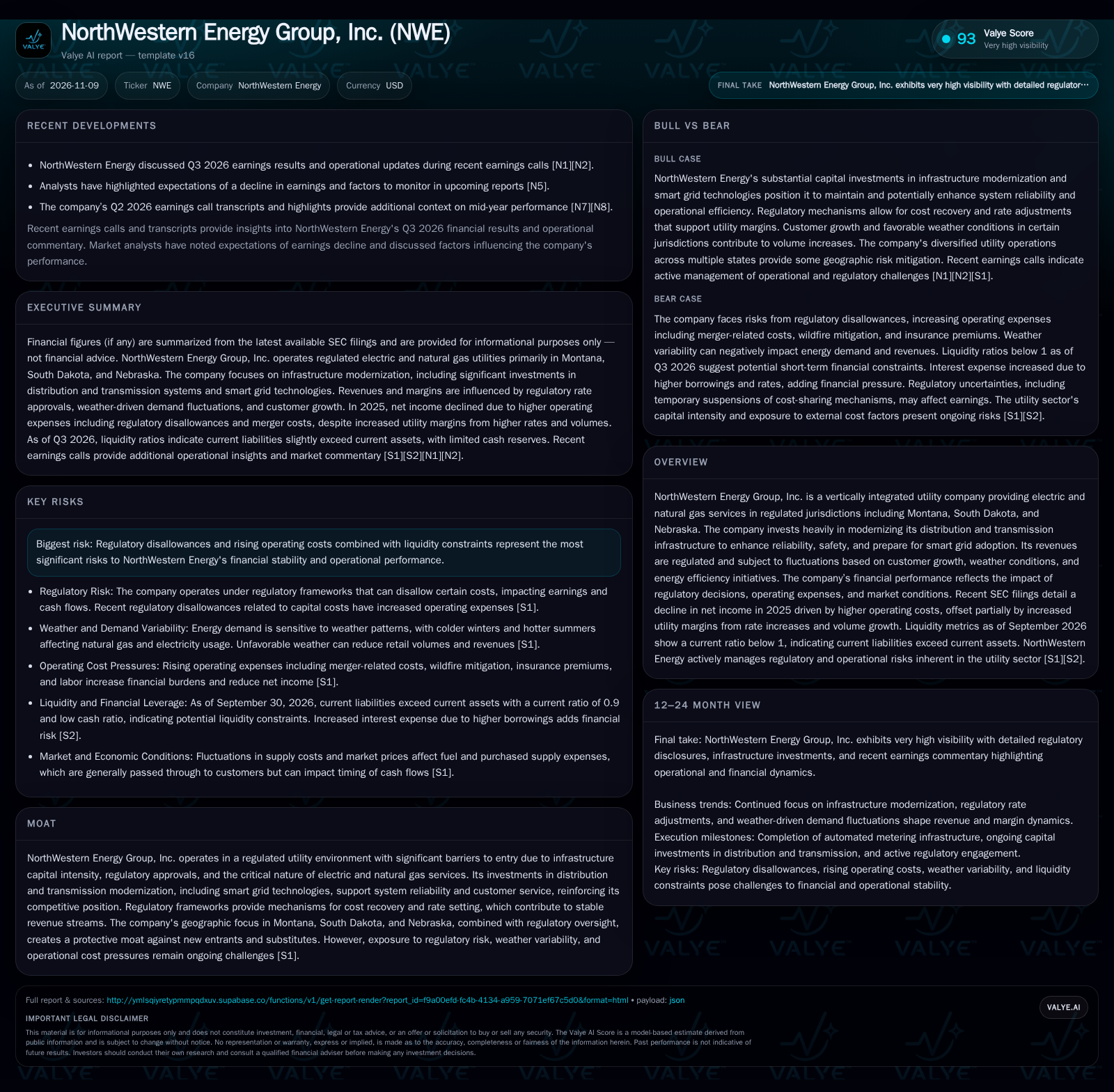
NorthWestern Energy is navigating a period of elevated capital spending and cost escalation, with 2025-26 results showing higher utility margins from rate hikes and volume growth, but net income compressed by regulatory disallowances, merger expenses, and increased interest costs. The company’s infrastructure modernization may improve long-term reliability and enable smart grid capabilities, but the near-term hinges on regulatory outcomes and disciplined cost management. [S1] [S2]
NorthWestern Energy’s 2025-26 financial results underscore the tension inherent in regulated utilities: the pursuit of reliability and modernization through capital spending, versus the risks of regulatory pushback and rising operating costs. The company’s substantial investments in grid infrastructure and smart metering are intended to support long-term system resilience and service quality, yet recent periods saw net income dip as cost pressures and regulatory disallowances outpaced margin gains from rate hikes and volume growth. [S1] [S2]
Recent Results Show Margin Gains Offset by Cost and Regulatory Headwinds
NorthWestern Energy reported a notable 11.2% increase in utility margin in 2025, reaching $1,200.8 million, buoyed by base rate increases, electric transmission revenue, and higher retail volumes. However, consolidated net income fell to $181.1 million from $224.1 million in 2024, primarily due to a surge in operating expenses linked to regulatory disallowances, merger-related costs, and rising depreciation, interest, and property tax outlays. These pressures have outpaced the positive effects of rate increases and volume growth, underscoring the vulnerability of regulated utilities to cost shocks and regulatory decisions. [S1]
As of September 30, 2026, NorthWestern’s balance sheet reflects a cash and equivalents position of $6.54 million, current assets of $523.7 million, and current liabilities of $580.1 million, yielding a current ratio of 0.9 and a cash ratio of 0.01. This configuration signals limited short-term liquidity and heightened sensitivity to any operational or regulatory disruptions. [S2]
The company’s capital allocation remains heavily skewed toward infrastructure: approximately $2.3 billion, or 70% of its capital forecast, is earmarked for distribution and transmission modernization, including smart grid technologies. This long-term investment thrust is central to NorthWestern’s operational strategy but requires regulatory buy-in for cost recovery. [S1]
Regulated Revenue Model and the Dynamics of Cost Recovery
NorthWestern Energy operates a vertically integrated, rate-regulated utility business where the economics are shaped by the interplay between capital investment, operating cost escalation, and the regulatory approval process. Revenues are primarily determined by approved rates, which are set to allow a reasonable return on invested capital and to recover prudently incurred operating expenses. However, regulatory disallowances—where certain costs are not permitted for recovery—can directly compress net income, as seen in 2025.
The company’s heavy capital spending is typical for utilities seeking to modernize grid assets and prepare for smart grid integration, creating a high fixed-cost base and significant depreciation charges. This capital intensity theoretically enables operating leverage as incremental demand or rate increases flow through to the bottom line—provided that cost recovery is granted. Variable costs (fuel, purchased power) are generally passed through to customers, mitigating commodity price risk but not insulating the company from timing mismatches or regulatory lag.
Interest expense is another critical lever: NorthWestern’s increased borrowings and higher interest rates in 2025 led to a material uptick in interest costs, reducing net income despite higher utility margins. The company’s ability to fund ongoing capital projects without eroding potential financial flexibility will depend on consistent regulatory support and access to affordable debt.
Barriers, Regulatory Moats, and the Challenge of Cost Discipline
NorthWestern Energy’s competitive position is anchored by the structural barriers inherent in regulated utility markets: the capital required for grid infrastructure, the regulatory permissions needed to operate, and the essential nature of electric and gas service. These factors shield incumbent utilities from direct competition and substitute risk, especially in its core territories of Montana, South Dakota, and Nebraska.
However, the company’s moat is not absolute. Regulatory bodies have substantial influence over returns, cost recovery, and allowable capital projects. Disallowances or delays in rate adjustments can erode profitability and strain cash flows, as evidenced by recent earnings. Additionally, while distributed energy resources and energy efficiency programs do not yet represent existential threats to the core utility model in these geographies, they may gradually reduce volumetric growth or necessitate new capital expenditures.
Peer utilities in adjacent regions face similar regulatory and capital-intensity dynamics, but differences in regulatory climates, cost structures, and customer mix can affect relative performance. NorthWestern’s focus on modernization and reliability could be a differentiator if it translates into fewer outages, better customer satisfaction, or regulatory goodwill—but only if costs are contained and recovery mechanisms are robust.
If Regulatory Alignment and Cost Control Prevail, Margin Expansion Could Follow
A favorable outcome for NorthWestern Energy hinges on the company securing timely and full regulatory approval for its large-scale capital investments and operating expense recovery. If regulators accept the prudence of these expenditures and authorize sufficient rate increases, the high fixed-cost base could yield operating leverage as new assets come online and customer volumes grow.
Successful smart grid and infrastructure upgrades could also drive operational efficiencies—such as reduced outage frequency and duration, lower maintenance costs, or deferred capital needs—which may improve margins over time. Customer growth in the service territory, especially from industrial or commercial segments, would further amplify positive volume effects.
Evidence confirming this scenario would include regulatory filings or approvals granting full or accelerated cost recovery, stable or improving net income despite ongoing capex, and sustained or rising utility margins. Commentary from earnings calls highlighting cost containment and positive regulatory relationships would further validate the thesis. [S1] [N1] [N2]
Margin Pressure Persists as Regulatory and Cost Challenges Offset Growth
The most plausible outcome is a continuation of current dynamics: NorthWestern Energy manages to secure incremental rate increases and partial cost recovery, but operating expense growth—driven by regulatory disallowances, maintenance, and elevated interest—continues to offset much of the benefit from higher utility margins.
Capital spending on grid modernization remains high, keeping depreciation and interest expense elevated. Regulatory lag, or partial disallowances, persist as a drag on net income growth. Weather-driven demand variability and energy efficiency gains may moderate retail volume growth, limiting upside from the customer base.
This scenario would be confirmed by further earnings reports showing modest increases in utility margin but flat or only slightly rising net income, persistent commentary on regulatory headwinds, and little improvement in liquidity ratios. Analyst and management commentary suggesting a cautious outlook or highlighting ongoing cost pressures would reinforce this trajectory. [S1] [S2] [N5]
Regulatory Disallowances, Cost Surges, and Liquidity Stress Trigger Financial Strain
A more adverse scenario could materialize if regulators impose stricter cost disallowances or delay rate increases, leaving NorthWestern unable to fully recover rising operating and capital costs. If wildfire mitigation, insurance, labor, or technology expenses accelerate faster than anticipated, and weather variability reduces volumetric growth, net income could erode further.
Rising interest rates or tightening credit markets would amplify the challenge, increasing debt service costs and further reducing potential financial flexibility.
Confirmation of this downside would come from regulatory decisions rejecting or sharply limiting cost recovery, negative free cash flow trends, increased reliance on short-term borrowing, or management guidance pointing to potential liquidity actions. A sustained decrease in net income and negative analyst revisions would also support this scenario. [S2] [N5]
Milestones That Will Define NorthWestern Energy’s Margin and Modernization Trajectory
Progress and outcomes of regulatory filings for rate cases and cost recovery, especially those relating to major capital projects and wildfire mitigation. Evidence of favorable or adverse decisions would test the thesis.
Trends in operating expense growth, particularly in depreciation, insurance, labor, and technology, versus management’s cost-control guidance. A useful metric would be year-over-year changes in non-fuel operating expenses, if disclosed.
Customer growth and volumetric changes in core regions, especially any shifts in industrial/commercial demand or weather-driven retail volumes.
Implementation milestones for smart grid and infrastructure projects, including any realized operational efficiencies or reliability metrics.
Interest expense trajectory in the context of capital markets conditions and future borrowing needs.
Disclaimer: This is research-only, informational analysis and not investment advice. It may include AI-generated interpretation and general industry context. Always verify important details using primary sources.

Comments