
Regis Corp 2026: Franchise Leverage, Liquidity Tension, and the Challenge of Salon Consolidation
The durability of its franchise model faces a real-world test as consumer spending remains volatile and industry fragmentation challenges both operational leverage and growth.
Recent leadership changes and the Alline Salon Group acquisition are reshaping the brand portfolio, yet the company must balance operational improvements with the inherent cyclicality and competitive intensity of the salon industry. Monitoring franchisee health, integration progress, and cash management will be critical as Regis seeks to stabilize and grow.
The company’s ongoing integration of the Alline Salon Group and recent CEO transition signal strategic intent to consolidate and leverage its salon brands—yet the broader reality is an industry defined by intense competition, economic sensitivity, and franchisee variability. Regis’s performance over the coming quarters will hinge on its ability to drive operational improvements while navigating the risks inherent to its capital-light, franchise-centric model.
Recent Results Reveal Stability and Strain in Regis’s Operating Model
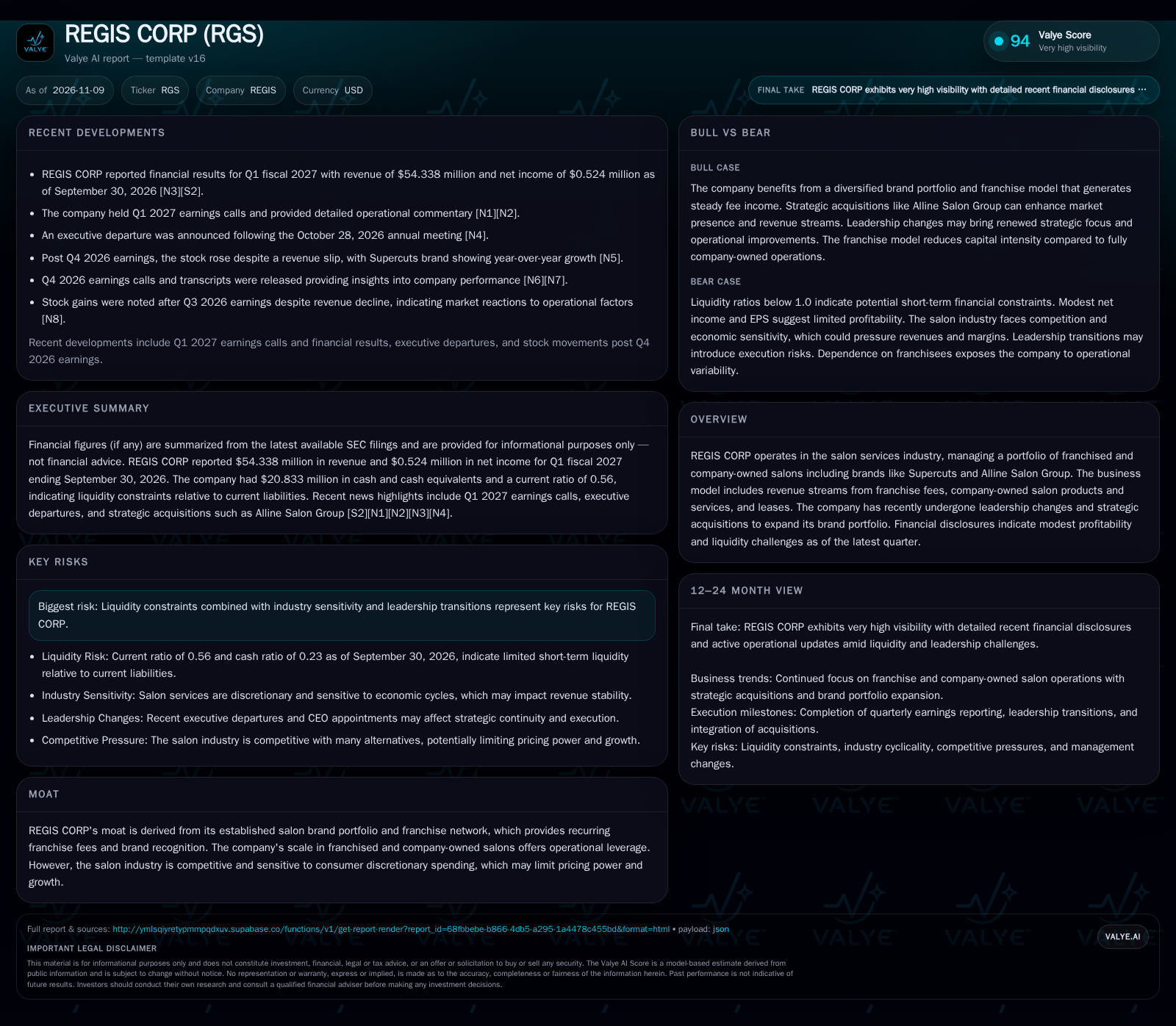
Regis Corp reported Q1 fiscal 2027 revenue of $54.338 million and net income of $0.524 million, signaling the ability to achieve modest profitability even as the broader salon industry faces ongoing volatility [S2] [N3]. The company reported cash and liquidity metrics for the period; these figures do not by themselves establish operating runway, investment capacity, financial flexibility, or financing capacity. [S2] These figures are notable given Regis’s reliance on a franchise model, which typically reduces capital intensity but can also limit direct control over operating cash flows.
Recent developments include the acquisition of Alline Salon Group and a new CEO appointment in March 2026, followed by executive departures after the October 2026 annual meeting [N4]. This leadership turnover and portfolio expansion reflect both a strategic push for scale and the operational complexities that come with change management in a highly competitive sector.
How Regis’s Franchise-First Model Shapes Profitability and Risk
Regis generates revenue primarily from franchise fees and company-owned salon operations, with the former offering a capital-light, fee-based income stream and the latter providing direct exposure to service margins and product sales. Franchise fees generally provide steady, recurring cash flows, but the company’s actual margin profile hinges on the health and compliance of the franchisee base, which can vary across geographies and economic cycles.
Company-owned salons, while offering greater control, are more exposed to labor, rent, and product cost inflation. Fixed costs are significant, especially in owned units, so same-store sales growth or improved utilization can deliver operating leverage. However, when system-wide volume is flat or declining, fixed overheads can quickly erode profitability.
The acquisition of Alline Salon Group suggests an attempt to consolidate regional brands and drive scale, but integration costs and the risk of underperforming acquired units could dilute near-term margins.
The franchise-first model also introduces a layered risk profile tied to regional economic disparities and consumer behavior shifts. Franchisees operating in economically resilient markets may sustain fee payments and local marketing investments better than those in weaker regions, creating uneven revenue streams for Regis. Furthermore, the model's dependence on franchisee compliance with brand standards and operational protocols can affect overall system reputation and customer experience, which in turn influences long-term profitability. Thus, the company's ability to enforce quality controls and provide scalable support services is critical to mitigating variability and sustaining franchisee performance across diverse markets.
Brand Scale vs. Industry Fragmentation: Competitive Realities for Regis
Regis’s competitive advantage stems from its portfolio of established brands such as Supercuts and now Alline Salon Group, which deliver consumer recognition and attract franchisees seeking affiliation with a national platform. The franchise model, in theory, enables rapid network expansion and local market penetration without assuming the full capital burden of company-owned growth.
However, the salon industry remains highly fragmented, with a mix of independent operators, regional chains, and emerging tech-enabled platforms. Price competition is intense, and consumer loyalty is often driven by individual stylists rather than brand affinity—limiting pricing power and reducing barriers to entry for new concepts. The proliferation of home-based and boutique salons, as well as potential substitution from at-home grooming solutions, further challenges the traditional franchise playbook.
Regis’s scale provides some negotiation leverage with suppliers and landlords, but any sustained advantage depends on its ability to offer compelling franchise economics and support systems that mitigate churn and encourage unit growth.
Operational Turnaround and Franchise Health Drive Sustainable Growth
If Regis successfully integrates the Alline Salon Group, improves franchisee support, and leverages its national platform to drive same-store sales and new unit openings, the company could see a meaningful uplift in both profitability and cash flow. Operational improvements—such as better labor management, technology adoption, and targeted marketing—may enhance franchisee economics and attract new partners, boosting fee revenue with limited incremental capital.
A favorable scenario would be confirmed by accelerating system-wide sales growth, improved franchisee unit economics (if disclosed), and a rising proportion of recurring franchise fee income. Evidence of positive operating leverage—such as margin expansion alongside revenue growth—would further validate the turnaround story.
Managing Through Industry Cyclicality and Franchise Variability
The most plausible outlook is one of measured progress: Regis maintains modest profitability by stabilizing its franchise base, extracting incremental efficiencies from company-owned salons, and selectively integrating new acquisitions. Revenue growth is likely to track industry trends, with any gains offset by ongoing labor and occupancy cost pressures.
Confirmation would come from steady or improving net income and cash flow, as well as stable franchisee retention rates (if disclosed).
Liquidity Erosion and Franchisee Stress Amplify Downturn Risk
The primary downside risk is that liquidity constraints force Regis to curtail investment, delay payments, or seek expensive external financing. Should economic conditions deteriorate or competitive pressures intensify, franchisees may struggle—leading to store closures, lower fee income, and potential brand dilution.
This scenario would be confirmed by a further decline in the current ratio, rising accounts payable, franchisee bankruptcies or closures (if disclosed), and negative operating cash flow. Leadership instability or failed integration of recent acquisitions would compound these pressures and threaten Regis’s ability to maintain its national network.
Milestones and Metrics That Will Shape Regis’s Post-Acquisition Trajectory
System-wide same-store sales growth, especially within key brands like Supercuts and Alline, would help validate the effectiveness of operational improvements.
Franchisee retention rates and new unit openings, if disclosed, are crucial for assessing the health and appeal of Regis’s franchise model.
Trends in the current ratio and cash balance will indicate whether liquidity is stabilizing or deteriorating.
Gross and operating margin evolution, particularly in the company-owned salon segment, would show whether cost controls and integration efforts are translating into profitability.
The pace and cost of Alline Salon Group integration—including any disclosed restructuring charges or synergies—will be a litmus test for acquisition strategy execution.
Leadership stability and the impact of recent executive changes on strategic direction should be monitored through subsequent earnings calls and management commentary.
Store closure rates and any evidence of franchisee distress or bankruptcy filings, if disclosed, will offer early warnings of systemic stress within the network.
Disclaimer: This is research-only, informational analysis and not investment advice. It may include AI-generated interpretation and general industry context. Always verify important details using primary sources.

Comments