
NCR Voyix: Recurring Revenue Ambitions, Segment Economics, and the Test of Liquidity Resilience
NCR Voyix is shifting toward a recurring SaaS and services model across retail and restaurant verticals, with recent quarterly results showing positive net income and revenue outperformance. As the company divests non-core banking tech assets and leans into its Voyix Commerce Platform, the durability of its margin profile, cash conversion, and ability to manage liquidity amid modest cash coverage become central to the forward thesis.
With a strategic focus on recurring SaaS and managed services in retail and restaurant verticals, the company’s ability to drive margin expansion and manage working capital will be critical as it transitions away from legacy hardware and non-core banking operations. Key thesis tests include recurring revenue mix growth, service margin durability, and cash flow generation under evolving macro and competitive conditions. [S2] [N2] [N3]
NCR Voyix stands at a strategic inflection point as it pivots from legacy hardware and non-core banking technology toward a SaaS-driven, services-heavy business model centered on retail and restaurant customers. As margin structure and recurring revenue growth become increasingly important, NCR Voyix’s ability to balance investment, cash conversion, and competitive pressures will define its next chapter. [S2] [N2] [N3]
Recent Financial Results Highlight Profitability and Liquidity Constraints
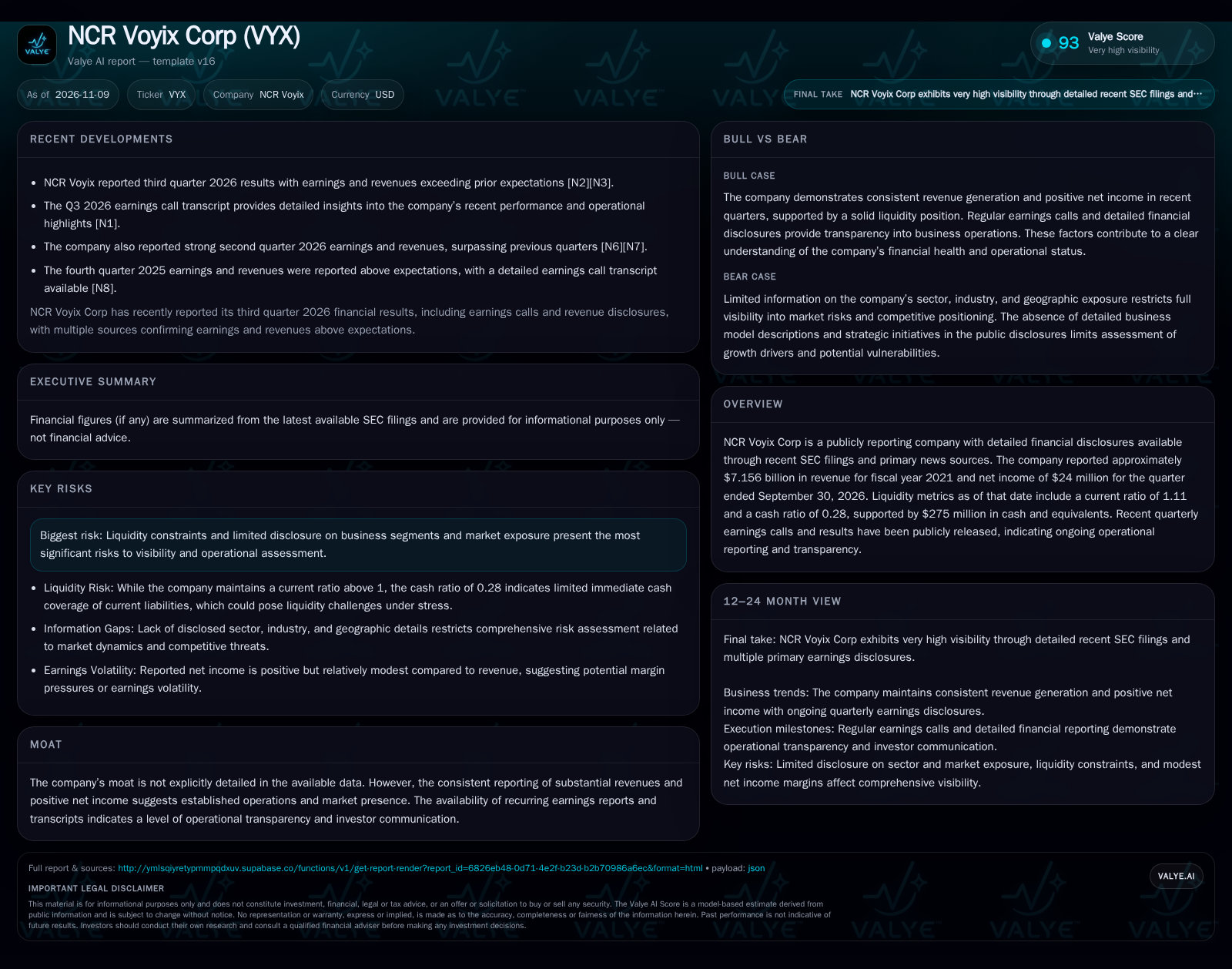
NCR Voyix reported net income of $24 million for the quarter ending September 30, 2026, with current assets of $1.076 billion versus current liabilities of $972 million, yielding a current ratio of 1.11. However, its cash and equivalents stood at $275 million, resulting in a cash ratio of just 0.28. The company’s service revenue accounted for 93.5% of segment revenue in the most recent quarter, reflecting a successful transition toward SaaS and managed services, while product revenue continues to decline. The sale of the Japan bank technology solutions business was completed and classified as discontinued operations, further sharpening the company’s focus on retail and restaurant verticals. Recent quarterly results have exceeded expectations, but the modest cash coverage of liabilities remains a structural vulnerability. [S2] [N2] [N3]
Recurring Revenue Model Drives Margins but Raises Working Capital Stakes
NCR Voyix’s economic engine is increasingly built on recurring revenue streams from SaaS, managed services, and payment solutions for retail and restaurant clients. This model typically offers higher gross margins and greater revenue predictability than legacy hardware sales. The Q3 segment mix—with service revenue comprising over 90%—suggests the company is capturing this structural shift. However, the transition from upfront hardware sales to recurring software/service contracts can temporarily strain cash flows and working capital, as customer payments are spread over longer periods.
The company’s capital needs are shaped by ongoing platform investment (notably in the Voyix Commerce Platform), customer onboarding costs, and potential working capital requirements to deliver managed services. As the product revenue base shrinks, fixed costs tied to hardware operations may create short-term margin drag until the cost base can be right-sized. Operating leverage potential improves as SaaS and services scale, but only if churn remains low and the company can upsell new modules or payment solutions to its installed base.
The company reported a cash ratio of 0.28 for the period. This makes cash conversion from operations, not just accounting profitability, a central thesis variable going forward. [S2]
Ecosystem Integration and Customer Stickiness Versus Platform Substitution Risk
NCR Voyix operates in intensely competitive verticals—retail and restaurant technology—where large enterprises and mid-market customers demand unified commerce solutions integrating POS, payments, loyalty, and supply chain management. Potential advantages for NCR Voyix include its broad platform approach, legacy customer relationships, and the depth of its service offerings, which may create switching frictions for enterprise clients.
However, the company faces competition from pure-play SaaS vendors, payments specialists, and verticalized software platforms, many of which are cloud-native and may offer lower onboarding friction or more flexible pricing. Technology substitution risk is real: if NCR Voyix’s platform fails to keep pace with usability, integration, or data analytics demands, customers may migrate to alternative providers. In addition, the company’s ability to upsell new modules and retain clients through contract renewals is critical to defending its installed base and growing wallet share.
The recent divestiture of non-core banking tech assets could sharpen strategic focus, but also removes a source of cross-segment diversification, increasing exposure to sector-specific shocks in retail and restaurant end markets. [S2]
Margin Expansion and Cash Flow Acceleration Through SaaS Penetration
A favorable trajectory for NCR Voyix would involve accelerating SaaS and managed services penetration in both retail and restaurant segments, driving a higher mix of recurring revenue and expanding gross and operating margins. As more legacy hardware customers convert to the Voyix Commerce Platform, the company could benefit from reduced churn, higher average revenue per customer, and lower cost to serve over time.
Upside confirmation would come from sequential increases in service gross margin, rising deferred revenue balances (indicating longer-term contracts), and positive operating cash flow despite the working capital drag of recurring models. Successful upselling of new modules—such as advanced analytics, payments, or supply chain automation—to the existing base would further validate pricing power and ecosystem stickiness.
The scenario is further supported if NCR Voyix can contain customer acquisition costs and demonstrate stable or improving retention rates, suggesting that the platform’s value proposition is resonating against both legacy and cloud-native competitors.
Service Mix Growth Offsets Hardware Decline, but Margin and Liquidity Remain Tight
The most plausible path for NCR Voyix is one in which recurring service revenue continues to grow as a percentage of the mix, offsetting declines in legacy product sales. The company maintains positive net income and operational transparency, but margin expansion is gradual, constrained by ongoing platform investment and the need to right-size the cost structure as hardware revenue erodes.
Confirmation of this scenario would include continued outperformance versus quarterly expectations, stable or slightly improving current ratios, and modest but positive free cash flow. Falsification would come from a sharp increase in payables, negative operating cash flow, or evidence of customer churn outpacing new wins.
This scenario assumes that NCR Voyix manages to leverage its existing relationships and platform breadth to defend market share, even as competitive intensity and technology substitution risks persist.
Liquidity Squeeze and Margin Compression Amid Competitive and Macro Shocks
A negative outcome would be triggered if NCR Voyix faces unexpected churn or pricing pressure in its core segments, leading to slower recurring revenue growth and loss of key accounts.
Margin compression could accelerate if the company fails to right-size its cost base as product revenue declines, or if SaaS/platform investments do not yield expected upsell and retention benefits. Confirmation of this scenario would include a declining current ratio, negative operating cash flow, rising short-term debt, or a need to divest additional assets to maintain liquidity.
This downside is amplified by the company’s limited immediate cash coverage, which reduces its ability to absorb shocks or fund strategic pivots without dilution or balance-sheet risk.
Testing the NCR Voyix Thesis: Revenue Mix, Cash Conversion, and Platform Retention
Sequential changes in service revenue as a percentage of total revenue, to confirm SaaS and managed services penetration.
Disclosure (if available) of service gross margin and segment Adjusted EBITDA trends, to track operating leverage and margin expansion.
Operating cash flow and free cash flow generation, to assess whether accounting profits translate to sustainable liquidity.
Deferred revenue balances and contract duration metrics, which would indicate the predictability and length of recurring revenue streams.
Customer retention and churn rates, if disclosed, to gauge platform stickiness and vulnerability to substitution.
Working capital swings, especially days sales outstanding (DSO) and payables trends, as early signals of liquidity strain.
Evidence of successful upsell/cross-sell of new modules or payment solutions to the existing customer base.
Impact of further segment divestitures or asset sales on both cash position and future revenue stability.
Disclaimer: This is research-only, informational analysis and not investment advice. It may include AI-generated interpretation and general industry context. Always verify important details using primary sources.

Comments