
Sezzle’s Next Act: From BNPL Platform to Regulated Bank—Thesis Shifts, Execution Stakes, and the Economics of Fintech Reinvention
Sezzle’s Q3 2026 profit surge and bank charter ambitions mark a pivotal moment: if regulatory approval comes through, the company’s economics, risk profile, and competitive position could fundamentally change. The challenge will be integrating banking operations, scaling AI-driven risk management, and defending its niche in a crowded fintech market.
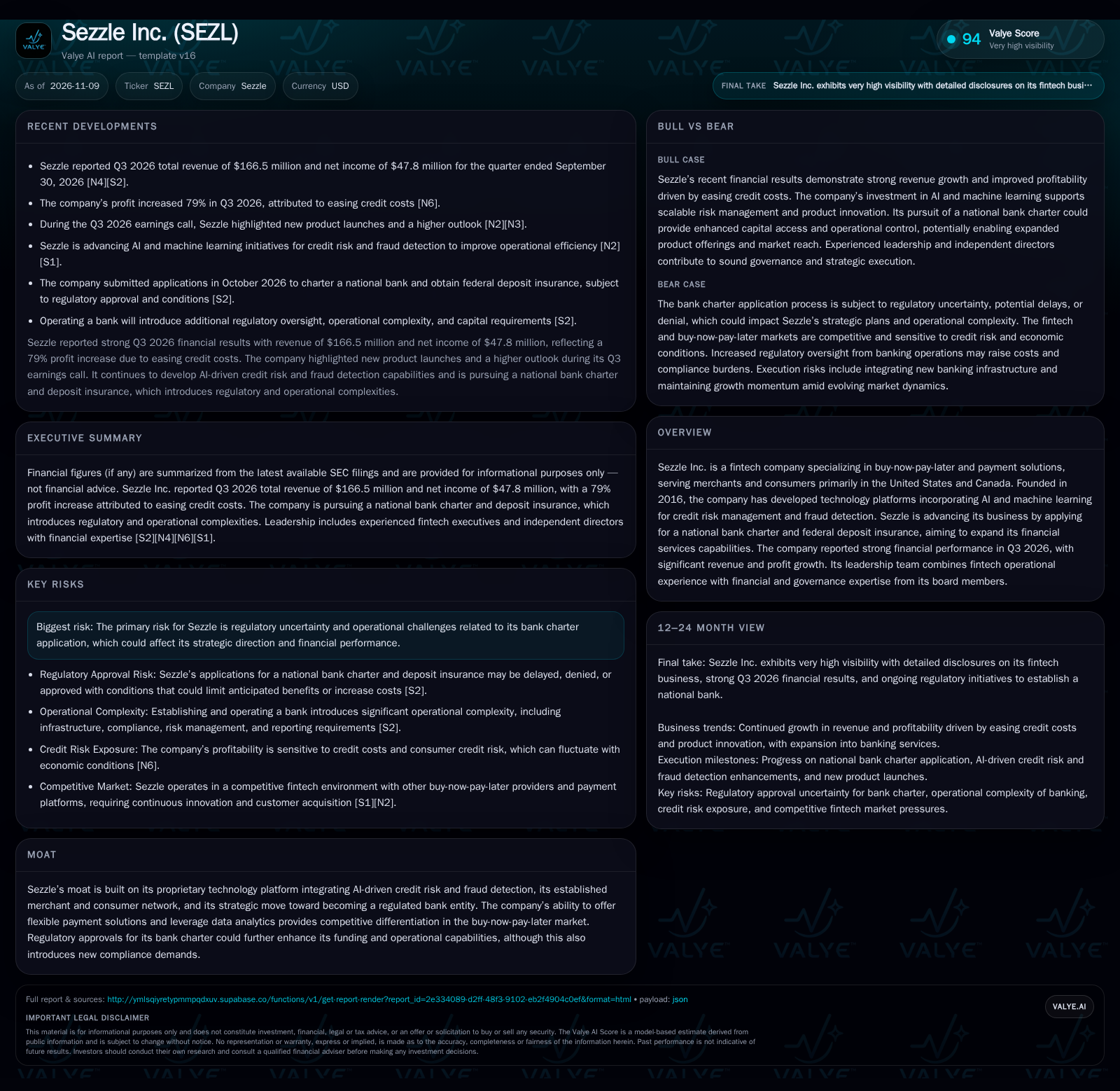
Sezzle’s strong Q3 2026 results—a 79% profit jump and $166.5 million in revenue—reflect easing credit costs and operational improvements. The company’s applications for a national bank charter and deposit insurance introduce new opportunities and risks, potentially transforming its funding model and regulatory obligations. Execution hinges on regulatory approval, ongoing credit risk management, and the ability to innovate in a highly competitive buy-now-pay-later landscape. [S2] [N4] [N6]
Sezzle Inc. is at a strategic inflection point: its Q3 2026 earnings showcased a dramatic 79% profit increase, supported by easing credit costs and operational gains. The company’s push to secure a national bank charter and federal deposit insurance could usher in a new era—potentially lowering funding costs, expanding its service offerings, and introducing regulatory rigor and complexity. The core question for investors is whether Sezzle can successfully transition from a nimble fintech to a regulated financial institution, leveraging its AI-driven risk management and merchant-consumer network to defend and grow its market position.
Sezzle’s Financial Inflection and Regulatory Pivot: The Latest Developments
Sezzle reported $166.5 million in revenue and $47.8 million in net income for Q3 2026, marking a 79% year-over-year profit increase, a surge largely attributed to easing credit costs. This performance reflects both underlying operational improvements and favorable macro credit trends. Meanwhile, the company submitted applications in October 2026 to charter a national bank and obtain federal deposit insurance, moves that—if approved—would place Sezzle under federal banking regulation and could enable more direct funding, new product development, and broader consumer reach. These twin developments—profit acceleration and the bank charter initiative—signal a potential transformation in both the economics and risk profile of the business. [S2] [N4] [N6]
How Sezzle Makes Money—and How Banking Could Reshape the Model
Sezzle’s core business model is built around buy-now-pay-later (BNPL) and payment solutions, earning revenue from merchant fees and, to a lesser extent, consumer charges. The economics depend on transaction volume, take rate (merchant discount rate), and effective management of credit and fraud risk. The company’s profitability is highly sensitive to credit costs: as Q3 2026 results demonstrated, improved credit conditions can rapidly expand margins. Variable costs scale with transaction volume, while technology, compliance, and risk infrastructure create a mix of fixed and semi-variable expenses.
If Sezzle’s bank charter and deposit insurance are approved, the funding model could shift dramatically. Rather than relying primarily on wholesale funding or external credit lines, Sezzle could accept deposits—potentially lowering its cost of capital and improving net interest margins. This would also enable a broader suite of financial products, such as savings accounts, debit cards, or integrated consumer banking, but would introduce new capital requirements, liquidity constraints, and regulatory compliance costs. The success of this pivot depends on whether Sezzle can achieve sufficient scale in deposit gathering to offset the fixed costs of banking operations and maintain underwriting discipline as its balance sheet grows.
Defending a Niche in a Crowded Fintech Arena
Sezzle operates in an intensely competitive segment, facing both pure-play BNPL providers and diversified payment platforms. Its competitive differentiation rests on proprietary AI-driven credit risk and fraud detection, a network of merchant and consumer partnerships, and the potential to become a regulated bank. However, the BNPL market is characterized by low switching costs for consumers and merchants, price-based competition, and frequent product imitation.
The move toward banking could create a structural moat if Sezzle can leverage deposit funding to underwrite risk more efficiently than non-bank rivals, or if it can cross-sell banking products to its existing user base. However, regulatory burdens and the need to build consumer trust as a bank may slow innovation and increase fixed costs. Incumbent banks and large fintechs with established deposit franchises represent formidable competition if they move aggressively into installment payments and embedded finance.
A Successful Bank Transition Could Unlock Margin Expansion and Product Innovation
In the most favorable scenario, Sezzle secures its bank charter and deposit insurance without onerous conditions, rapidly builds a deposit base, and uses its AI-driven risk management to minimize losses as it scales. Access to low-cost deposit funding enables improved net interest margins, while the ability to offer integrated banking products increases customer lifetime value and retention. The company continues to launch new products, leveraging data from both payments and banking activity to refine underwriting and cross-sell.
Evidence that would confirm this trajectory includes regulatory approval of the bank charter, rapid deposit growth, sustained or improved profitability even as the balance sheet expands, and positive customer adoption of new banking products. If disclosed, a rising proportion of revenue from interest income and banking fees would also support the thesis.
Staged Expansion with Regulatory Delays and Incremental Product Growth
The most plausible outcome is that Sezzle experiences a protracted bank charter approval process, with incremental progress but regulatory delays and additional compliance requirements. Core BNPL and payment operations remain the main revenue drivers, with profitability continuing to hinge on credit cost management and operational efficiency. The company gradually introduces new products, but banking-related revenue and cost savings materialize more slowly than hoped.
This scenario would be confirmed by continued strong performance in the legacy BNPL business, moderate growth in new product lines, and disclosures of ongoing regulatory engagement without full approval. Margins may improve modestly if credit costs remain low, but significant margin expansion would likely be deferred until full banking operations commence.
Regulatory Setbacks and Credit Headwinds Erode Momentum
A negative scenario would see Sezzle’s bank charter application delayed indefinitely or rejected, forcing the company to continue relying on higher-cost funding and limiting its product expansion ambitions. Simultaneously, a deterioration in consumer credit or a competitive price war could drive up losses and compress margins. Operational complexity and compliance costs could rise even without full bank status, straining profitability.
This outcome would be supported by regulatory communications indicating rejection or onerous approval conditions, rising credit losses or delinquency rates (if disclosed), and stagnant or declining profitability. If Sezzle is forced to abandon or scale back banking ambitions, investor focus would likely return to the sustainability of its core BNPL economics.
Thesis-Testing Benchmarks for Sezzle’s Fintech-Banking Crossover
Progress and outcome of the national bank charter and deposit insurance applications—regulatory milestones and any disclosed conditions or delays.
Growth and composition of funding sources: a useful metric would be the proportion of funding from deposits versus wholesale or other sources, if and when the bank is operational.
Credit performance trends, including delinquency rates and net charge-offs, especially if macroeconomic conditions worsen (if disclosed).
Adoption and revenue contribution of new products launched in 2026 and beyond—evidence of successful cross-sell or expanded wallet share.
Sustained improvement in profitability metrics, particularly net interest margins and operating leverage, as banking operations scale (if disclosed).
Customer acquisition, retention, and engagement rates for both core BNPL and any new banking products—would help test the stickiness of Sezzle’s ecosystem.
Compliance costs and operational expense trends as regulatory complexity increases—potential margin pressure points.
Competitive responses from incumbent banks and large fintechs, especially their willingness to subsidize BNPL or integrated banking offerings.
Disclaimer: This is research-only, informational analysis and not investment advice. It may include AI-generated interpretation and general industry context. Always verify important details using primary sources.

Comments