
ANI Pharmaceuticals: Acquisition Ambitions, Portfolio Complexity, and the Stakes of Integration Execution
With a broadened rare disease portfolio, active generics pipeline, and a major cross-border acquisition pending, ANI Pharmaceuticals faces a pivotal period where operational discipline, integration success, and risk management will determine whether its diversified strategy can deliver durable value.
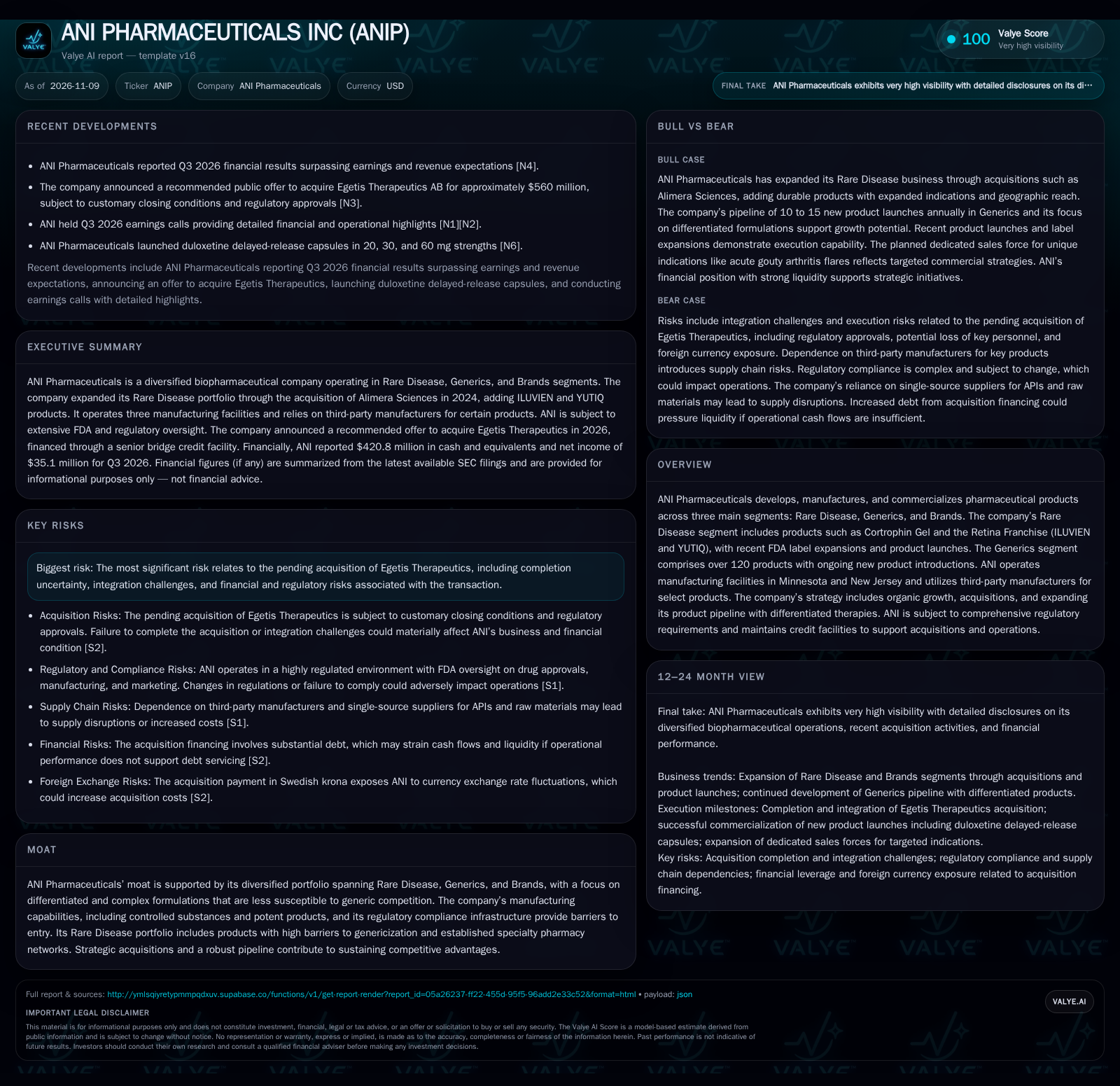
ANI Pharmaceuticals has recently expanded its rare disease portfolio through the Alimera acquisition and now aims to acquire Egetis Therapeutics for $560 million, financed by a large bridge facility. The company continues to launch new generics and branded products, while reporting strong Q3 2026 earnings and a reported current ratio. However, integration challenges, elevated leverage, supply chain dependencies, and complex regulatory/commercial execution in multiple geographies heighten both upside and downside optionality in the next 12–24 months. [S1] [S2] [N3] [N4]
ANI Pharmaceuticals stands at a strategic crossroads in late 2026, leveraging a multi-pronged approach across rare diseases, generics, and branded products. The company’s recent acquisitions and label expansions have set the stage for further growth, but the proposed $560 million acquisition of Egetis Therapeutics—financed by a sizable bridge loan—introduces new layers of integration complexity, regulatory exposure, and financial risk. With strong recent earnings and a robust generics pipeline, ANI’s next phase will be shaped by its ability to integrate new assets, manage debt, and sustain operational momentum in a highly regulated, competitive landscape.
Major Acquisition Push, Strong Quarter, and a Diversified Product Engine
ANI Pharmaceuticals has announced a recommended public offer to acquire Egetis Therapeutics AB for approximately $560 million, to be financed by a senior bridge credit facility of up to $676 million maturing in less than a year. This move comes on the heels of the recent Alimera Sciences acquisition, which brought ILUVIEN and YUTIQ into ANI's rare disease portfolio and expanded its geographic reach into Europe, Asia, and the Middle East. [N3] [S2]
Operationally, ANI reported Q3 2026 net income of $35.1 million and maintains a cash balance of $420.8 million, with a current ratio of 2.75 and cash ratio of 1.28. The company’s rare disease and brands business has seen expanded FDA labeling for ILUVIEN, a new prefilled syringe format for Cortrophin Gel, and ongoing generics launches such as duloxetine delayed-release capsules. [S1] [S2] [N4] [N6]
These developments position ANI as an increasingly diversified operator, but they also magnify the stakes around acquisition integration, financing risk, and operational execution across a more complex portfolio.
How ANI’s Product Mix and Expansion Shape Its Economic Engine
ANI’s business model is built on three segments—Rare Disease, Generics, and Brands—each with different economic profiles and risk-return dynamics. The rare disease franchise, anchored by products like Cortrophin Gel and ILUVIEN, typically commands higher gross margins due to limited competition and specialized distribution, but requires sustained investment in sales infrastructure, medical education, and market access. The FDA’s expanded labeling for ILUVIEN and introduction of a prefilled syringe for Cortrophin Gel create opportunities for further market penetration, but also increase promotional and compliance costs. [S1]
The generics business, comprising over 120 products and 10–15 new launches per year, offers scale and cash flow diversification but is exposed to intense price competition, periodic shortages, and customer concentration in the U.S. pharmacy supply chain. Margins in generics are structurally lower, and portfolio renewal is critical to fend off erosion from new entrants.
ANI’s capital structure is undergoing significant change as it layers on acquisition debt. The $676 million bridge facility for the Egetis deal, combined with the $325 million term loan from 2024, will materially increase leverage and interest expense. While the company’s current reported liquidity position, future free cash flow generation will need to keep pace with debt service and integration costs. The balance between fixed manufacturing overhead (three facilities) and variable third-party manufacturing adds operational flexibility but also exposes ANI to counterparty and supply chain risks. [S1] [S2]
Portfolio Differentiation, Supply Chain Vulnerabilities, and Market Dynamics
ANI’s competitive positioning benefits from a diversified product portfolio that includes both complex, differentiated rare disease therapies and a broad base of generics. In rare diseases, products like Cortrophin Gel (with new indications and formats) and the retina franchise (ILUVIEN, YUTIQ) are shielded from rapid genericization by formulation complexity, regulatory exclusivity, and specialty pharmacy networks. These factors can support pricing power and customer retention if the company continues to invest in clinical evidence and market access.
However, ANI’s reliance on third-party and single-source suppliers for APIs and finished goods—especially for high-value products—creates vulnerability to supply disruptions, regulatory actions, or quality issues. Competitors in the rare disease and specialty brands space include both large multinationals and focused biotechs, while the generics segment faces pressure from large global manufacturers and aggressive pricing from new entrants. The success of ANI’s strategy will depend on its ability to integrate acquired assets, maintain regulatory compliance, and defend its differentiated positions against both branded and generic substitutes. [S1]
Integration Synergies and Rare Disease Expansion Drive Outperformance
In a favorable scenario, ANI successfully closes and integrates the Egetis Therapeutics acquisition, leveraging its expanded rare disease portfolio and global footprint to accelerate revenue growth and margin expansion. Synergies could materialize from cross-selling in new markets, operational efficiencies in manufacturing and supply chain, and enhanced negotiating leverage with payers and distributors.
Confirmation of this scenario would come from rapid realization of Egetis revenue, above-plan uptake for products like ILUVIEN and Cortrophin Gel (especially in new indications such as acute gouty arthritis), and evidence of operating margin improvement despite elevated debt service. Additional upside could be unlocked if ANI delivers on its promise of 10–15 high-value generic launches annually and demonstrates sustained innovation in branded and specialty products.
Falsification would occur if integration costs overrun or if key personnel departures, regulatory setbacks, or supply disruptions erode the expected benefits from the Egetis and Alimera acquisitions.
Balancing Portfolio Growth with Integration and Debt Management
The most plausible outcome is that ANI completes the Egetis acquisition and gradually integrates the new business, while contending with a higher debt burden and the operational complexity of a larger, more geographically diverse portfolio. Revenue growth continues in rare diseases and generics, but is offset by incremental costs associated with integration, regulatory compliance, and commercial expansion.
Base case confirmation would include steady sequential revenue and earnings growth, continued successful product launches, and maintenance of compliance and supply continuity. Debt reduction and improved free cash flow conversion would indicate effective financial discipline.
This scenario would be challenged if integration drags on, if new launches face competitive pushback, or if regulatory or supply chain issues disrupt the product pipeline.
Integration Missteps and Financial Strain Undermine Growth Ambitions
A negative scenario would see ANI struggle to integrate Egetis, with delays, cost overruns, or regulatory hurdles eroding the anticipated revenue and synergies. The elevated debt load from the bridge facility could pressure cash flows, especially if operational disruptions or supply chain issues impact key products sourced from single suppliers.
Further downside could emerge if new product launches fail to achieve expected uptake, or if pricing and margin pressure in generics intensify beyond expectations. Regulatory or quality setbacks—whether in manufacturing, labeling, or post-market surveillance—could trigger additional costs, product withdrawals, or reputational damage.
Evidence for this scenario would include missed earnings or revenue targets, negative free cash flow, persistent integration challenges, covenant breaches, or supply interruptions impacting flagship products.
What Will Prove ANI’s Integration and Portfolio Expansion Thesis
Progress and closing timeline for the Egetis Therapeutics acquisition, including regulatory approvals and financing drawdown.
Integration milestones post-acquisition—evidence of successful product transfer, retention of key personnel, and realization of cost or revenue synergies.
Revenue growth and market share trends for newly acquired rare disease assets (ILUVIEN, YUTIQ) and for Cortrophin Gel, especially in expanded or new indications.
Execution and uptake of the dedicated sales force for acute gouty arthritis flares—prescription volume, formulary wins, and payer adoption if disclosed.
Pace and profitability of generics launches (10–15 annually)—a useful metric would be gross margin contribution by new launches if disclosed.
Supply chain resilience—incidence of API or finished product shortages, delays, or regulatory warnings relating to third-party or single-source suppliers.
Net leverage and free cash flow trends post-acquisition; ability to refinance or pay down the bridge facility without equity dilution or covenant stress.
Regulatory compliance status—any warning letters or 483 observations impacting core manufacturing sites or critical third-party partners.
Disclaimer: This is research-only, informational analysis and not investment advice. It may include AI-generated interpretation and general industry context. Always verify important details using primary sources.

Comments