
Expedia 2026: AI Initiatives, Platform Dynamics, and Regulatory Impact
Expedia’s Q3 2026 beat and raised guidance signal operational momentum, but the platform’s heavy technology bets and exposure to evolving regulations in alternative accommodations introduce new layers of risk and opportunity.
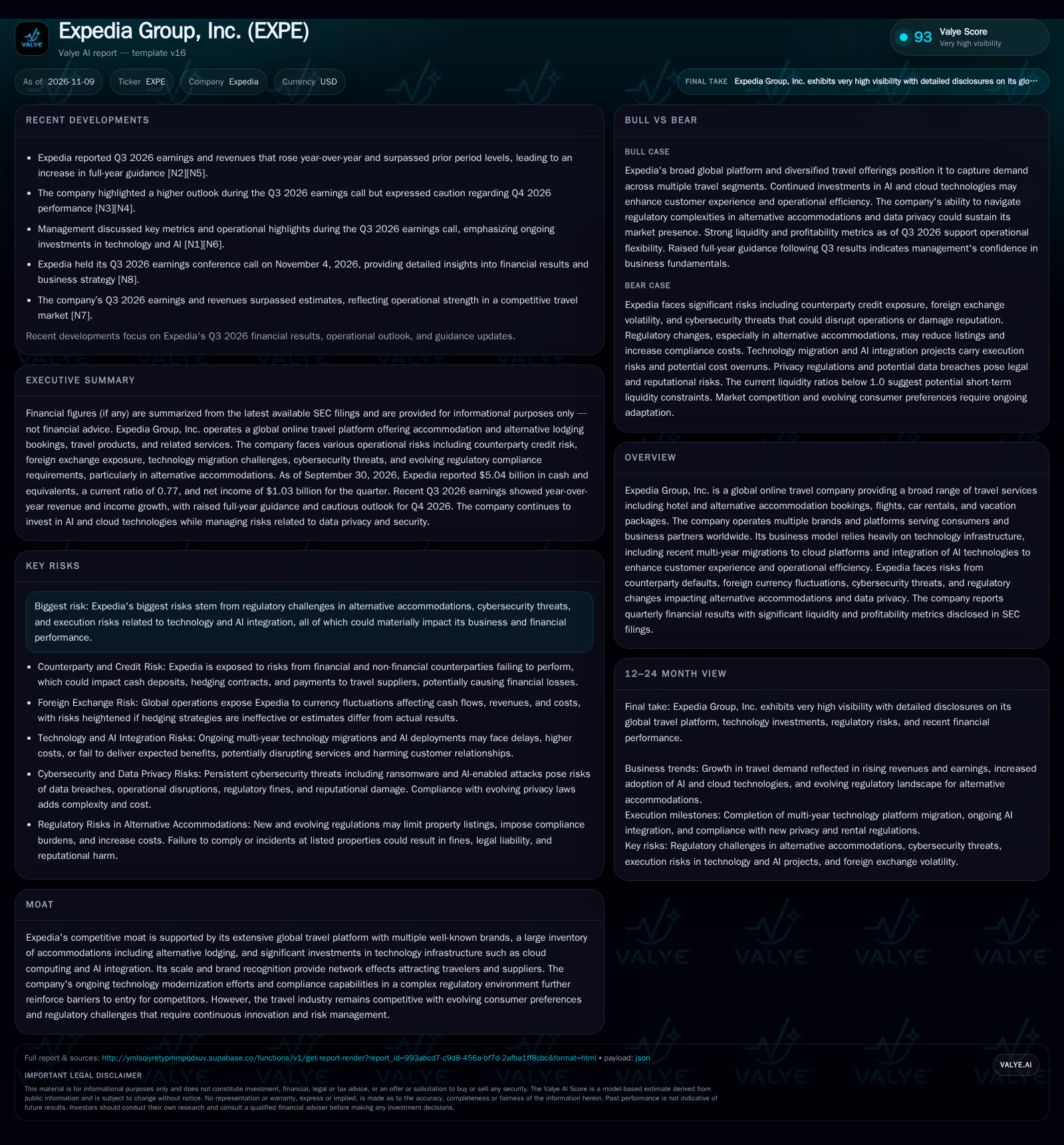
Expedia posted strong Q3 2026 earnings with a raised full-year outlook, reflecting operational strength and technology-driven momentum. However, the company’s reported current ratio and exposure to regulatory shifts in alternative accommodations highlight persistent vulnerabilities. The next phase will test whether Expedia’s technology investments and diversified platform can deliver sustainable growth amid shifting industry forces. [N2] [N5] [N3] [S2]
Expedia’s robust Q3 2026 results and upwardly revised guidance underscore the platform’s ability to capture travel demand in a competitive digital landscape. The next 12-24 months will reveal whether Expedia’s AI and cloud strategies can translate into enduring competitive advantage—or if mounting external risks will erode recent gains.
Q3 2026 Results and Emerging Strategic Themes
Expedia reported Q3 2026 earnings and revenues that surpassed both year-over-year and prior period levels, resulting in a raised full-year guidance. Net income for the quarter reached $1.03 billion, with basic EPS of $8.59 and diluted EPS of $8.42. These results reflect operational strength and market momentum in the travel sector. [N2] [N5] [S2]
While the company held $5.04 billion in cash and equivalents, its current assets ($14.19 billion) were notably below its current liabilities ($18.37 billion). [S2]
Management’s raised guidance after Q3 was tempered with caution for Q4 2026, highlighting both optimism and heightened sensitivity to near-term operational and macroeconomic risks. [N3] [N4]
The Mechanics of Expedia’s Travel Demand Monetization
Expedia’s core business model aggregates travel inventory—hotels, alternative accommodations, flights, car rentals, and vacation packages—across multiple branded platforms. Revenues are primarily generated through commissions, service fees, and, for some segments, merchant margins on bundled offerings. The company’s scale enables it to negotiate favorable terms with suppliers and leverage cross-brand marketing and loyalty programs to drive repeat bookings.
Technology investment is a major cost center, as Expedia continues a multi-year migration to cloud infrastructure (notably AWS) and integrates AI to improve both the consumer experience and back-office efficiency. These investments aim to boost conversion rates, reduce manual overhead, and enable dynamic pricing and personalized recommendations. If AI improves booking funnel efficiency or reduces fraud, operating leverage could increase.
Fixed costs include platform maintenance, technology R&D, and compliance, while variable costs track closely with transaction volumes (marketing, payment processing, supplier payments). Operating leverage is possible if technology modernization yields efficiencies or if higher-margin alternative accommodations grow as a share of mix. However, increased compliance and regulatory costs—especially in alternative accommodations—could offset some of these gains, particularly as new EU laws take effect in 2026.
A deeper understanding of Expedia’s monetization mechanics requires examining the interplay between consumer behavior shifts and technology adoption. For instance, AI-driven personalization can segment customers more granularly, allowing for tailored marketing spend that optimizes acquisition costs and maximizes lifetime value. However, the effectiveness of these tools is conditional on data quality, privacy regulation compliance, and algorithmic transparency. If consumer trust erodes due to perceived privacy intrusions or algorithmic bias, conversion improvements may be muted despite technical capabilities. Additionally, the elasticity of demand in travel bookings implies that even small improvements in user experience can disproportionately impact booking volumes, but this sensitivity varies by region and travel segment, requiring nuanced deployment of AI features.
Evaluating Platform Reach Amidst Competition and Regulation
Expedia’s competitive position is anchored in its global platform, multi-brand reach, and breadth of inventory, including both traditional hotels and alternative accommodations. This breadth allows Expedia to serve a wide range of travelers and capture value across the travel funnel. Its technology investments (cloud migration, AI) are intended to keep the platform agile and responsive amid fast-changing consumer expectations.
Key competitive threats come from other large online travel agencies (OTAs), direct supplier channels (hotels/airlines investing in their own digital platforms), and specialized short-term rental platforms. Technology-driven differentiation—such as superior personalization, seamless cross-brand loyalty integration, or unique inventory—could help Expedia defend share, but such advantages are often rapidly commoditized.
Regulatory pressure is intensifying, especially in the alternative accommodations segment. The new EU Short-Term Rental Law (effective May 2026) and similar global trends may reduce available listings, raise compliance costs, and shift market power toward platforms with robust compliance infrastructure. Expedia’s ability to absorb these costs or pass them on to hosts will be tested, as smaller platforms may exit but larger players face higher regulatory scrutiny.
Potential Gains from Accelerated Tech Modernization
A favorable scenario would see Expedia’s cloud migration and AI integration meaningfully improving platform conversion, lowering customer acquisition costs, and enabling dynamic pricing that lifts take rates. If technology investments drive operating leverage and regulatory costs in alternative accommodations are contained—or even lead to rationalized competition—Expedia could expand margins and grow share.
Confirmation would come from sustained year-over-year revenue and income growth exceeding industry averages, improving gross and operating margins, and continued upward revisions to full-year outlooks. Evidence would also include stable or increasing alternative accommodation listings despite new regulations, and disclosures attributing performance gains to AI-driven personalization or cost efficiencies.
Falsification would be seen if technology costs balloon without corresponding margin improvement, or if regulatory headwinds lead to shrinking supply and stagnant or declining revenues in alternative accommodations.
Managing Growth Amid Operational and Regulatory Challenges
The most likely outcome is that Expedia continues to post moderate revenue and earnings growth, supported by travel demand and incremental gains from technology modernization. However, regulatory compliance costs in alternative accommodations and ongoing cybersecurity and privacy investments will weigh on margins, partially offsetting technology-driven efficiencies.
Performance would likely track with the broader travel sector, with periodic volatility due to macroeconomic shocks, regulatory developments, or competitive actions. Confirmation would be quarterly results that show steady—but not accelerating—growth, stable alternative accommodation supply, and margin improvement roughly in line with peers.
Falsification would occur if compliance costs or regulatory restrictions in major markets escalate faster than Expedia can adapt, leading to declining listings or margin compression.
Risks from Regulatory Pressures and Cybersecurity Threats
In a negative scenario, regulatory changes in key geographies (such as the EU) sharply reduce alternative accommodation listings and drive up compliance costs, eroding one of Expedia’s core growth segments. Simultaneously, execution missteps in technology migration—or a major cybersecurity incident—could disrupt platform reliability or damage brand reputation.
This scenario could be confirmed by declining alternative accommodation inventory, rising legal and compliance expenses, or a publicized data breach. Additional warning signs would include downward revisions to guidance, missed earnings, or the need to raise capital to cover short-term obligations if liquidity tightens further.
If Expedia’s technology investments fail to generate operating leverage, or if regulatory and cyber risks translate into sustained margin pressure or market share loss, downside pressures could accelerate.
Factors Influencing Expedia’s Market and Regulatory Position
Quarterly trends in alternative accommodation listings, especially in regions affected by new short-term rental regulations, would help test Expedia’s ability to adapt its supply base.
Gross margin and operating margin progression, particularly in relation to disclosed technology and compliance investments, would clarify whether AI and cloud migration are yielding expected efficiencies.
Updates on technology migration milestones (such as completion of cloud migration or specific AI feature rollouts) would indicate progress toward operational goals.
The pace and magnitude of compliance cost increases for alternative accommodations—if disclosed—would reveal regulatory impact.
Incidence and severity of cybersecurity events, along with related remediation costs or regulatory fines, would test operational resilience.
Management commentary or disclosures attributing revenue or margin gains to technology-driven initiatives would support the upside scenario.
The presence of any material legal or regulatory settlements, or new market restrictions, would signal escalated external risk.
Disclaimer: This is research-only, informational analysis and not investment advice. It may include AI-generated interpretation and general industry context. Always verify important details using primary sources.

Comments