
Southern Company 2026: Regulated Utility Visibility, Transition Pressures, and the Stakes of Energy Mix Evolution
The next phase hinges on execution of rate recovery, resource transition, and management strategy amid evolving policy and market dynamics.
Execution on rate cases, project delivery, and GHG targets will decide whether the company sustains its stable profile or faces margin compression and capital strain.
Southern Company’s 2026 results underscore the enduring power of the regulated utility model—steady cash flows anchored by state-approved rates and a diversified portfolio spanning electric, gas, and renewable assets.Yet beneath the surface, the company faces a shifting landscape: liquidity pressure from a reported current ratio, escalating regulatory and decarbonization demands, and the operational complexities of integrating new energy resources. As Southern Company leans further into renewables and navigates management transition, the durability of its rate recovery mechanisms and execution on capital projects will determine whether it can maintain its historical stability or faces a new era of margin and capital risk.
2026 Snapshot: Above-Estimate Earnings, Renewables Growth, and Liquidity Constraints
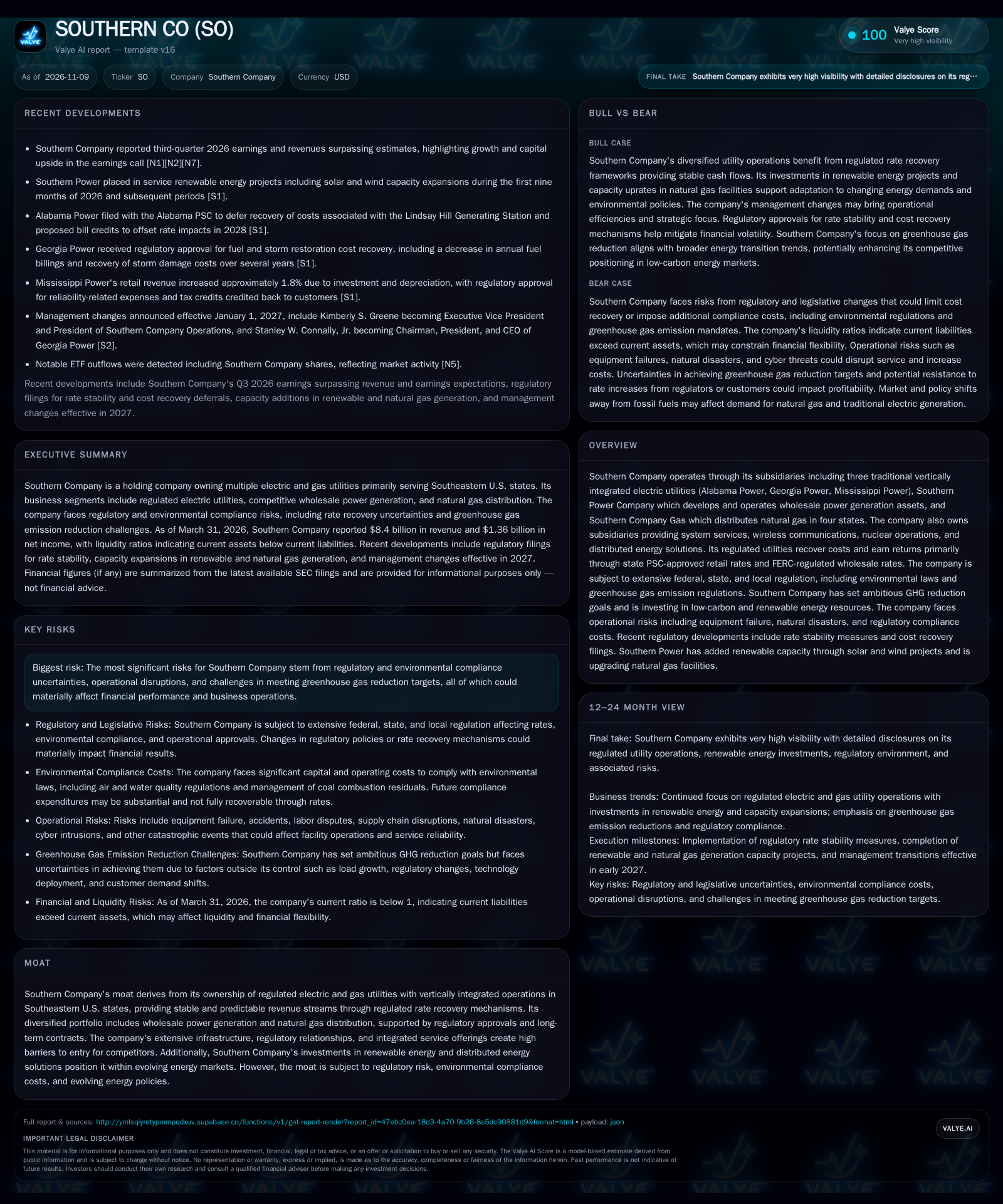
In Q3 2026, Southern Company reported earnings and revenues that exceeded analyst expectations, with management highlighting both growth and capital upside during the earnings call [N1] [N2] [N7]. This outperformance was supported by new renewable energy projects placed in service by Southern Power and capacity uprates at natural gas facilities [S1]. Regulatory approvals across core subsidiaries allowed for recovery of fuel and storm restoration costs, as well as modest retail revenue increases, which provided a buffer against input cost volatility and storm-related expenses [S1]. [S2] This dynamic sets the stage for both resilience and risk as Southern Company pursues its decarbonization and capital investment agenda.
How Southern Company’s Vertically Integrated Model Generates Cash—and Where the Pressure Points Emerge
Southern Company’s primary cash engine is its trio of regulated, vertically integrated electric utilities—Alabama Power, Georgia Power, and Mississippi Power—which earn allowed returns on invested capital through state PSC-approved retail rates. These rates are periodically reset to allow for recovery of operating expenses, capital investments, fuel costs, and storm restoration outlays. This structure creates a high degree of revenue predictability and insulation from commodity price swings, provided regulators permit timely and sufficient cost recovery.
The company supplements this core with Southern Power, which develops and operates wholesale generation assets (including renewables and gas) and sells power at market-based rates, and Southern Company Gas, whose distribution utilities recover costs and earn returns through similar regulatory regimes in four states. The economics of wholesale operations are more exposed to market pricing and contract renewal risk, while the gas business faces both regulatory and volume-driven variability.
Capital intensity is a defining feature: Southern must continually invest in generation, grid, and environmental compliance, with the ability to earn on these investments hinging on regulatory approval. Operating leverage is moderate—labor, fuel, and maintenance are variable, but depreciation and interest costs are substantial and largely fixed in the short term.
Regulatory Moats, Market Shifts, and the Erosion Risk from Energy Transition
Southern Company’s most defensible advantage is its entrenched position as the regulated provider of electric and gas service in key Southeastern states—a functionally monopolistic setup underpinned by regulatory rate recovery, long-lived infrastructure, and deep local relationships. This creates high barriers to entry, as new competitors must overcome both regulatory hurdles and the massive capital requirements of duplicating transmission, distribution, and generation assets.
However, the durability of this moat is increasingly tested by several forces. First, decarbonization policies and customer demand for cleaner energy are driving both regulatory mandates and competitive pressure from independent renewable developers, distributed energy providers, and demand-side technologies. Second, electrification trends and evolving grid needs may require more flexible, modular, and digital approaches, where Southern’s legacy asset base could become a liability if not managed proactively.
Peer utilities and energy conglomerates—ranging from other regional regulated utilities to national renewable developers—compete on execution, regulatory finesse, and the pace of resource transition. Southern’s ability to maintain its relative advantage depends on regulatory trust, execution on capital projects, and the speed at which it can pivot its generation mix without impairing returns or reliability.
If Regulatory Support Holds and Renewable Execution Accelerates, Southern Could Sustain Premium Stability
In a favorable scenario, Southern Company secures ongoing regulatory approval for timely rate recovery of both legacy and new capital expenditures—including renewables, grid upgrades, and environmental compliance. The company successfully delivers new renewable projects and gas capacity uprates on time and within budget, capturing allowed returns and mitigating input cost volatility. Management transitions in 2027 bring operational discipline and strategic focus, enabling Southern to meet its GHG reduction targets without sacrificing earnings or reliability.
Upside confirmation would come from continued outperformance versus earnings guidance, evidence of constructive rate case outcomes, declining carbon intensity per MWh, and rising allowed returns on equity.Further, if Southern is able to maintain strong access to capital markets despite its reported current ratio, and if customer and regulatory sentiment remains favorable toward cost recovery for the energy transition, the company could preserve its status as a low-volatility, yield-oriented utility with incremental growth from renewables.
Most Plausible Trajectory: Incremental Progress with Persistent Frictions and Tradeoffs
The most likely outcome is a continuation of Southern’s core strengths—steady regulated earnings, incremental renewables growth, and periodic regulatory negotiations—tempered by persistent cost, liquidity, and execution frictions. The company will likely achieve gradual decarbonization of its generation fleet, but at the cost of higher capital spending and complex resource planning. Regulatory support for cost recovery generally holds, but not without delays, disallowances, or constraints on allowed returns in certain jurisdictions.
Under this scenario, the company’s liquidity remains manageable but tight, requiring disciplined capital allocation and ongoing access to both debt and equity markets. Margin pressure could emerge if operating costs, compliance expenses, or project overruns outpace allowed recovery. Confirmation would come from stable but unremarkable EPS growth, a steady pace of renewable additions, and periodic but not severe regulatory pushback. Falsification would occur if a major rate case is denied, a large project materially overruns, or Southern loses access to favorable capital market terms.
When Regulatory or Market Shocks Collide with Tight Liquidity, Margin Compression and Capital Strain Follow
In a negative scenario, regulatory support for cost recovery weakens—whether due to political pressure, customer pushback on rate increases, or more aggressive environmental mandates. Southern could face partial or delayed recovery of major capital or compliance expenditures, leading to earnings volatility and potential credit concerns. Project execution missteps—such as cost overruns or delays in renewable or gas facility builds—could further erode returns and stretch the balance sheet.
Downside confirmation would include a material regulatory disallowance, credit rating downgrade, sharply negative free cash flow, or a spike in short-term borrowing costs. Falsification would require evidence of robust capital market access and consistent regulatory support even in the face of adverse developments.
What Will Decide Southern Company’s Next Chapter? Concrete Tests for Stability, Transition, and Growth
Pace and cost of new renewable generation and battery storage projects placed in service—timely completion and budget discipline would support the thesis; overruns would undermine it.
Outcomes of major rate cases and regulatory filings across Alabama, Georgia, and Mississippi, especially regarding capital recovery, storm cost deferrals, and fuel adjustments.
Progress toward GHG reduction milestones, including carbon intensity per MWh and share of generation from renewables—if disclosed.
Earnings guidance and actuals versus consensus, particularly in the wake of major weather events or regulatory changes.
Execution on management transition effective January 2027 and any shifts in strategic direction or capital allocation priorities.
Customer sentiment and political developments affecting regulatory environments in core Southeastern states.
Access to capital markets and terms of new debt or equity issuance—deterioration would signal balance sheet risk.
Disclaimer: This is research-only, informational analysis and not investment advice. It may include AI-generated interpretation and general industry context. Always verify important details using primary sources.

Comments