
U.S. Bancorp 2026: Capital Markets Expansion, Leadership Transition, and the Stakes of Diversified Banking at Scale
U.S. Bancorp seeks to deepen its capital markets presence through the pending BTIG acquisition, while managing leadership turnover and competing across traditional and digital banking channels. The firm’s diversified revenue base, physical and digital footprint, and regulatory discipline shape its resilience, but integration risks, fintech competition, and operational complexity remain central to its future trajectory.
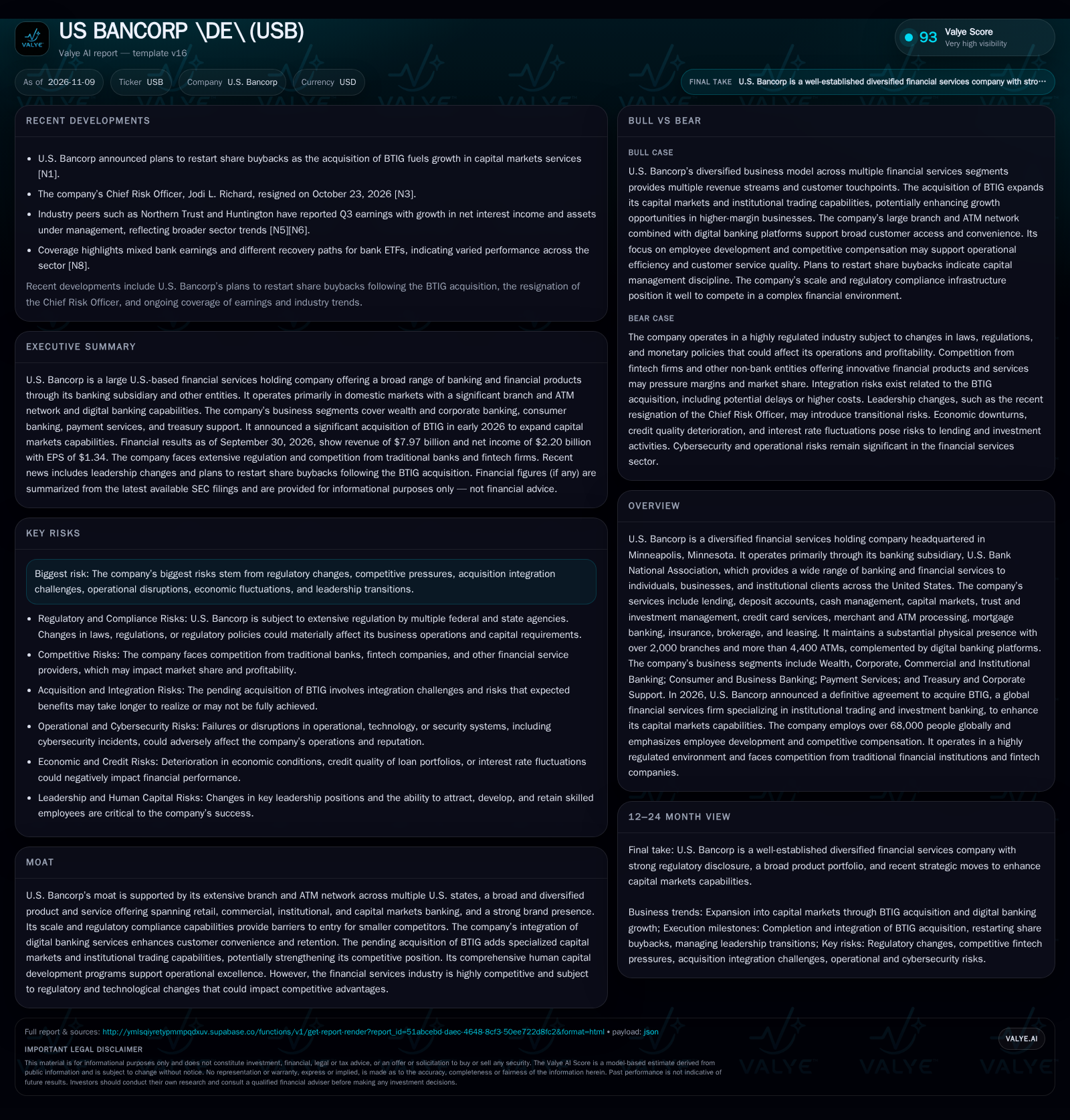
As of late 2026, U.S. Bancorp is leveraging its nationwide branch network and digital channels while planning the acquisition of BTIG to enhance capital markets capabilities. Recent leadership transition and a commitment to resume share buybacks highlight both opportunity and operational risk. The company’s broad business mix offers revenue stability, but success will depend on effective integration, regulatory navigation, and adaptation to rising fintech competition. [S2] [N1] [N3]
U.S. Bancorp enters the final months of 2026 at a strategic crossroads. The firm is set to acquire BTIG, a move that could significantly deepen its capital markets capabilities, while also navigating a major leadership transition with the resignation of its Chief Risk Officer. Recent financial results highlight the resilience of its diversified business model, but the coming quarters will test the company’s ability to integrate new operations, manage risk under evolving leadership, and defend its position against both traditional rivals and fast-moving fintech challengers. The outcome will be shaped by how effectively U.S. Bancorp leverages its scale, digital reach, and regulatory expertise to adapt to a rapidly shifting industry landscape. [S2] [N1] [N3]
Strategic Moves and Leadership Changes Shape the 2026 Landscape
U.S. Bancorp’s 2026 operating context is defined by three pivotal developments: the January agreement to acquire BTIG for up to $1 billion, the resignation of Chief Risk Officer Jodi L. Richard on October 23, and a stated intention to resume share buybacks. The BTIG deal signals a material push into institutional trading, investment banking, and global brokerage, potentially diversifying USB’s earnings beyond its traditional strengths in lending, payments, and consumer banking. Leadership turnover in the risk function introduces uncertainty at a moment of heightened regulatory scrutiny and operational complexity. The return of share buybacks, meanwhile, suggests management’s confidence in capital strength even as the company absorbs new business lines and integration risk. These moves collectively position U.S. Bancorp at a strategic inflection point, where execution on integration, risk management, and capital allocation will drive near-term investor and regulatory scrutiny. [S2] [N1] [N3]
How U.S. Bancorp’s Diversified Revenue Model Drives Profitability
U.S. Bancorp generates revenue across four major segments: Wealth, Corporate, Commercial and Institutional Banking; Consumer and Business Banking; Payment Services; and Treasury and Corporate Support. This diversification buffers the company from shocks in any single segment, with income streams ranging from interest margin on loans and deposits, to fee-based revenues in payments, capital markets, and asset management.
The pending BTIG acquisition, if closed, could shift the company’s mix further toward fee-based, transaction-driven businesses—potentially reducing sensitivity to net interest margin compression but increasing exposure to market volatility and deal flow cycles. The cost base is split between fixed infrastructure—over 2,000 branches, 4,400+ ATMs, and a substantial digital platform—and variable costs related to personnel, compliance, and technology. Operating leverage is achievable when loan growth, payments volume, or capital markets activity rise, but the capital intensity of banking (driven by regulatory capital requirements) limits the degree to which incremental revenue drops to the bottom line.
Funding is primarily through core deposits, which are relatively low-cost but can be sensitive to rate competition and shifts in consumer behavior. The company’s capital management, including the planned resumption of share buybacks, must balance regulatory requirements, integration costs, and organic growth needs. The need to invest in technology, cybersecurity, and compliance remains a structural fixed cost in the modern banking landscape.
Competing on Scale, Digital Reach, and Product Breadth—But Facing Fintech Disruption
U.S. Bancorp’s competitive position is underpinned by its extensive branch and ATM presence, broad product offering, and established regulatory capabilities. This scale enables cross-selling, brand trust, and a large deposit base, but also creates complexity and slower adaptation cycles relative to digital-native competitors.
The company faces direct competition from other national and super-regional banks, as well as an increasingly aggressive cohort of fintechs and digital-first banks offering streamlined credit, payments, and investment platforms. Fintechs can attack high-margin niches and attract digitally savvy customers with lower friction and faster innovation. U.S. Bancorp’s ongoing investment in digital banking is a defensive and offensive response, aiming to retain core retail and small business customers while expanding into higher-value advisory and capital markets services through acquisitions like BTIG.
Regulatory compliance is both a barrier to entry for smaller rivals and a source of cost disadvantage versus lightly regulated fintechs. The question is whether U.S. Bancorp’s combination of physical scale, digital engagement, and product breadth will be enough to maintain share as customer expectations and technology evolve.
If Integration Succeeds, Fee Income Rises, and Digital Initiatives Deliver
In a favorable scenario, U.S. Bancorp successfully integrates BTIG, expanding its institutional client base and capital markets revenue. This would diversify and grow fee income, making overall results less dependent on net interest income and traditional lending spreads. Strong execution in digital banking could further lower customer acquisition costs, improve retention, and enable cross-selling of higher-margin services.
Share buybacks in this context would signal surplus capital generation and management confidence, supporting shareholder returns. Evidence confirming this scenario would include rapid growth in non-interest income, stable or improved efficiency ratios despite integration costs, and digital engagement metrics showing increased transaction volume and customer satisfaction. Successful retention of BTIG leadership and key clients, as well as minimal regulatory or operational hiccups during the transition, would further validate the upside case.
Expecting Steady Core Banking with Incremental Capital Markets Impact
The most plausible trajectory is for U.S. Bancorp to maintain stable performance in its core segments, with the BTIG acquisition contributing gradually as integration progresses. Lending, deposits, and payment services remain the primary revenue drivers, while capital markets and institutional services grow but do not transform the company’s overall economics in the near term.
Regulatory and integration costs offset some of the benefits, and leadership transition in the risk function requires close management attention. Evidence supporting this scenario would be continued resilience in net interest income and fee revenue, steady efficiency ratios, moderate growth in digital adoption, and no major risk management incidents following the CRO transition. Any delays or underperformance in the BTIG integration would keep the overall business mix anchored to legacy strengths.
Integration Stumbles or Leadership Gaps Expose Risk, Eroding Profitability
A more adverse outcome could result if U.S. Bancorp encounters significant challenges integrating BTIG—such as client attrition, cultural clashes, or regulatory delays—while simultaneously managing the disruption from its Chief Risk Officer’s resignation. Failure to maintain robust risk oversight could lead to operational missteps, compliance lapses, or unexpected losses, particularly as the company expands into more volatile capital markets activities.
Rising competition from fintechs, combined with potential economic or credit deterioration, could further pressure margins and asset quality. Evidence pointing to this scenario would include a spike in non-performing assets, unexpected regulatory penalties, worsening efficiency ratios, or a sharp increase in technology or integration expenses. Loss of key BTIG personnel or major client defections would also be confirmatory.
Milestones and Metrics That Will Test U.S. Bancorp’s Strategic Evolution
Progress toward closing and integrating the BTIG acquisition, including regulatory approvals, retention of key personnel, and client migration metrics.
Trends in non-interest income, especially from capital markets, institutional services, and payment processing, as an indicator of successful business mix diversification.
Digital banking adoption rates and transaction volumes, if disclosed, to gauge the effectiveness of technology investments in defending and expanding customer relationships.
Net interest margin trends and loan/deposit growth as core banking performance signals amid macro and competitive pressures.
Risk and compliance incident reports, including any regulatory findings or operational disruptions following the CRO transition.
Efficiency ratio movements, particularly post-acquisition, as a test of cost discipline and integration execution.
Employee turnover rates, especially in risk, technology, and newly acquired capital markets teams, as a proxy for organizational stability.
Dividend and buyback activity, if resumed, and any explicit management commentary on capital allocation priorities.
Disclaimer: This is research-only, informational analysis and not investment advice. It may include AI-generated interpretation and general industry context. Always verify important details using primary sources.

Comments