
WaterBridge Infrastructure: Delaware Basin Leverage, Producer Exposures, and the Economics of Produced Water Management
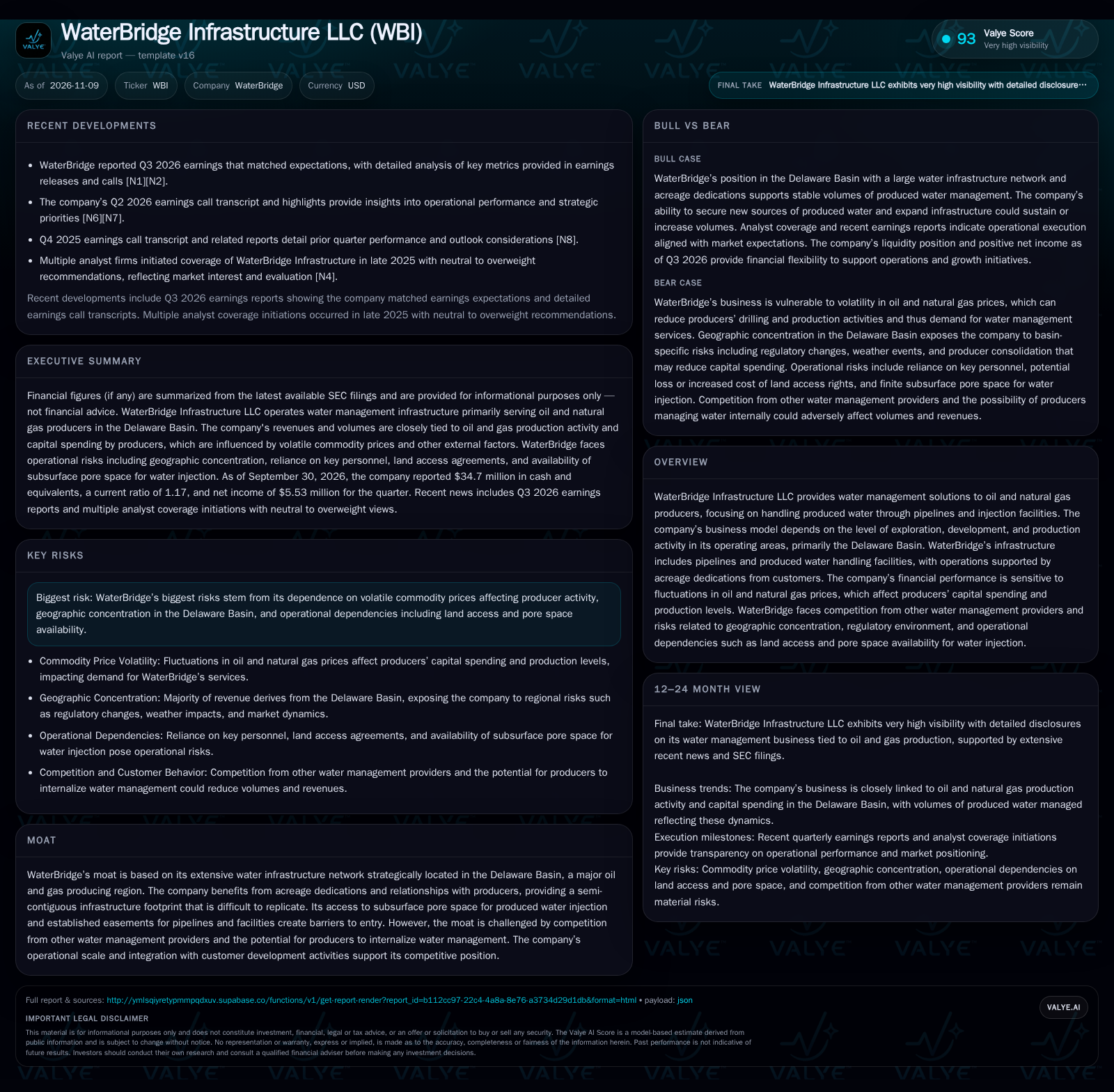
WaterBridge Infrastructure’s Q3 2026 results confirm operational execution amidst volatile oil and gas markets, but the company’s fortunes remain tightly linked to producer activity in the Delaware Basin. Its infrastructure footprint, acreage dedications, and subsurface rights offer scale advantages—yet geographic and commodity concentration, regulatory dependencies, and the risk of producer self-management keep the long-term risk/reward profile finely balanced.
The company’s revenues remain highly sensitive to oil and gas production in the Delaware Basin, with competition and operational dependencies presenting ongoing risks. Its moat is grounded in infrastructure scale and acreage dedications, but long-term value will hinge on producer activity, regulatory shifts, and the evolution of water management practices in upstream energy.
WaterBridge Infrastructure LLC stands at the intersection of critical energy infrastructure and upstream production cycles, managing produced water for oil and gas operators in the Delaware Basin. However, WaterBridge’s fate is tightly coupled to the volatility and capital discipline of its producer customers. Its competitive position rests on infrastructure scale, acreage dedications, and access to critical pore space for water injection, but the business model’s durability will be tested as oilfield water management evolves, regulatory risks mount, and producers seek efficiency—potentially through in-house solutions or alternative providers.
Recent Earnings and the Strategic Importance of Producer Activity
WaterBridge reported Q3 2026 net income of $5.53 million, with basic and diluted EPS of $0.10, and cash and equivalents of $34.7 million as of September 30, 2026. The company’s current assets stood at $307.9 million against current liabilities of $263.1 million, yielding a current ratio of 1.17 and a cash ratio of 0.13 [S2] [N1] [N2]. These results matched analyst expectations and provided evidence of operational steadiness amid fluctuating commodity markets. However, the company’s revenue stream is fundamentally tied to oil and gas production activity in the Delaware Basin—a region experiencing its own cycles of boom and retrenchment. Recent analyst coverage, ranging from neutral to overweight, reflects both the stability of WaterBridge’s core operations and the recognized risks from commodity volatility and geographic concentration [N4].
How WaterBridge Monetizes Produced Water: Volume, Pricing, and Capital Intensity
WaterBridge’s business model is built around transporting and handling produced water—wastewater generated during oil and gas extraction—via pipelines and injection facilities. Revenue is largely a function of volumes handled for upstream producers, with pricing typically negotiated through service agreements that may be indexed to throughput or acreage dedications. While these contracts can provide a degree of revenue visibility, actual volumes and thus revenues are ultimately dictated by producer drilling and completion activity, which in turn depend on oil and gas prices.
The economics of WaterBridge’s infrastructure are characterized by high upfront capital investment (pipelines, pumps, disposal wells) and relatively low variable costs per incremental barrel once facilities are in place. This creates operating leverage: incremental volumes can drive outsized EBITDA and margin expansion if fixed infrastructure is well-utilized. However, this leverage cuts both ways—underutilization, whether from a downturn in drilling or customer loss, can quickly compress margins and impair returns on invested capital. Ongoing capital needs also include maintenance, compliance, and periodic expansion to secure new acreage or pore space, making access to financing and disciplined capital allocation essential for long-term sustainability.
Infrastructure Footprint and Acreage Dedications: Durable Advantages or Vulnerable Assets?
WaterBridge’s competitive position in the Delaware Basin is underpinned by its extensive network of pipelines, disposal wells, and handling facilities, all supported by acreage dedications from oil and gas producers. These dedications can lock in volumes and create semi-contiguous infrastructure footprints that are costly and time-consuming for rivals to replicate. Additionally, its access to subsurface pore space for water injection is a critical asset—regulatory, geological, and permitting hurdles often make new disposal capacity hard to secure.
However, these advantages are not absolute. Competition from other third-party water management providers remains significant, especially as producers seek to optimize costs. The potential for large producers to internalize water management—building their own pipelines or disposal wells—also threatens long-term volume commitments. Geographic concentration in the Delaware Basin exposes WaterBridge to basin-specific regulatory, weather, and consolidation risks, while the company’s reliance on land access agreements and surface easements introduces operational uncertainty if agreements are not renewed or challenged. The question is whether WaterBridge’s scale and embedded infrastructure will deter substitution over the medium term, or whether customer bargaining power and changing producer strategies will erode its position.
What Would Drive Sustained Volume Growth and Margin Expansion?
The most favorable scenario for WaterBridge involves a sustained upcycle in Delaware Basin oil and gas production, driven by robust commodity prices and increased drilling activity. In this environment, producers would maximize throughput on existing wells and expand into new acreage, directly lifting WaterBridge’s handled volumes and driving improved utilization of its fixed infrastructure. This would enable operating leverage, with incremental revenue translating into higher margins and free cash flow.
Confirmation of this scenario would come from sequential volume growth, increased contract wins or acreage dedications, and positive revisions to producer drilling budgets. Evidence would also include regulatory stability in the Delaware Basin (facilitating new well permitting and water disposal), as well as signs that major producers are renewing or expanding third-party water management agreements rather than insourcing. Conversely, a lack of volume growth, shrinking acreage dedications, or a trend toward in-house water management would undermine the upside thesis.
Operating Within the Commodity Cycle: A Plausible Outlook
The most likely scenario is that WaterBridge’s revenues and profitability will continue to mirror Delaware Basin production trends, oscillating with commodity prices and producer capital allocation. The company’s existing infrastructure and contract relationships provide a modest buffer against short-term volume shocks, but do not fully insulate it from the cyclical nature of upstream activity.
Confirmation of this trajectory would be relatively stable handled volumes, maintenance of existing acreage dedications, and earnings in line with historical ranges. Falsification would occur if WaterBridge either breaks out with outsized volume/margin growth (suggesting a structural shift) or suffers a material volume decline from contract losses, regulatory disruptions, or basin-specific shocks.
Commodity Price Shocks and Producer Self-Sufficiency: How the Model Could Break
A negative scenario would be triggered by a prolonged downturn in oil and gas prices, leading producers to sharply curtail drilling and completion activity in the Delaware Basin. This would directly reduce produced water volumes and lower demand for WaterBridge’s services, potentially resulting in underutilized infrastructure and margin compression. The risk is compounded if major customers consolidate or are acquired by larger producers with in-house water management capabilities, accelerating volume attrition.
Further downside could come from regulatory changes that restrict water injection, limit pore space access, or impose costly compliance burdens. Operational setbacks—such as the loss of key land access agreements or exhaustion of critical pore space—could force unplanned capital spending or impair revenue streams. Evidence of this scenario would include declining handled volumes, loss of acreage dedications, shrinking margins, or adverse regulatory developments in the Delaware Basin.
Milestones and External Forces That Will Shape WaterBridge’s Value Proposition
Quarterly trends in handled produced water volumes—if disclosed—would provide a direct read on business momentum and utilization rates.
The pace and scale of new acreage dedications, contract renewals, or expansions with major producers would help gauge future revenue visibility.
Any disclosure of customer concentration or changes in the mix of top-producing customers would highlight dependence or diversification risk.
Updates on regulatory developments in the Delaware Basin—especially around water injection permits, pore space access, or environmental restrictions—would be critical for assessing operational continuity.
Capital expenditure guidance and deployment, particularly toward new capacity or compliance, would signal management’s outlook on growth and regulatory risk.
Evidence of producer consolidation or shifts toward internal water management solutions would be an early warning for volume and revenue risk.
Turnover among key personnel or changes in management structure would be notable, given WaterBridge’s reliance on experienced operators with basin relationships.
Disclaimer: This is research-only, informational analysis and not investment advice. It may include AI-generated interpretation and general industry context. Always verify important details using primary sources.

Comments