
Cognex 2026: AI-Driven Machine Vision, Expanding Markets, and the Stakes of Broader Adoption
Cognex’s latest results highlight robust profitability, expanding demand across logistics and manufacturing, and a strategic push into broader customer segments. The company’s transformation hinges on leveraging AI innovation and a revamped salesforce to capture growth beyond its traditional base—but success depends on execution, competitive differentiation, and navigating cyclicality in key end markets.
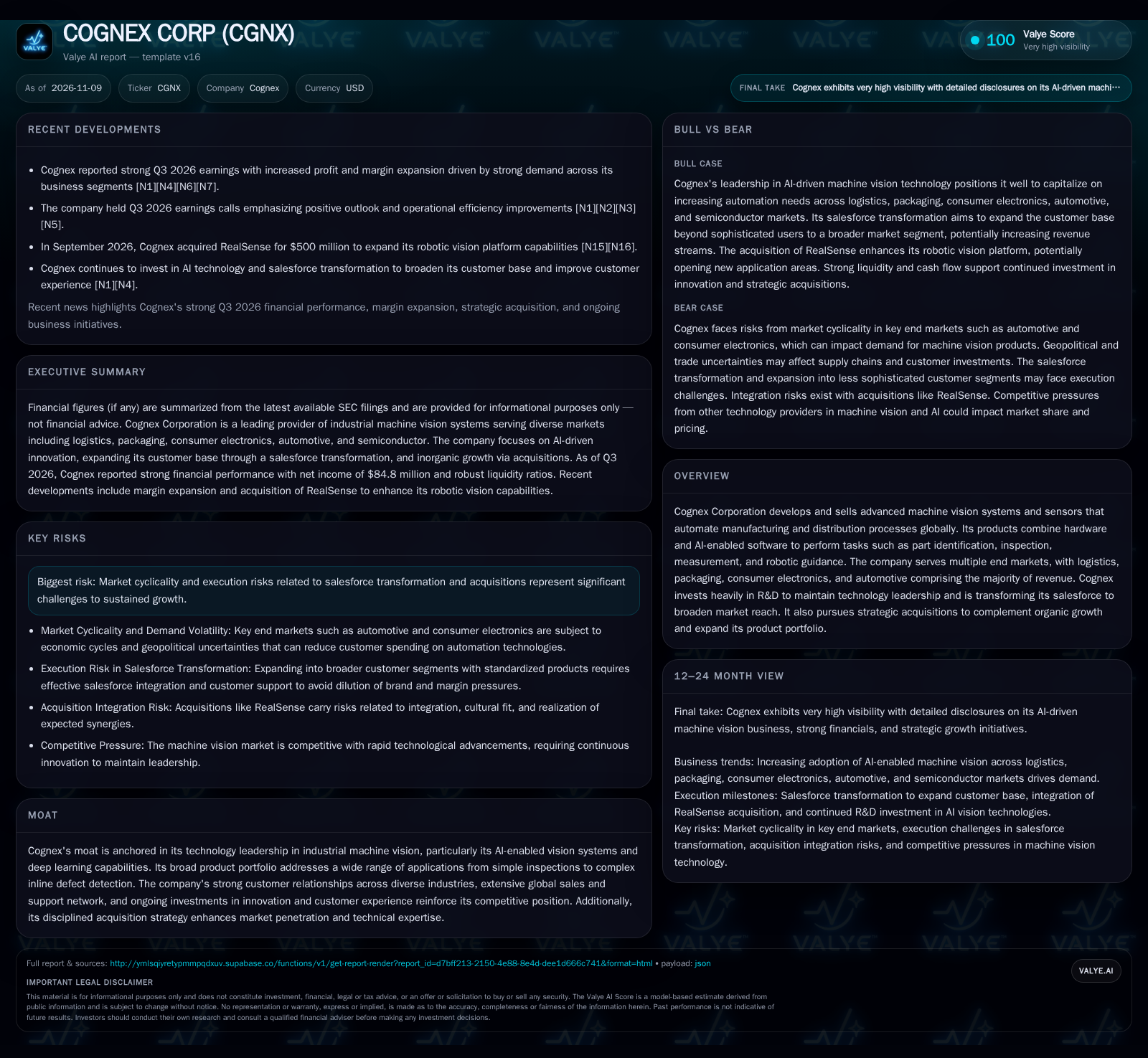
Cognex reported strong Q3 2026 profitability and margin expansion on the back of growing demand in logistics, packaging, and manufacturing. The company’s strategy centers on AI-enabled machine vision, a revamped salesforce to reach new customers, and disciplined acquisitions. The outlook is positive, but future performance will depend on successful execution of salesforce transformation, maintaining technology leadership, and managing end-market cyclicality. [N1] [N4] [S2]
Cognex enters late 2026 with a strong financial position and clear strategic priorities: harnessing AI-enabled machine vision to serve a wider spectrum of industrial automation needs. Recent quarterly results confirm rising demand and margin improvement, but the company’s next phase depends on executing a salesforce transformation and broadening its customer base beyond sophisticated manufacturers. The question is whether Cognex can translate its technical edge and reported liquidity position into sustainable, diversified growth—especially as it navigates cyclical end markets and intensifying competition.
Momentum in Q3: Profitability, Demand Expansion, and Strategic Initiatives
Cognex reported net income of $84.8 million for the three months ended October 4, 2026, with basic EPS of $0.50, reflecting strong profitability and margin expansion. This financial outcome was driven by robust demand across logistics, packaging, consumer electronics, and automotive segments—the latter four accounting for approximately 85% of 2025 revenue. The company highlighted growing adoption of its AI-enabled vision solutions, particularly in logistics and packaging, where regulatory and operational pressures drive automation. Additionally, Cognex’s current ratio of 5.04 and cash ratio of 3.04, supported by $694.7 million in cash, point to substantial financial resources available for R&D and acquisitions. The company is also executing a salesforce transformation to reach less sophisticated customers, aiming to expand its addressable market and improve sales efficiency. [S2] [N1] [N4]
Economic Drivers: AI Vision, Product Mix, and the Leverage of Scalable Solutions
Cognex’s business model is centered on selling hardware and software solutions that automate inspection, identification, and measurement tasks in manufacturing and logistics. Revenue is generated through direct product sales, integration services, and, increasingly, software-driven solutions. The company’s economics benefit from a mix of high-margin, standardized products—such as barcode readers and AI-enabled vision systems—and more complex, custom solutions for large manufacturers.
AI-driven innovation enables Cognex to offer value-added features like real-time defect detection and predictive analytics, which can command premium pricing and embed the company deeper into customer workflows. The introduction of standardized, easy-to-deploy products (like the 2025 SLX devices) supports higher sales volumes and lower customer acquisition costs, particularly as the salesforce targets less sophisticated buyers. This shift could increase operating leverage if the company can scale sales without proportionally increasing support costs.
Fixed costs are dominated by R&D and salesforce investments, while variable costs are tied to manufacturing and deployment. As Cognex expands its customer base, the potential for recurring software and service revenue may rise—though the current evidence primarily supports a product-centric revenue mix. [S2]
Technology Leadership and the Challenge of Broader Market Penetration
Cognex’s competitive strength lies in its technical leadership in AI-enabled machine vision, deep learning, and edge learning systems. This leadership is reinforced by heavy R&D investment, a broad product portfolio, and longstanding relationships with leading manufacturers in logistics, packaging, consumer electronics, and automotive. However, the company is now seeking to penetrate less sophisticated, more price-sensitive customer segments—markets historically addressed by lower-cost or more commoditized solutions.
Competitive pressure comes from other machine vision and automation providers, including both specialized vision companies and large industrial automation conglomerates. Rapid technological advances, especially in AI and edge computing, lower the barrier for new entrants and can compress the product lifecycle. The question is whether Cognex’s moat—rooted in technology, integration capability, and customer experience—can be extended to standardized products without eroding margins or diluting brand value.
Switching costs in traditional end markets are moderate to high, given the integration of Cognex systems into production workflows and the cost of downtime. In new customer segments, however, switching frictions may be lower, and price sensitivity higher, necessitating a differentiated go-to-market strategy.
If Salesforce Transformation Unlocks New Markets, Growth Could Accelerate
The most favorable scenario for Cognex is one in which its salesforce transformation successfully expands the customer base into previously underserved segments, driving higher sales volumes of standardized, AI-enabled products. If these customers adopt SLX and similar solutions with minimal training and support, Cognex could realize substantial operating leverage—boosting margins as revenue outpaces fixed cost growth.
This scenario would be confirmed by sustained above-market revenue growth in logistics and packaging, improved sales efficiency metrics (such as revenue per sales rep, if disclosed), and rising software/service attach rates. Evidence of broadening customer adoption, lower churn among new segments, and ongoing margin expansion would further validate the thesis.
A key falsifier would be stagnation in new customer acquisition or signs that support and customization costs rise sharply as Cognex moves down-market, offsetting the benefits of higher volumes.
Incremental Gains as AI Vision Adoption Broadens, but Cyclicality and Execution Remain Central
The most plausible trajectory is that Cognex continues to benefit from secular tailwinds in industrial automation, with moderate revenue growth across logistics, packaging, and manufacturing as AI-enabled vision systems become standard. The salesforce transformation delivers incremental gains but does not fully unlock mass-market adoption in the near term, either due to execution complexity or competitive pushback.
Margins gradually expand as standardized products gain share and R&D investments yield new features, but the company must continue to invest in customer support and integration for both new and existing customers. End-market cyclicality, especially in automotive and consumer electronics, introduces volatility but does not fundamentally derail the growth trend.
This scenario would be confirmed by steady, if unspectacular, top-line growth, consistent margin improvement, and evidence of ongoing R&D productivity. Falsifiers would include a stall in new product adoption or unanticipated margin compression from competitive pricing.
Execution Missteps or Demand Shocks Could Undermine Expansion Efforts
A downside scenario would unfold if Cognex encounters significant execution challenges in its salesforce transformation, leading to weak adoption among less sophisticated customers and higher-than-expected support costs. If the transition to standardized products dilutes the value proposition or exposes the company to price-based competition, margin pressure could intensify.
External shocks—such as a cyclical downturn in automotive or consumer electronics, or a slowdown in logistics investment—could further reduce demand and amplify volatility. Integration missteps from acquisitions could also erode operational focus and distract from core initiatives.
Evidence for this scenario would include declining or flat revenue in key end markets, margin contraction, increased customer churn (if disclosed), and rising SG&A or support expenses outpacing revenue growth. Failure to launch or gain traction with new products would also signal risk.
Testing the Cognex Thesis: Adoption, Margins, and Execution Benchmarks
Monitor revenue growth and market share trends in logistics and packaging, especially the adoption rate of SLX and other standardized AI-enabled products.
Track gross and operating margin evolution relative to historical benchmarks, looking for signs of operating leverage or margin compression.
Assess R&D productivity by observing the pace and impact of new product launches and software feature releases.
If disclosed, watch sales efficiency metrics such as revenue per sales rep and customer acquisition cost—especially as the salesforce targets new segments.
Evaluate customer churn rates and retention trends, particularly among less sophisticated or newly acquired customers (if disclosed).
Follow developments in end-market demand, with particular attention to macro shocks in automotive, consumer electronics, and logistics.
Monitor acquisition activity and integration outcomes, watching for signs of operational distraction or synergy realization.
Disclaimer: This is research-only, informational analysis and not investment advice. It may include AI-generated interpretation and general industry context. Always verify important details using primary sources.

Comments