
LandBridge 2026: Surface Acreage Leverage, Infrastructure Royalties, and the Stakes of Delaware Basin Activity
LandBridge Co LLC’s expansive land portfolio in the Delaware Basin underpins a high-margin royalty and fee model, with growth tied to drilling activity, infrastructure buildout, and regulatory dynamics. The company’s minimal capital outlay and strategic partnerships could insulate it from commodity volatility, but dependence on customer investment and legal structures that limit shareholder recourse present meaningful counterweights.
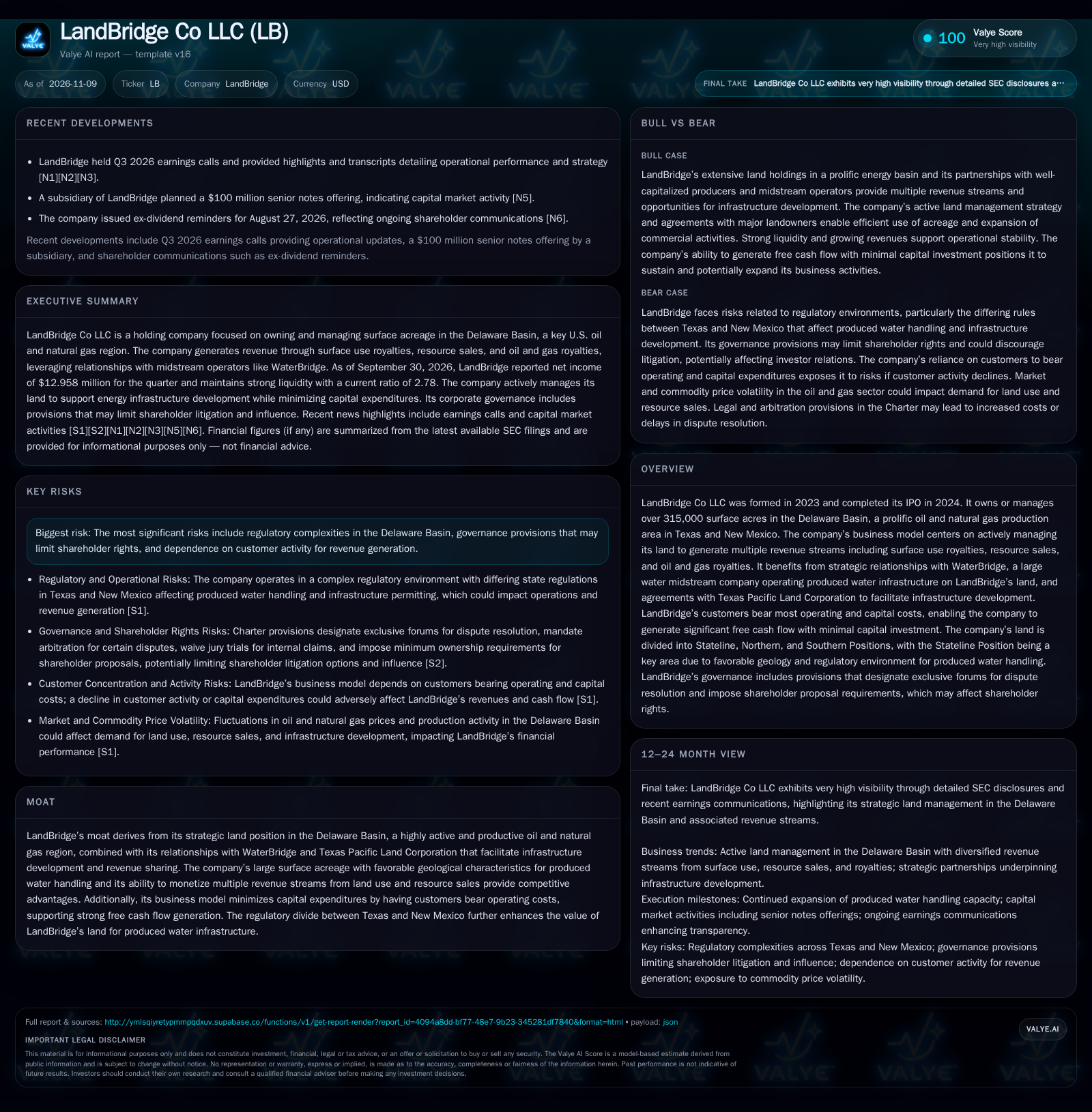
LandBridge monetizes over 315,000 surface acres in the Delaware Basin through royalties and fees, benefiting from customer-funded infrastructure and partnerships with midstream operators. Revenue growth and rising economic efficiency metrics highlight operational momentum, but exposure to drilling activity, regulatory shifts, and governance provisions that restrict shareholder influence remain central variables for the investment case. [S1] [S2]
LandBridge Co LLC sits at the intersection of land ownership, energy infrastructure, and royalty economics in the prolific Delaware Basin. By monetizing surface rights, resource sales, and mineral royalties across more than 315,000 acres, LandBridge has engineered a business model with minimal capital requirements and heavy reliance on customer investment. Recent financials show robust revenue growth and improving efficiency metrics, reflecting both increased activity and successful commercial optimization. Yet, the company’s fortunes are closely tied to the pace of drilling, regulatory developments, and the durability of customer partnerships—while governance structures that limit shareholder recourse could shape long-term risk and investor perception. The question for investors is whether LandBridge’s asset-light, partnership-driven model can sustain its momentum through commodity and regulatory cycles.
Recent Performance and Strategic Positioning in the Delaware Basin
LandBridge owns or manages over 315,000 surface acres in the Delaware Basin, with its Stateline Position—approximately 169,000 acres near the Texas-New Mexico border—being a core asset due to favorable geology and regulatory conditions for produced water handling. As of September 30, 2026, the company reported $12.96 million in net income for the quarter, cash and equivalents of $16.78 million, and a current ratio of 2.78. Revenue climbed from $72.87 million in 2023 to $199.09 million in 2025, while the surface use economic efficiency metric increased by 21% year-over-year, signaling optimization of commercial agreements and expansion of high-value uses. These developments underscore LandBridge’s ability to leverage its land base for multiple revenue streams and highlight the operational momentum driven by customer activity and infrastructure partnerships. [S1] [S2]
How LandBridge Converts Acreage into Cash Flow
LandBridge’s economics are rooted in an asset-light, royalty-driven model: the company monetizes land through surface use royalties and fees, resource sales (such as brackish water and caliche), and mineral royalties from a smaller subset of its acreage. Critically, customers—oil and gas operators, midstream firms, and infrastructure developers—fund the vast majority of operating and capital expenses for projects on LandBridge’s land. This structure enables LandBridge to capture high-margin revenue streams with minimal ongoing capital investment or operational risk. Consequently, a significant portion of revenue converts to free cash flow, with scalability tied more to acreage utilization and commercial optimization than to capital outlays.
Pricing is typically negotiated based on the intensity and type of use (e.g., well pads, water handling, pipeline easements), with market rates influenced by regional drilling activity, infrastructure bottlenecks, and the scarcity of suitable land. Volume drivers include the pace of drilling, infrastructure expansion, and the ability to attract non-traditional energy or digital infrastructure customers. While customer-funded development insulates LandBridge from direct commodity exposure, it also means revenue is sensitive to customer investment cycles, regulatory permitting, and the broader health of the Delaware Basin ecosystem. The company’s recent senior notes offering by a subsidiary signals selective use of leverage, likely for opportunistic expansion or capital management, but the core business remains low-capital and high-ROIC. [S1] [S2] [N5]
Defensible Acreage, Partnership Leverage, and the Limits of Location
LandBridge’s competitive position is anchored by the scale, contiguity, and location quality of its surface rights in the Delaware Basin—a region with high drilling activity and infrastructure demand. Its Stateline Position benefits from both favorable geology and the regulatory environment of Texas, particularly for produced water handling, which is a major constraint and cost in unconventional oil and gas operations. The company’s relationships with WaterBridge (for produced water midstream) and Texas Pacific Land Corporation (for reciprocal crossing rights and revenue sharing) enhance the utility and marketability of its acreage, supporting higher surface use fees and reducing fragmentation risk.
However, these advantages are not absolute. Competing landowners, including institutional holders and legacy ranches, offer alternative sites for energy and infrastructure projects. Substitution risk is most pronounced in areas where regulatory or geological factors are less differentiated. Additionally, as technology evolves (for example, in produced water recycling or alternative infrastructure routing), the premium for specific parcels could erode. The company’s ability to attract non-energy customers (e.g., data centers or renewables) remains largely unproven and could be a differentiator if successfully executed.
If Infrastructure Buildout and Multi-Use Agreements Accelerate
The most favorable scenario for LandBridge envisions sustained drilling activity in the Delaware Basin, further expansion of produced water, pipeline, and digital infrastructure, and successful commercialization of new revenue streams—such as data centers or renewable energy installations—on its acreage. In this scenario, LandBridge continues to optimize surface use agreements, driving both volume and pricing per acre higher. The company leverages its partnerships to capture incremental value from infrastructure buildouts, while regulatory or technological shifts (such as broader produced water recycling mandates) increase the strategic importance of its Texas acreage.
Confirmation would come from continued double-digit growth in revenues per acre, further expansion of permitted produced water handling capacity, announcements of new non-oil-and-gas customers, and evidence of successful integration of new revenue streams with minimal capital outlay. Additional indicators could include sustained or rising free cash flow margins, new partnerships, and favorable contract renewals or expansions with existing customers.
Commercial Optimization Amid Cyclical Drilling and Regulatory Complexity
The most plausible outcome is that LandBridge maintains a steady pace of commercial optimization: revenue per acre continues to improve, but at a moderated pace as drilling activity in the Delaware Basin fluctuates with commodity prices and capital spending cycles. The company renews and incrementally expands agreements with core customers, while new revenue streams outside of oil and gas remain exploratory or modest in contribution. Regulatory complexity—especially the contrast between Texas and New Mexico permitting—creates both opportunities (for high-value acreage) and friction (for expansion into less favorable regimes).
Evidence for this scenario would be stable-to-slowly rising economic efficiency metrics, continued reliance on oil and gas-related customers, and periodic but not transformative growth in infrastructure-related revenue.
Customer Capital Retrenchment and Regulatory Headwinds Threaten Revenue Base
A negative scenario unfolds if drilling and infrastructure activity in the Delaware Basin contracts sharply—whether due to commodity price declines, regulatory tightening (especially on produced water or surface disturbance), or consolidation among operators leading to reduced capital spending. LandBridge’s revenue would come under pressure as fewer projects are initiated on its land, pricing power weakens, and competition among landowners for a shrinking pool of projects intensifies. If regulatory conditions in Texas were to become more restrictive or if technological shifts reduce demand for surface-intensive infrastructure, the value of LandBridge’s acreage could decline.
Downside confirmation would include flat or declining revenues per acre, contract terminations or renegotiations on less favorable terms, notable reductions in customer activity, and rising legal or regulatory costs. A drop in free cash flow margins, increased leverage without clear reinvestment opportunities, or evidence of customer defaults would further support the bear case.
Developments That Will Shape LandBridge’s Earnings Power and Risk Profile
Quarterly and annual changes in surface use economic efficiency (revenues per weighted average surface acre), which directly measure commercial optimization and pricing trends. [S1]
Permitted and utilized produced water handling capacity in the Stateline and other positions—expansion or underutilization would signal changes in infrastructure demand and regulatory impact. [S1]
Mix and number of new commercial agreements, especially with non-traditional customers (e.g., digital infrastructure or renewables), which would test the company’s diversification narrative. If disclosed, new contract announcements or customer types would be a leading indicator.
Revenue and cash flow contribution from resource sales (such as brackish water and caliche) relative to surface use royalties—shifts in this mix could affect margin resilience if commodity markets fluctuate. If disclosed, segment detail would clarify this dynamic.
Changes in customer concentration and the renewal status of major agreements—customer churn or renegotiation risk are central to revenue stability. If disclosed, customer-level metrics would help test this risk.
Impact of regulatory or permitting developments in Texas and New Mexico, especially regarding produced water and surface use. Monitoring public filings and state agency updates would provide early warning of regulatory headwinds.
Governance changes, litigation, or shareholder proposal activity that could alter risk or perception of minority investor rights. Charter amendments or proxy contest developments, if any, would be material.
Disclaimer: This is research-only, informational analysis and not investment advice. It may include AI-generated interpretation and general industry context. Always verify important details using primary sources.

Comments