
LeMaitre Vascular 2026: Navigating Regulatory Pressures Amid Core Niche Strength
LeMaitre Vascular’s latest quarter highlights the tension between resilient financial performance and persistent regulatory scrutiny, as the company balances specialized vascular product demand with ongoing FDA remediation.
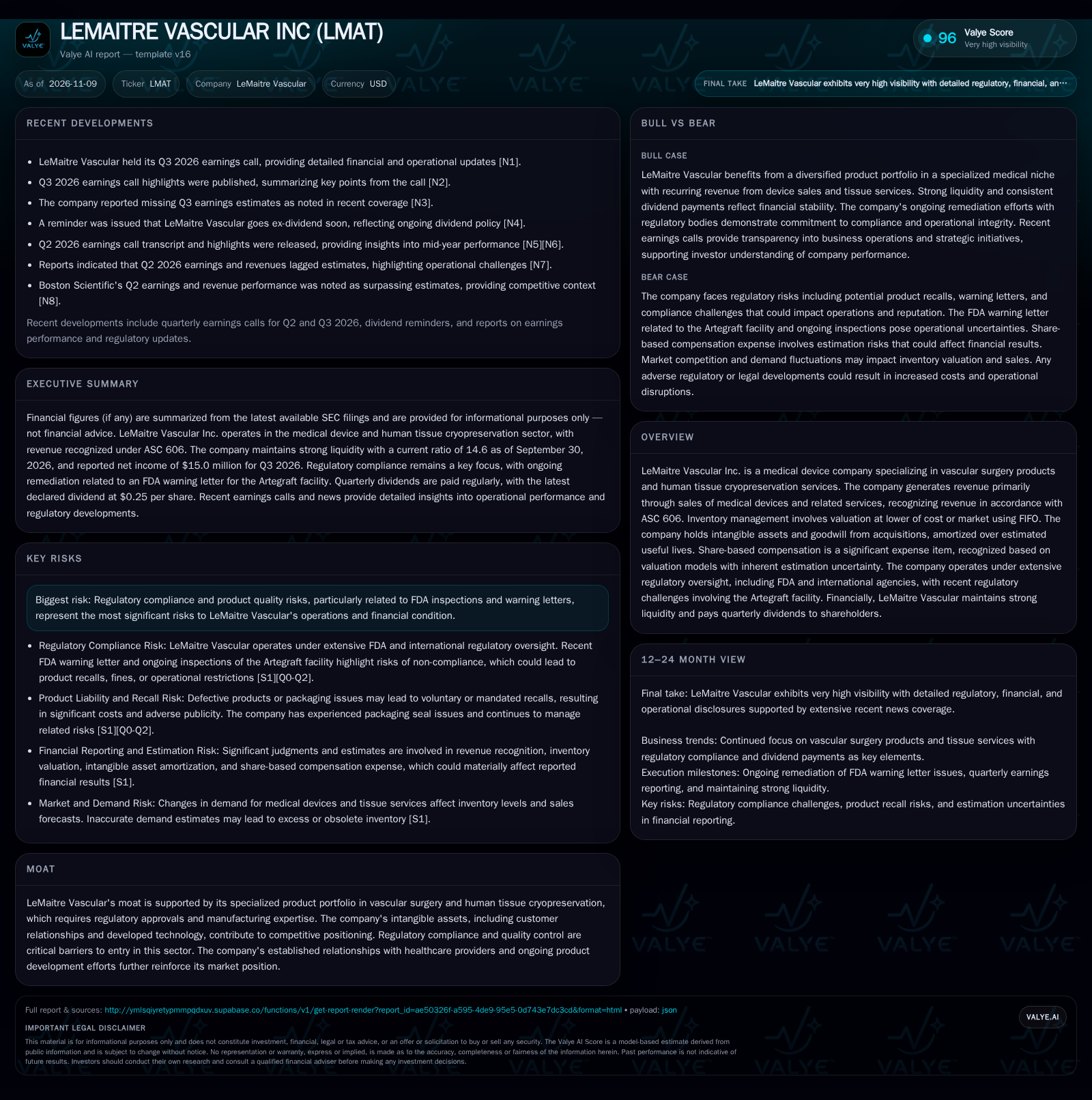
LeMaitre Vascular reported Q3 2026 net income of $15.0 million and maintains a robust balance sheet, but faces ongoing regulatory challenges tied to its Artegraft facility. [S2] [N3]
LeMaitre Vascular, a specialist in vascular surgery devices and human tissue cryopreservation, enters late 2026 with a blend of financial resilience and operational uncertainty. While the company’s latest quarter delivered $15 million in net income and maintained a reported liquidity position, recent earnings have missed expectations, and the business remains under FDA scrutiny for compliance issues at its Artegraft facility. The next year will hinge on LeMaitre’s ability to resolve regulatory headwinds, manage estimation risks, and sustain its niche product demand amid evolving competitive and market dynamics. [S2] [N3]
Q3 2026: Regulatory Remediation and Resilient Earnings Define the Moment
LeMaitre Vascular reported net income of $15.0 million for the quarter ended September 30, 2026, with basic EPS of $0.66 and diluted EPS of $0.65. The company’s balance sheet reflects $27.5 million in cash and equivalents, current assets of $505.5 million, and current liabilities of $34.6 million, yielding a current ratio of 14.6 and cash ratio of 0.8 [S2]. The company reported cash and liquidity metrics for the period; these figures do not by themselves establish operating runway, investment capacity, financial flexibility, or financing capacity. However, the company continues to face regulatory challenges, specifically an FDA warning letter for its Artegraft facility, with remediation efforts ongoing and potential implications for operations and reputation [S1]. Recent earnings have missed analyst estimates, as noted in Q3 and Q2 2026 coverage, suggesting that operational and regulatory headwinds are affecting performance [N3] [N7]. The interplay between solid financials and regulatory uncertainty is central to understanding LeMaitre’s current risk-reward profile.
How LeMaitre’s Niche Drives Revenue and Margin Dynamics
LeMaitre Vascular generates revenue from sales of vascular surgery devices and human tissue cryopreservation services, both of which demand specialized manufacturing and regulatory compliance [S1]. Pricing in this sector is typically supported by the critical nature of products and the lack of direct substitutes for certain vascular procedures, lending some degree of pricing power. However, volume growth can be sensitive to hospital capital budgets, reimbursement trends, and procedure volumes—factors that can fluctuate with macroeconomic and healthcare system changes.
The company’s cost structure is characterized by a mix of fixed costs (such as manufacturing facilities and regulatory compliance overhead) and variable costs tied to production volumes and sales. Operating leverage becomes significant as incremental sales can drive margin expansion, provided fixed costs are covered. Inventory includes finished products, work-in-process, and raw materials, with FIFO valuation and a need for tight inventory management to avoid obsolescence, especially given the regulatory oversight and perishability of some tissue products [S1].
Intangible assets (customer relationships, developed technology, trademarks) and goodwill from acquisitions are amortized over useful lives, impacting reported earnings and introducing estimation risk. Share-based compensation expense, recognized based on valuation models, adds further complexity to cost assessment [S1]. Capital requirements are moderate relative to larger medtech peers, but compliance, remediation, and potential product recalls can introduce episodic spikes in expenses.
Specialization as a Double-Edged Sword in the Vascular Device Landscape
LeMaitre’s competitive positioning is anchored in its specialization within vascular surgery products and tissue cryopreservation, a niche with meaningful regulatory and technical barriers to entry. Intangible assets—particularly customer relationships and proprietary technologies—further reinforce its position, as switching costs for hospitals and surgeons can be significant due to procedural complexity and the need for proven safety and efficacy [S1].
However, this specialization also means concentrated exposure to regulatory events, as evidenced by the impact of the Artegraft facility warning letter. Larger diversified device companies may be better equipped to absorb such shocks. Additionally, the sector faces ongoing innovation: minimally invasive procedures, bioengineered grafts, and digital health integrations could threaten the relevance of existing product lines if LeMaitre is slow to adapt. Competitors include both large diversified medtech firms and smaller, innovation-focused vascular device companies, each with varying approaches to R&D, regulatory navigation, and commercialization.
Regulatory Clearance and Product Innovation Unlock Margin Expansion
A favorable scenario for LeMaitre hinges on successfully resolving the FDA warning letter and demonstrating robust compliance, which would reduce operational risk and restore confidence among customers and partners. If regulatory remediation is completed efficiently, the company could reallocate resources toward product development, commercial execution, and potential tuck-in acquisitions.
Margin expansion may occur if fixed regulatory and remediation costs decline, and if the company leverages its specialized portfolio to drive higher average selling prices or expand into adjacent vascular indications. Increased adoption of LeMaitre’s products in new geographies or procedures would further support this upside thesis.
Sustained Niche Strength Amid Regulatory and Market Friction
The most plausible outcome is that LeMaitre maintains its core position in vascular surgery devices, with moderate growth tempered by ongoing regulatory and operational friction. Remediation efforts at the Artegraft facility may persist for several quarters, keeping compliance costs elevated and limiting management’s ability to focus fully on growth initiatives.
Revenue and earnings could fluctuate around current levels as the company balances steady demand for its specialized products with periodic regulatory or operational disruptions. Dividend payments likely continue, but upside is capped until regulatory risks are clearly resolved. Confirmation of this scenario would include continued profitability, neutral-to-slightly negative earnings surprises, and regular regulatory disclosures without major escalation or resolution. Falsification would be signaled by either a major regulatory breakthrough or a significant adverse event, such as a large-scale recall or legal action.
Escalating Compliance Costs and Market Share Erosion
A negative outcome could materialize if regulatory issues at the Artegraft facility worsen or trigger broader scrutiny of LeMaitre’s manufacturing and quality systems. This could result in forced product recalls, halted sales of key products, or significant remediation expenses, directly impacting revenue and margins. Adverse regulatory findings could also damage customer trust and drive hospitals to seek alternative suppliers, eroding market share.
If the company’s estimation risks around inventory, revenue recognition, or share-based compensation materialize as negative adjustments, financial results could deteriorate further. Evidence supporting this scenario would include additional FDA or international agency actions, sharp drops in revenue or earnings, disclosure of large one-time charges, or suspension of dividend payments. A significant increase in inventory write-offs or a spike in legal expenses would further corroborate this downside risk.
What Will Determine LeMaitre’s Trajectory in the Year Ahead?
Progress updates on remediation efforts and final resolution of the FDA warning letter for the Artegraft facility.
Quarterly trends in net income, EPS, and revenue versus analyst estimates, especially any return to outperformance or continued shortfalls.
Disclosure of new product launches, pipeline developments, or expansion into adjacent therapeutic indications.
Inventory management metrics—such as inventory turns or write-offs—if disclosed, to assess demand forecasting and obsolescence risk.
Material changes in regulatory risk disclosures, including any new warning letters, recalls, or international agency actions.
Updates on customer concentration, contract renewals, or major wins/losses with key hospital or health system partners, if disclosed.
Operating expense trends, particularly R&D and remediation costs, as a signal of management’s ability to shift focus back to growth.
Disclaimer: This is research-only, informational analysis and not investment advice. It may include AI-generated interpretation and general industry context. Always verify important details using primary sources.

Comments