
MercadoLibre 2026: Ecosystem Leverage, Fintech Expansion, and the Pressures of Regional Complexity
MercadoLibre’s Q3 2026 results underscore its unique position as Latin America’s leading integrated e-commerce and fintech platform. With $10.75 billion in net revenues and a broad product ecosystem, the company is balancing aggressive growth initiatives against profit pressures and the realities of scaling digital and physical infrastructure across volatile markets.
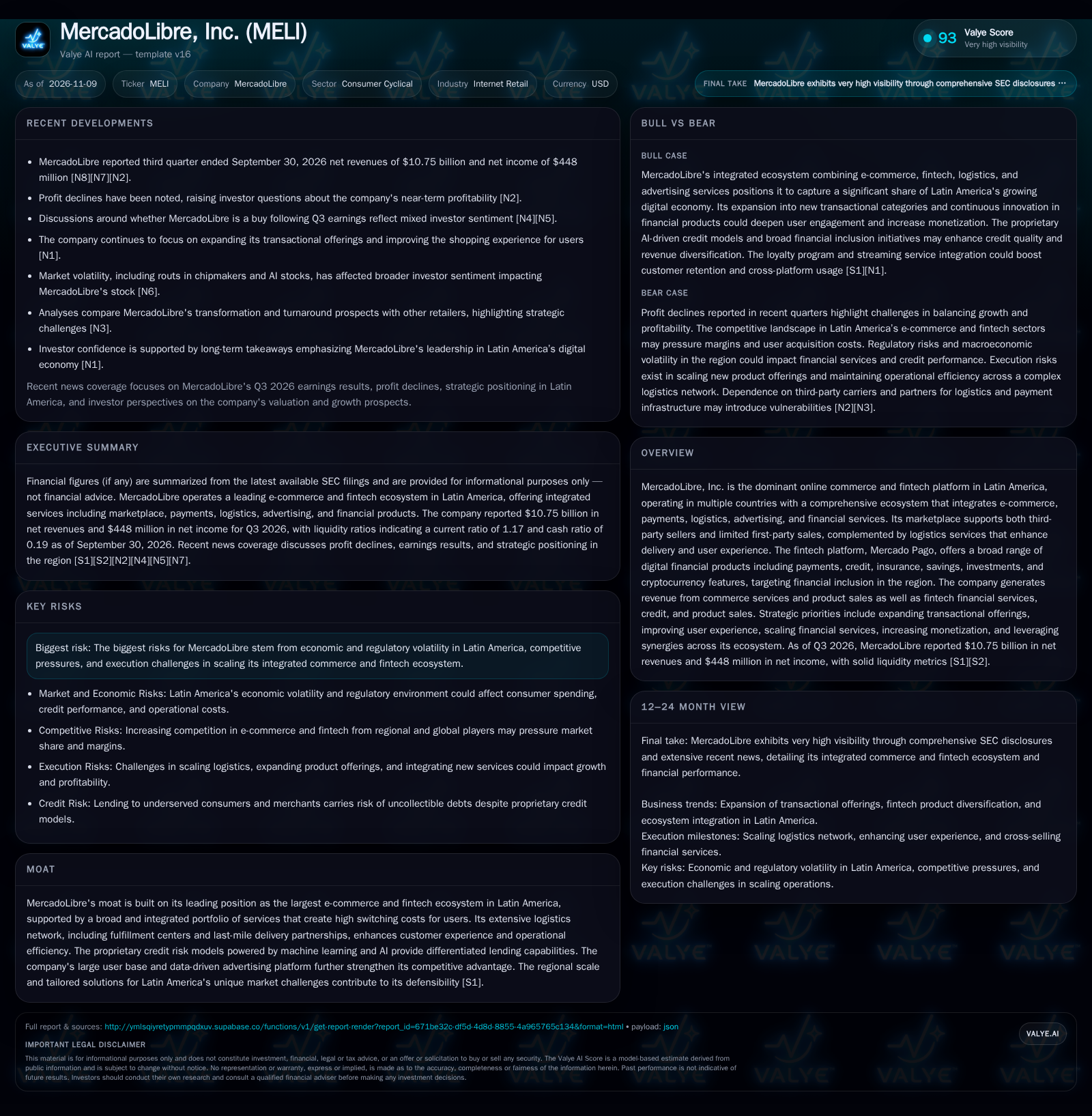
MercadoLibre remains the dominant e-commerce and fintech player in Latin America, reporting $10.75 billion in Q3 2026 revenue and $448 million in net income. Its integrated model—spanning marketplace, payments, logistics, and financial services—offers strong cross-sell potential but faces margin and credit risks amid intense competition and macro volatility. The company’s ability to deepen ecosystem engagement, sustain fintech innovation, and manage regional challenges will determine whether it can translate scale into durable profitability.
MercadoLibre’s latest quarterly results reinforce its status as Latin America’s preeminent digital commerce and fintech ecosystem. With $10.75 billion in Q3 2026 net revenues, the company’s integrated approach—combining marketplace, payments, logistics, and financial services—positions it at the heart of the region’s digital transformation. Yet, as MercadoLibre pushes for deeper monetization and broader financial inclusion, it faces intensifying competition, economic volatility, and the operational complexities of serving a diverse and often unpredictable region. The company’s ability to leverage its ecosystem advantages while navigating these headwinds will shape its long-term value creation.
Recent Results Highlight Both Scale and Profitability Pressures
MercadoLibre reported net revenues of $10.75 billion and net income of $448 million for the third quarter of 2026, confirming its leadership in Latin American e-commerce and fintech [S2] [N8]. This scale demonstrates the company’s ability to drive substantial transaction volumes across its integrated ecosystem. However, recent profit declines have attracted investor scrutiny, with earnings coverage noting that profitability remains pressured even as topline growth continues [N2] [N5]. The company ended the quarter with $4.16 billion in cash and equivalents and $3.21 billion in short-term investments, and reported a current ratio of 1.17 and cash ratio of 0.19 [S2]. The company reported cash and liquidity metrics for the period; these figures do not by themselves establish operating runway, investment capacity, financial flexibility, or financing capacity. The company’s continued focus on expanding transactional offerings and scaling financial services is central to its thesis, but the challenge is whether ecosystem investments and cross-selling will translate into durable margin improvement.
Ecosystem Economics: Multiple Monetization Paths, Shifting Margin Mix
MercadoLibre’s business model is built on a multi-pronged ecosystem that generates revenue from both commerce and financial services. Marketplace revenues are driven by service fees, shipping, advertising, and a limited amount of first-party inventory sales [S1]. Fintech revenues are sourced from payment commissions, credit products (including loans and cards), and sales of fintech hardware like POS devices [S1]. This breadth provides multiple levers for monetization and cross-sell, but also exposes the company to a complex blend of margin profiles.
Marketplace service revenues generally offer higher incremental margins than first-party sales, especially as logistics scale and advertising grows. However, logistics investments—such as fulfillment centers and transportation networks—require significant fixed and working capital, with operating leverage depending on shipment density and utilization. The expansion of Mercado Envios logistics aims to improve delivery speed and user experience, but also introduces variable costs tied to third-party carriers and last-mile complexity.
Fintech operations, especially credit, add a different risk-reward dynamic. Loan and credit card products can drive high-margin revenue if credit risk is well-managed, but losses can quickly erode profitability in volatile economic environments. The company’s use of machine learning and AI for credit modeling is intended to contain losses, but the real-world effectiveness is tested by regional macro shocks. Payments, insurance, and digital investment products may offer recurring fee income with lower direct risk, but are also subject to regulatory and competitive pressure.
Overall, the company’s ability to scale operating leverage depends on balancing growth in services and fintech against the costs and risks of expanding logistics and managing credit exposure. The company’s capital needs remain significant, especially as it continues to invest in infrastructure and product innovation.
Ecosystem Integration vs. Rising Regional Competition
MercadoLibre’s competitive edge stems from its comprehensive ecosystem, which integrates commerce, payments, logistics, and financial services in a region where digital infrastructure is uneven and incumbency is difficult to replicate [S1]. The company’s logistics network and proprietary credit models, powered by AI, create switching frictions for both buyers and sellers. Its loyalty program (Meli+) and bundled streaming (Mercado Play) further embed users in the platform.
However, the competitive landscape in Latin America is intensifying. Regional e-commerce platforms, global entrants, and specialized fintech startups are all targeting segments of MercadoLibre’s business. In payments and credit, local banks and neobanks are expanding digital offerings, while global players introduce alternative payment methods and wallets. In logistics, regional carriers and new delivery startups are attempting to chip away at MercadoLibre’s fulfillment advantage.
The company’s broad product suite and network effects provide defensibility, but rapid innovation cycles in fintech and regulatory changes can erode advantages. The question is whether MercadoLibre’s scale and integration can continue to outpace both local and international challengers, especially as user acquisition and retention costs rise.
Ecosystem Flywheel Unlocks Accelerated Monetization and Margin Expansion
The most optimistic scenario for MercadoLibre is that its integrated ecosystem creates a self-reinforcing flywheel, where improvements in user experience, logistics, and fintech product breadth drive higher engagement and cross-sell. As more sellers and buyers transact on the platform, logistics density increases, improving delivery economics and service reliability. This, in turn, enhances customer satisfaction, further increasing transaction frequency and seller participation.
On the fintech side, successful expansion of credit, insurance, and investment products could deepen user relationships and generate high-margin recurring revenue. If machine learning-driven credit models prove robust through economic cycles, credit losses could remain contained even as lending scales. Increased adoption of loyalty programs and bundled services (like Mercado Play) could further reduce churn and increase average revenue per user.
Evidence that would confirm this scenario includes sustained growth in high-margin service revenues, improving operating margin trends, and stable or declining credit loss rates even as fintech lending expands. Accelerating cross-selling rates between commerce and fintech products, and rising share of wallet among core users, would further validate the ecosystem thesis.
Integrated Growth Continues, but Margin Expansion Is Gradual Amid Regional Constraints
The most plausible near-term scenario is that MercadoLibre continues to grow its ecosystem across commerce and fintech, but faces ongoing pressures on profitability. Topline revenues may expand through increased transaction volumes, new product launches, and deeper cross-sell between marketplace and financial services. However, margin expansion could be limited by persistently high logistics costs, competitive user acquisition spending, and the need to provision for credit losses in a volatile macro environment.
In this path, operating leverage from logistics and advertising may be partially offset by investments in infrastructure and new markets. Fintech revenues grow, but credit losses remain a drag on margin, especially if economic conditions worsen in key markets. Regulatory developments could intermittently disrupt product launches or require changes to credit and payments practices.
Evidence for this scenario would be continued revenue growth with stable or modestly improving margins, but with periodic fluctuations in net income tied to credit provisioning and investment cycles. Operating cash flow would remain positive, but free cash flow could be volatile depending on the pace of infrastructure and working capital investments.
Credit Losses and Macro Shocks Undercut Ecosystem Profitability
A more adverse scenario would see MercadoLibre’s expansion into credit and financial services expose it to outsized losses during macroeconomic downturns. If machine learning models fail to anticipate sharp deteriorations in borrower quality, credit losses could spike, eroding profits and potentially constraining capital available for reinvestment. Simultaneously, intensified competition could force higher spending on user incentives and marketing, compressing marketplace and fintech margins.
Logistics investments might not achieve sufficient density or operational efficiency, leading to persistently high cost per delivery and diluting the benefits of scale. Regulatory interventions—such as caps on lending rates, payment restrictions, or new data/privacy rules—could further limit monetization or increase compliance costs.
This scenario would be confirmed by rising credit loss rates, declining net income despite revenue growth, and negative operating or free cash flow. Market share losses to new entrants or visible declines in user engagement metrics would further signal ecosystem erosion.
Milestones That Will Test MercadoLibre’s Ecosystem Thesis in 2027
Marketplace service revenue growth rates: If disclosed, tracking the share of revenue from service fees, shipping, and advertising (versus first-party sales) would clarify margin trajectory.
Fintech lending and credit loss metrics: Detailed disclosure of loan book growth, delinquency rates, and provisions would help assess credit risk management.
Logistics network efficiency: Metrics such as fulfillment cost per order, delivery speed, and shipment density would illuminate operating leverage and scalability.
User engagement and retention: Insights into active user trends, cohort retention, and cross-platform usage would validate the flywheel effect.
Advertising revenue and monetization rates: Growth in Mercado Ads as a share of total revenue would indicate progress in leveraging user data and scale.
Regulatory developments: Monitoring new laws or policy changes in key markets, especially around fintech and payments, is critical for scenario risk.
Competitive user acquisition costs: Evidence of rising or falling CAC in e-commerce and fintech segments would signal shifts in competitive intensity.
Capital allocation disclosures: Updates on infrastructure investment, buybacks, or new financing could clarify runway and risk appetite.
Disclaimer: This is research-only, informational analysis and not investment advice. It may include AI-generated interpretation and general industry context. Always verify important details using primary sources.

Comments