
ACADIA Pharmaceuticals 2026: Patent Defenses, Product Concentration, and the Economics of Commercial Expansion
ACADIA’s 2026 profile is shaped by reported liquidity position, ongoing patent litigation, and a product portfolio anchored by Nuplazid and Daybue. The company’s ability to defend exclusivity, manage legal risk, and translate pipeline planning into durable commercial growth will determine whether recent earnings strength proves sustainable.
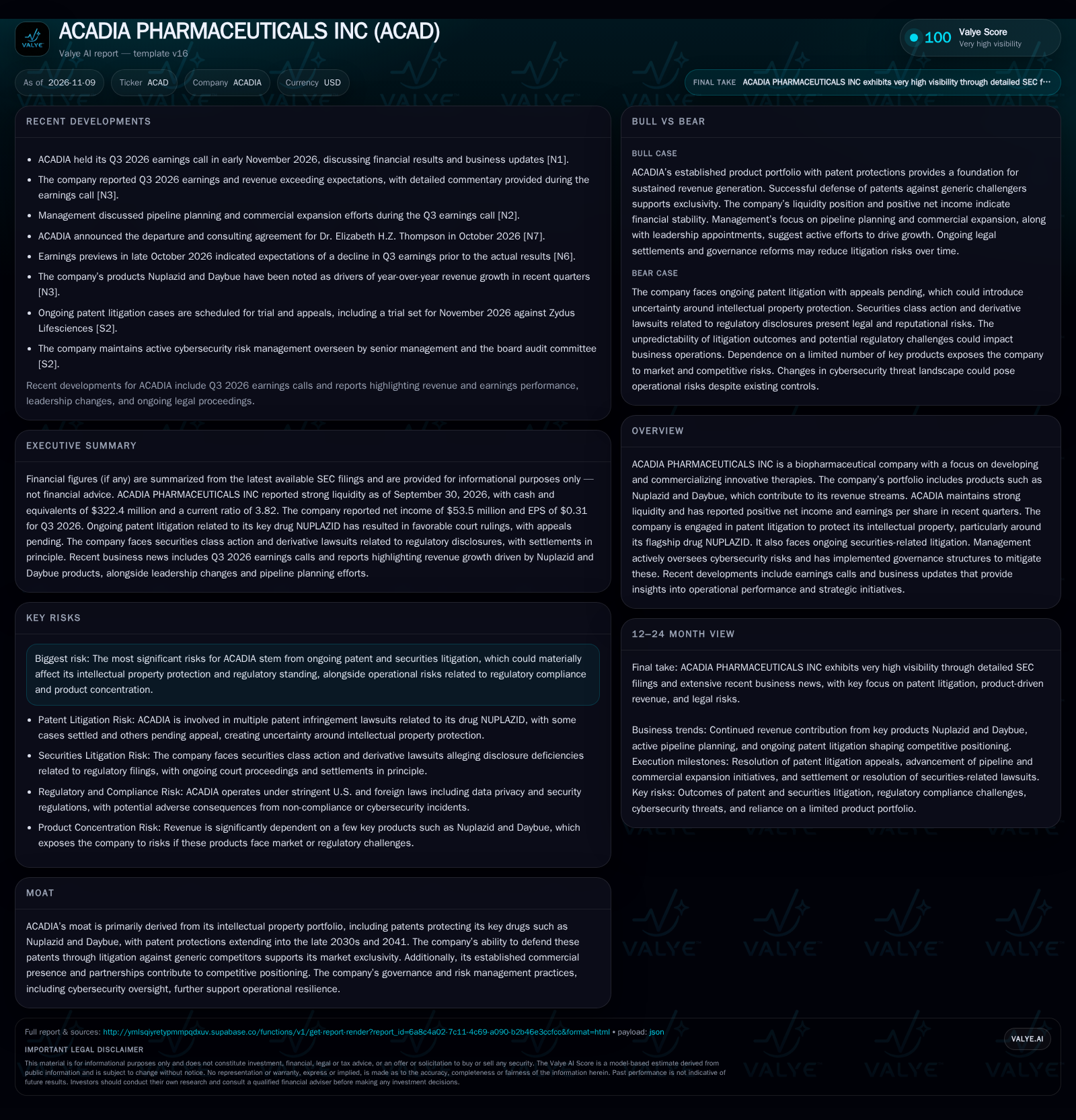
ACADIA Pharmaceuticals reported positive net income and reported liquidity position as of Q3 2026, with revenue growth driven by Nuplazid and Daybue. Ongoing patent litigation, particularly around Nuplazid, and securities lawsuits remain key risks. The company’s future hinges on defending its intellectual property, expanding its product pipeline, and reducing dependence on a limited set of products. Execution on these fronts will test the durability of current earnings momentum. [S2] [N3]
ACADIA Pharmaceuticals enters late 2026 with a reported balance sheet position, positive quarterly earnings, and revenue momentum from its flagship drugs Nuplazid and Daybue. Yet, the company operates under a cloud of ongoing patent and securities litigation, with its future growth prospects tied to the defense of core intellectual property and the success of commercial expansion efforts. How ACADIA navigates these legal and operational challenges, while reducing reliance on its current product base, will shape its next phase of value creation.
Recent Financial Performance, Litigation Status, and Product Reliance: What’s Driving ACADIA’s 2026 Narrative?
As of September 30, 2026, ACADIA reported net income of $53.5 million and basic and diluted EPS of $0.31 for Q3, reflecting continued profitability [S2] [N3]. The company’s cash and cash equivalents stood at $322.4 million, supporting a current ratio of 3.82, which signals reported liquidity position [S2]. Revenue growth has been attributed to sales of Nuplazid and Daybue, both protected by patents extending into the 2030s and beyond [N3]. However, ACADIA remains embroiled in patent litigation around Nuplazid, with favorable court rulings but pending appeals, and faces securities lawsuits tied to regulatory disclosures [S2]. These facts set the stage for a company balancing near-term financial strength against legal and product-concentration risks.
Dissecting ACADIA’s Revenue Model: Dependence, Defensibility, and Margin Dynamics
ACADIA’s economics are fundamentally shaped by the commercial performance and exclusivity of Nuplazid (pimavanserin) and Daybue. These drugs generate the majority of company revenue, creating a high degree of product concentration. The pricing power associated with orphan or specialty pharmaceuticals often enables premium gross margins, but this is highly dependent on the duration and enforceability of patent protection. Fixed costs are substantial in the form of R&D, litigation, and commercial infrastructure, suggesting that incremental revenue from existing products can deliver operating leverage. However, variable costs in manufacturing and sales remain material, and the need for ongoing litigation and compliance adds to overhead.
Capital needs are moderate in the near term given the company’s reported liquidity, but the cost of defending patents and developing new pipeline assets could rise substantially if legal or regulatory setbacks occur. The ability to expand the portfolio—either through internal R&D or licensing—will determine whether ACADIA can diversify revenue and reduce vulnerability to patent cliffs. At present, the company’s margin profile and cash generation are most sensitive to the exclusivity and pricing of its two lead assets.
The interplay between fixed and variable costs in ACADIA’s business model warrants further examination, particularly in the context of scalability and margin sustainability. While fixed costs such as R&D and litigation expenses create a baseline overhead, the relatively high gross margins on specialty pharmaceuticals mean that incremental sales can disproportionately improve operating leverage. However, this leverage is conditional on maintaining exclusivity; if patent protections erode, pricing pressure from generics could compress margins and undermine this dynamic. Additionally, the company’s investment decisions in commercial infrastructure must balance the potential for growth against the risk of underutilization should product sales decline, making capacity planning a critical management consideration.
Another dimension of ACADIA’s economic model is the strategic allocation of capital between defending existing assets and investing in pipeline development. The opportunity cost of deploying funds toward patent litigation versus R&D could influence long-term value creation. If litigation costs escalate without commensurate success, resources may be diverted from innovation, limiting the company’s ability to replenish or expand its product portfolio. Conversely, successful defenses that extend exclusivity can justify higher upfront investments in lifecycle management and marketing. The balance of these expenditures, and their timing relative to patent expirations, will critically affect cash flow profiles and potential financial flexibility over the medium term.
Patent Shields, Pipeline Promise, and the Threat of Generics: ACADIA’s Competitive Landscape
ACADIA’s primary competitive advantage is its intellectual property portfolio, with Nuplazid and Daybue covered by U.S. patents into the 2030s and 2041, respectively [S2]. This patent protection underpins market exclusivity and pricing power, but generic manufacturers continue to challenge these protections, as evidenced by ongoing litigation with recent favorable but not final outcomes [S2]. Should these defenses weaken, the company could see rapid erosion of revenue and margin as generic competition enters.
Beyond IP, ACADIA’s commercial infrastructure and relationships with partners such as Neuren Pharmaceuticals and Saniona may support its market position, but these do not fully offset the risks inherent in a concentrated product base. Competitive threats also include alternative therapies in neurology and psychiatry, as well as broader industry moves toward biosimilars and price controls. The company’s ability to expand its pipeline or secure new indications will be critical to sustaining its edge as patents age and the external environment evolves.
The durability of ACADIA’s competitive position also hinges on the evolving regulatory environment and market access dynamics. Payers and healthcare systems increasingly scrutinize specialty drug pricing, which could pressure reimbursement levels despite patent protection. This external factor introduces uncertainty into revenue forecasts and may incentivize the company to pursue broader indications or combination therapies to justify premium pricing. Furthermore, the competitive landscape includes not only direct generic entrants but also novel mechanisms of action and alternative treatment modalities, which could shift prescribing patterns independently of patent status. ACADIA’s strategic response to these trends, including potential partnerships or adaptive pricing strategies, will influence its resilience against competitive erosion.
Moreover, the company’s reliance on partnerships for certain pipeline assets introduces both opportunity and risk. Collaborations can accelerate development timelines and share costs, but also create dependencies on external entities’ performance and priorities. Any misalignment or delays in partner contributions could disrupt ACADIA’s commercialization plans and revenue diversification efforts. The governance of these partnerships, including contractual terms and joint decision-making processes, will be important in mitigating operational risks. Additionally, the ability to integrate acquired or licensed products into existing commercial channels effectively will determine whether the company can capitalize on pipeline maturation to offset competitive pressures.
If Patent Defenses Hold and Pipeline Assets Mature, Earnings Durability Could Outpace Expectations
A favorable outcome for ACADIA would involve successful defense of Nuplazid’s and Daybue’s patents through the current litigation cycle, preserving exclusivity and high-margin revenue streams over the next several years. If pipeline planning yields additional approved products or new indications for existing drugs, the company could diversify its revenue base, reduce concentration risk, and leverage its existing commercial infrastructure. This scenario would likely result in sustained or expanding profitability, with cash flows available for further R&D or strategic acquisitions.
Evidence confirming this upside would include final court victories or favorable settlements in patent cases, accelerated regulatory approvals for pipeline candidates, and consistent year-over-year revenue growth with stable or improving gross margins. Announcements of major new licensing deals or successful market expansions would further support the bullish case.
Current Product Reliance Persists Amid Legal Overhang and Incremental Expansion Efforts
The most plausible path is that ACADIA continues to generate strong cash flow and earnings from Nuplazid and Daybue while navigating periodic legal and regulatory risks. Patent litigation may remain unresolved for several quarters, creating headline volatility but not immediate loss of exclusivity. Pipeline progress could be incremental, with select new indications or modest licensing activity, but no near-term blockbuster launches.
Confirming this scenario would be continued positive net income, stable or slightly growing revenue from the core products, and periodic updates on legal outcomes that neither decisively endanger nor fully secure exclusivity. Evidence against this base case would be a major adverse court ruling, abrupt loss of exclusivity, or a clinical failure that derails pipeline momentum.
Adverse Litigation Outcomes or Product Setbacks Could Trigger a Sharp Contraction
If pipeline programs fail to deliver new revenue streams in time, the company could face a rapid decline in profitability and cash flow, forced cost-cutting, or even strategic retrenchment.
This scenario would be confirmed by court decisions lifting patent protections or ordering significant financial penalties, coupled with pipeline setbacks or regulatory rejections. Accelerating revenue declines, shrinking margins, and negative cash flow would be clear warning signs. The company’s ability to secure bridge financing or restructure operations would become critical in this scenario.
Milestones That Will Determine Whether ACADIA’s Patent-Driven Earnings Are Sustainable
Final outcomes of ongoing Nuplazid patent litigation and any new legal challenges—court decisions, settlements, or regulatory rulings that determine exclusivity windows.
Quarterly revenue and margin trends for Nuplazid and Daybue, especially if disclosed by product line, to gauge concentration and pricing dynamics.
Progress on pipeline candidates—regulatory submissions, trial readouts, or licensing deals that could diversify the revenue base.
Resolution of securities class action and derivative lawsuits, and any new regulatory or legal actions that could affect potential financial flexibility.
Leadership changes and governance reforms, particularly in light of recent executive departures and their impact on pipeline execution.
Disclosures on commercial expansion initiatives, new partnerships, or international market entries that could broaden the company’s footprint.
Updates on cybersecurity incidents or risk management, given the board’s oversight and recent governance disclosures—would help test operational resilience.
If disclosed, R&D spending trends and allocation between lifecycle management of current products versus investment in new indications or assets.
Disclaimer: This is research-only, informational analysis and not investment advice. It may include AI-generated interpretation and general industry context. Always verify important details using primary sources.

Comments