
Royal Gold 2026: Portfolio Transformation, Acquisition Leverage, and the Economics of Streaming Growth
Royal Gold’s recent record quarter and strategic portfolio expansion highlight the strengths—and execution challenges—of the royalty and streaming model in a volatile commodity environment.
Royal Gold reported record Q3 2026 results, underscored by higher profit, debt paydown, and a strengthened balance sheet following major acquisitions. The company’s strategy remains anchored in acquiring royalties and streams that extend reserve life and support cash generation. While the business model insulates Royal Gold from direct mining risk, its top-line and cash flow are still highly sensitive to commodity prices and the operational fortunes of underlying mines. The next leg of value creation hinges on successful integration of recent deals and the ability to sustain portfolio quality amid sector volatility.
Royal Gold’s 2026 performance illustrates the appeal and complexity of the royalty and streaming business model in the precious metals sector. By achieving record quarterly profits and strengthening its balance sheet, the company has demonstrated both the resilience of its asset-light approach and the critical importance of disciplined portfolio management. As Royal Gold leans into acquisition-led growth to extend reserve life and cash flow, the coming quarters will test its ability to navigate commodity volatility, operational risk at underlying mines, and the integration of newly acquired assets. The company’s future value creation will depend on sustaining deal quality and translating portfolio expansion into durable returns.
Recent Results Signal Financial Strength and Strategic Repositioning
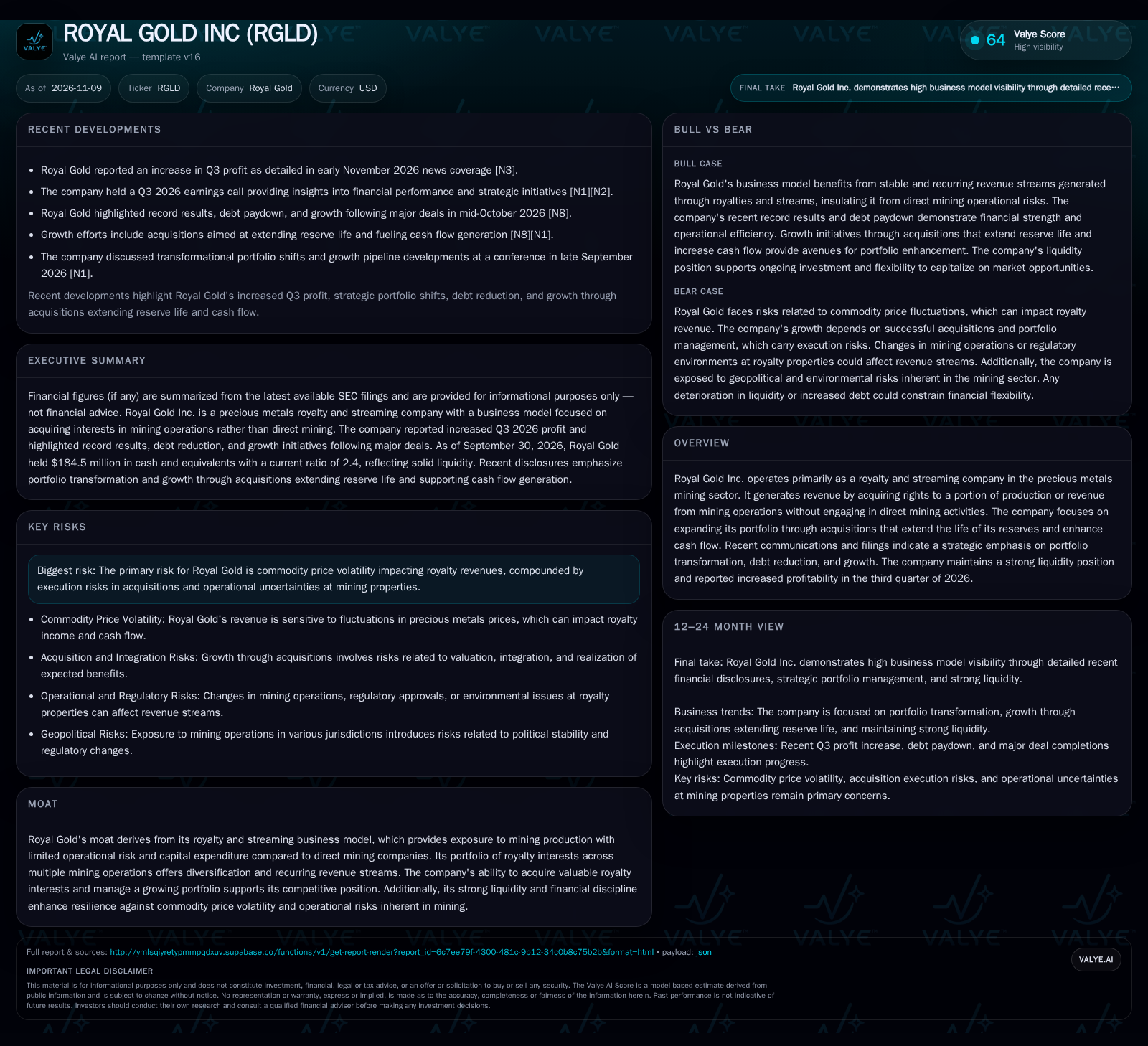
Royal Gold delivered a record Q3 in 2026, reporting net income of $227.4 million and holding $184.5 million in cash and equivalents as of September 30, 2026, with a current ratio of 2.4 [S1] [N3] [N8]. The company highlighted significant debt paydown and transformational portfolio growth following major acquisitions in October 2026 [N8]. These moves reflect a deliberate push to lengthen reserve life and underpin future cash generation. The company reported cash and liquidity metrics for the period; these figures do not by themselves establish operating runway, investment capacity, financial flexibility, or financing capacity.
How Royalty and Streaming Economics Shape Returns—and Risks
Royal Gold’s business model is built around acquiring royalty and streaming interests in precious metals mines, providing exposure to mine production without the direct capital intensity or operational risk of mining. Revenue is generated as a fixed percentage of production (royalties) or through the right to purchase a portion of output at pre-agreed prices (streams), both of which offer high-margin, capital-light cash flows when mines are operating and commodity prices are favorable.
The company’s cost base is predominantly fixed, with limited variable expense tied to the number of assets managed. This delivers substantial operating leverage when production or commodity prices rise but also exposes the business to sharp declines in revenue if mine output falls or if prices weaken. Capital needs are concentrated around new deal activity—acquiring new royalties or streams typically requires substantial upfront investment. Thus, Royal Gold’s ability to deploy capital efficiently, and to secure assets with long reserve lives and strong counterparty operators, is central to sustaining cash flow and portfolio value.
The recent debt paydown enhances the company’s flexibility to pursue new deals, but also raises the bar for future acquisitions: each new asset must be accretive not only on a headline basis, but also in terms of portfolio diversification, counterparty quality, and reserve duration.
Portfolio Quality, Sourcing Advantage, and the Pressure of Capital Competition
Royal Gold competes with other royalty and streaming companies—as well as private capital and sovereign wealth funds—for attractive deals in the precious metals sector. Its moat stems from the asset-light, recurring-revenue nature of the model, combined with long-standing operator relationships and a diversified portfolio of producing and development-stage assets.
However, competitive intensity in the royalty/streaming space has increased as more capital chases limited high-quality opportunities, pushing up acquisition prices and compressing potential returns. The ability to source proprietary deals, maintain discipline in underwriting, and avoid overpaying for assets is critical. Additionally, the value of the portfolio is ultimately tied to the operational and financial health of underlying mines—where Royal Gold has limited control. Substitution risk is relatively low for established royalty/streaming contracts, but competition for new assets is fierce, and mining companies may increasingly seek alternative financing structures if streaming terms are viewed as too onerous.
Translating Portfolio Expansion into Sustained Cash Flow Growth
The most favorable scenario for Royal Gold involves successful integration of recent acquisitions, with new assets delivering on production and reserve expectations. If commodity prices remain robust or trend higher, the company’s revenue and cash flow could expand meaningfully, leveraging the fixed-cost structure for margin expansion. Additional upside could come from further accretive acquisitions—financed through internally generated cash and selective use of balance-sheet capacity—that extend reserve life and diversify operator risk.
Evidence confirming this scenario would include: consistently rising royalty and streaming revenue, increasing average reserve life across the portfolio, stable or improving cash margins, and further debt reduction or prudent leverage for high-quality deals. Falsification would occur if newly acquired assets underperform, if commodity prices weaken sharply, or if acquisition discipline deteriorates (e.g., overpaying for marginal assets that dilute portfolio quality).
Disciplined Growth Amid Commodity and Operational Volatility
The most plausible path is that Royal Gold continues to deliver stable or modestly growing cash flow, driven by a diversified portfolio and occasional bolt-on acquisitions. Commodity price volatility will cause quarter-to-quarter swings, but the company’s exposure to a broad mix of assets and operators should buffer against extreme downside. The company is likely to remain disciplined in capital allocation, using its reported liquidity position to pursue only those deals that clearly extend reserve life and meet return thresholds.
Confirmation of this scenario would be steady portfolio reserve metrics, measured acquisition activity, stable dividend payments (if disclosed), and maintenance of a conservative balance sheet. The scenario would be challenged if a cluster of underlying mines face operational setbacks, if acquisition opportunities dry up or become uneconomical, or if sector-wide capital cost increases erode deal economics.
Commodity Price Shocks and Asset Underperformance Threaten Cash Flow Resilience
The adverse scenario would be triggered by a sustained decline in precious metals prices, combined with operational disruptions or underperformance at several key mines in Royal Gold’s portfolio. Because the company’s revenue is directly tied to both price and production volume, such a scenario would compress top-line results and challenge the maintenance of dividend payments or debt service if cash flow deteriorates.
Additional downside risk stems from integration missteps—if recent acquisitions fail to deliver on promised reserves or if counterparty financial distress leads to production curtailment or renegotiation of royalty terms. Confirmation of downside would be a marked decline in reported royalty/streaming revenue, asset impairments, negative portfolio reserve revisions, or the need to increase leverage to support ongoing operations.
Testing the Durability of Royal Gold’s Portfolio and Growth Model
Quarterly and annual royalty and streaming revenue growth, broken out by asset and commodity, would help track the effectiveness of portfolio expansion and exposure to price/volume swings.
Average remaining reserve life across the portfolio, if disclosed, will indicate the sustainability of future cash flows and the impact of recent acquisitions.
Operating performance updates from key underlying mines—especially those recently acquired—would help assess asset-level risk and upside/downside potential.
Cash margin per ounce or per dollar of revenue, if disclosed, would provide insight into the structural profitability and leverage of the business model.
Acquisition terms and integration progress, particularly for major deals completed in 2026, would clarify whether recent investments are delivering expected returns.
Sector-wide precious metals price trends and major regulatory or geopolitical events affecting portfolio jurisdictions could materially impact Royal Gold’s revenue and risk profile.
Disclaimer: This is research-only, informational analysis and not investment advice. It may include AI-generated interpretation and general industry context. Always verify important details using primary sources.

Comments