
Dutch Bros 2026: Expansion Ambitions, Menu Innovation, and the Stakes of Health-Conscious Consumer Shifts
Dutch Bros has achieved profitability amid rapid expansion, new product initiatives, and a complex risk landscape. The company’s future now hinges on sustaining shop-level economics, adapting to regulatory and health-driven consumer shifts, and maintaining its differentiation in a crowded quick-service beverage market.
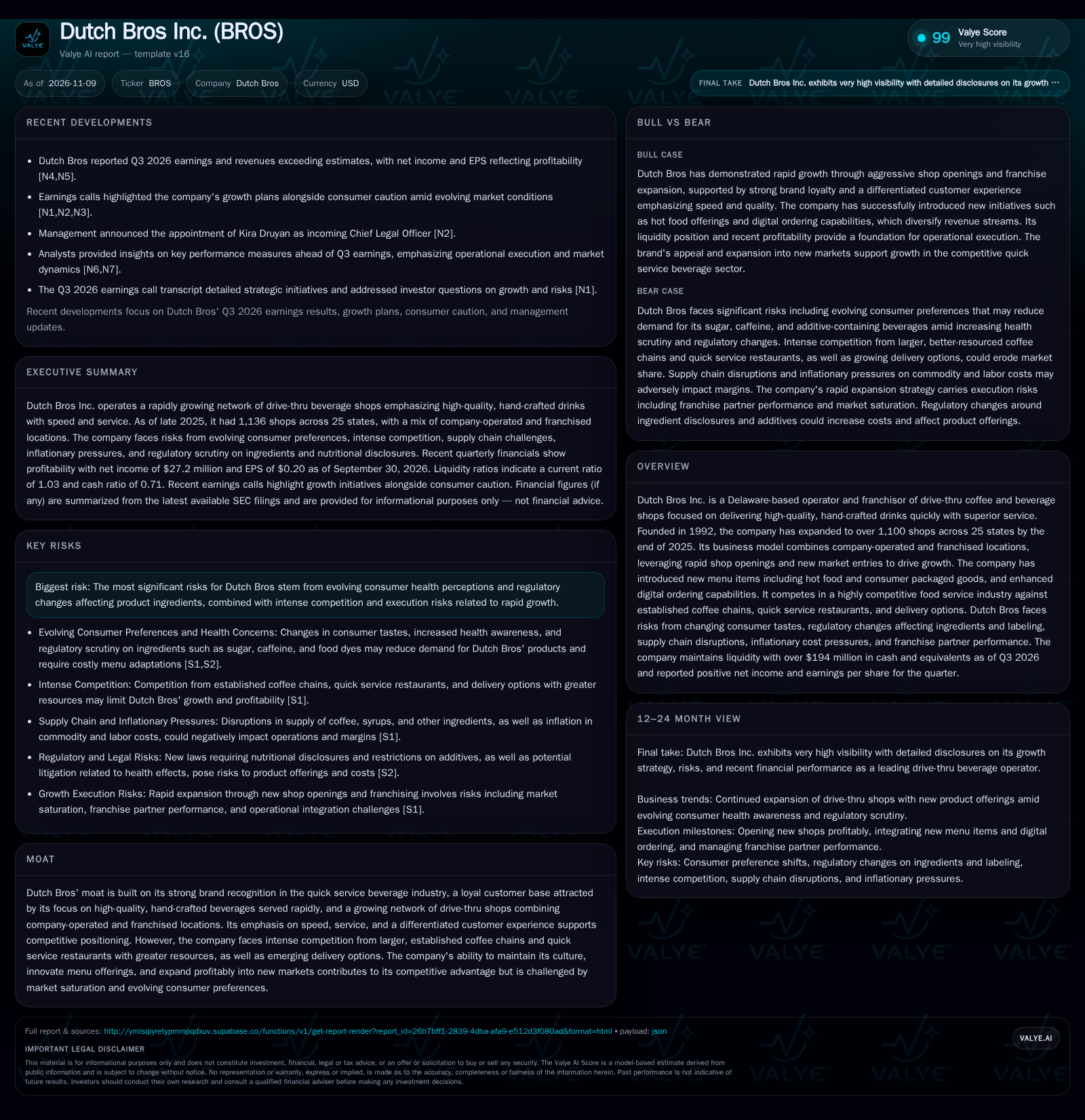
Dutch Bros reported Q3 2026 net income of $27.2 million with a current ratio of 1.03, reflecting operational profitability and near-term liquidity [S2]. With 1,136 shops across 25 states as of year-end 2025, the company continues its aggressive expansion and menu innovation strategy [S1]. The core question is whether Dutch Bros can preserve unit economics, brand loyalty, and growth momentum as health, regulatory, and competitive pressures mount.
Dutch Bros Inc. has reached a critical inflection point in its evolution from a regional drive-thru coffee contender to a national quick-service beverage brand. The company’s Q3 2026 results show sustained profitability and significant cash reserves, underlining the apparent success of its rapid expansion and product diversification strategies. Yet, as Dutch Bros pushes into new markets and categories, it must balance the demands of scale, menu innovation, and regulatory compliance with the potential for shifting consumer preferences and ever-intensifying competition. The next phase will test whether Dutch Bros’ distinctive brand and operational model can continue to deliver profitable growth in an industry where health trends and regulatory scrutiny are accelerating.
Profitability, Expansion, and Regulatory Scrutiny Define the Current Landscape
Dutch Bros reported net income of $27.2 million and EPS of $0.20 for Q3 2026, marking a period of sustained profitability as it continues its aggressive growth trajectory [S2]. The company ended 2025 with 1,136 shops across 25 states, of which 811 are company-operated and 325 are franchised [S1]. This mix underscores the dual focus on both direct operations and franchise expansion. Cash and equivalents stood at $194.6 million as of September 30, 2026, with a current ratio of 1.03, indicating neutral near-term liquidity [S2].
Strategically, Dutch Bros has leaned into menu innovation—introducing hot food options, expanding order-ahead capabilities to over 95% of locations, and piloting consumer packaged goods in select markets [S1]. However, these moves come against a backdrop of intensifying regulatory scrutiny on ingredients like sugar, caffeine, and food dyes, as well as heightened health awareness among consumers [S1] [S2]. These factors are now central to both the company’s risk profile and its operational agenda.
Unit Economics, Scale, and the Leverage of Shop-Level Performance
Dutch Bros’ revenue engine is driven by a mix of company-operated and franchised shops, each with distinct economics. Company-owned stores provide higher gross revenue capture but require greater upfront capital and ongoing operational oversight. Franchised locations offer capital-light expansion and recurring royalty streams but yield lower per-unit economics and introduce quality control and brand consistency risks.
The company’s rapid expansion strategy depends on opening new shops profitably—balancing initial capital outlay, ramp-up periods, and ongoing operating costs with the potential for high sales per location. Historically, drive-thru beverage concepts have benefited from high transaction throughput and variable cost structures, with labor, ingredients, and occupancy as primary cost drivers. The introduction of hot food and CPG products could increase average ticket size but may also add operational complexity and require investment in new equipment or supply chains.
Operating leverage is a double-edged sword: as fixed costs are spread across more locations and higher volumes, margins can expand rapidly if shop-level performance is strong. Conversely, underperforming new units or market saturation could erode profitability. Inflationary pressures on commodities and labor, as well as supply chain disruptions, remain material risks to cost structure and margin stability.
Brand, Service, and Differentiation in a Crowded Beverage Marketplace
Dutch Bros' competitive position hinges on a blend of experiential differentiation—emphasizing speed, friendliness, and a distinctive brand persona—and operational agility through its drive-thru format. The company has cultivated a loyal customer base, particularly in its legacy markets, by focusing on consistently high service levels and a unique menu profile.
However, Dutch Bros faces formidable competition from larger, more established coffee chains with national footprints, diversified menus, and substantial marketing budgets. Quick service restaurants and specialty beverage chains, as well as emerging delivery platforms, further intensify the fight for market share. Many competitors are adopting digital ordering, loyalty programs, and menu innovations that could dilute Dutch Bros’ differentiation.
A key challenge is sustaining the brand’s cultural and experiential edge as the company scales into new geographies and demographic segments. Market saturation—both within legacy regions and in new markets—could also pressure unit economics. The risk of competitors mimicking Dutch Bros’ format or value proposition is real, especially as digital and drive-thru models proliferate.
If Menu Innovation and Expansion Outpace Health and Regulatory Headwinds
In a favorable scenario, Dutch Bros continues to expand its shop footprint while successfully integrating hot food and CPG products, thereby increasing average ticket size and deepening customer engagement. The company leverages digital ordering and order-ahead capabilities to drive throughput and frequency, extracting greater value from each location.
If regulatory scrutiny on ingredients results in manageable compliance costs and Dutch Bros can adapt recipes or marketing without alienating its core customer base, the company could preserve brand loyalty while broadening its appeal. Continued profitability—even with margin pressures—would confirm the resilience of the business model.
Evidence supporting this scenario would include sustained or rising same-store sales, successful new market entries with strong initial performance, positive customer response to new menu items, and stable or expanding margins despite regulatory or commodity cost headwinds. Demonstrated ability to adapt to evolving health trends—such as through alternative sweeteners or cleaner label initiatives—would further validate the upside path.
Growth Continues, but Margin Pressures and Adaptation Costs Mount
The most plausible trajectory is that Dutch Bros sustains its expansion into new markets while experiencing a gradual increase in operational complexity and regulatory compliance costs. Shop openings remain robust, but per-unit economics show modest compression as the company enters less mature regions and faces higher competitive density.
Menu innovation—particularly hot food and CPG—contributes incremental revenue but also raises costs and operational requirements. Health-driven shifts in consumer preferences and regulatory changes on sugar, caffeine, and additives require ongoing recipe reformulation, nutritional disclosures, and marketing adjustments, pressuring margins and complicating execution.
Confirmation of this scenario would come from continued shop growth and overall revenue gains, offset by slower same-store sales growth or slight margin contraction. Evidence to the contrary would be a marked decline in new shop performance, significant pullback in menu initiatives, or failure to adapt to regulatory mandates.
Accelerating Health Concerns or Regulatory Shifts Disrupt Core Economics
In a negative scenario, consumer sentiment shifts sharply against high-sugar, high-caffeine, and artificially colored beverages, undermining Dutch Bros’ core menu appeal. Regulatory changes—such as bans or taxes on certain ingredients, or stricter labeling requirements—result in substantial compliance costs, forced menu changes, or product discontinuations.
If the company’s adaptations fail to resonate with its core demographic, or if competitors seize the health-conscious narrative more effectively, Dutch Bros could see declining same-store sales, erosion of brand loyalty, and underperformance of new units. Franchised locations may underdeliver, exacerbating operational and reputational risks.
This scenario would be validated by a sustained drop in same-store sales, contraction in shop-level profitability, accelerated closure of underperforming units, or negative customer sentiment tied to health and ingredient issues. Regulatory actions directly impacting the core beverage portfolio would be a major red flag.
Milestones and Data Points That Will Reveal Dutch Bros’ Next Chapter
Same-store sales growth trends, especially in newer markets, will be critical for gauging underlying demand and brand strength.
Unit economics of new shop cohorts—if disclosed—would clarify whether expansion is value-creating or dilutive.
Adoption rates and customer satisfaction with hot food and CPG offerings, tracked through basket size or product mix metrics, would help test the impact of menu innovation.
Gross margin and operating margin evolution, particularly in the face of commodity inflation and regulatory compliance costs, will reveal the business’s resilience.
Frequency of regulatory actions or ingredient-related news impacting the beverage industry at large could serve as early indicators of rising compliance burdens.
Franchise partner performance metrics—if available—would indicate the health of the franchise system and risk of quality dilution.
Digital ordering and order-ahead usage rates will indicate the success of Dutch Bros’ technology investments and their impact on throughput.
Customer retention and loyalty program participation rates, if disclosed, would provide insight into the durability of Dutch Bros’ brand engagement.
Disclaimer: This is research-only, informational analysis and not investment advice. It may include AI-generated interpretation and general industry context. Always verify important details using primary sources.

Comments