
Amplitude 2026: Platform Expansion, AI Ambitions, and the Stakes of Enterprise Analytics Economics
Amplitude’s Q3 2026 results point to renewed operational momentum, with platform and AI-driven expansion targeting enterprise analytics budgets.
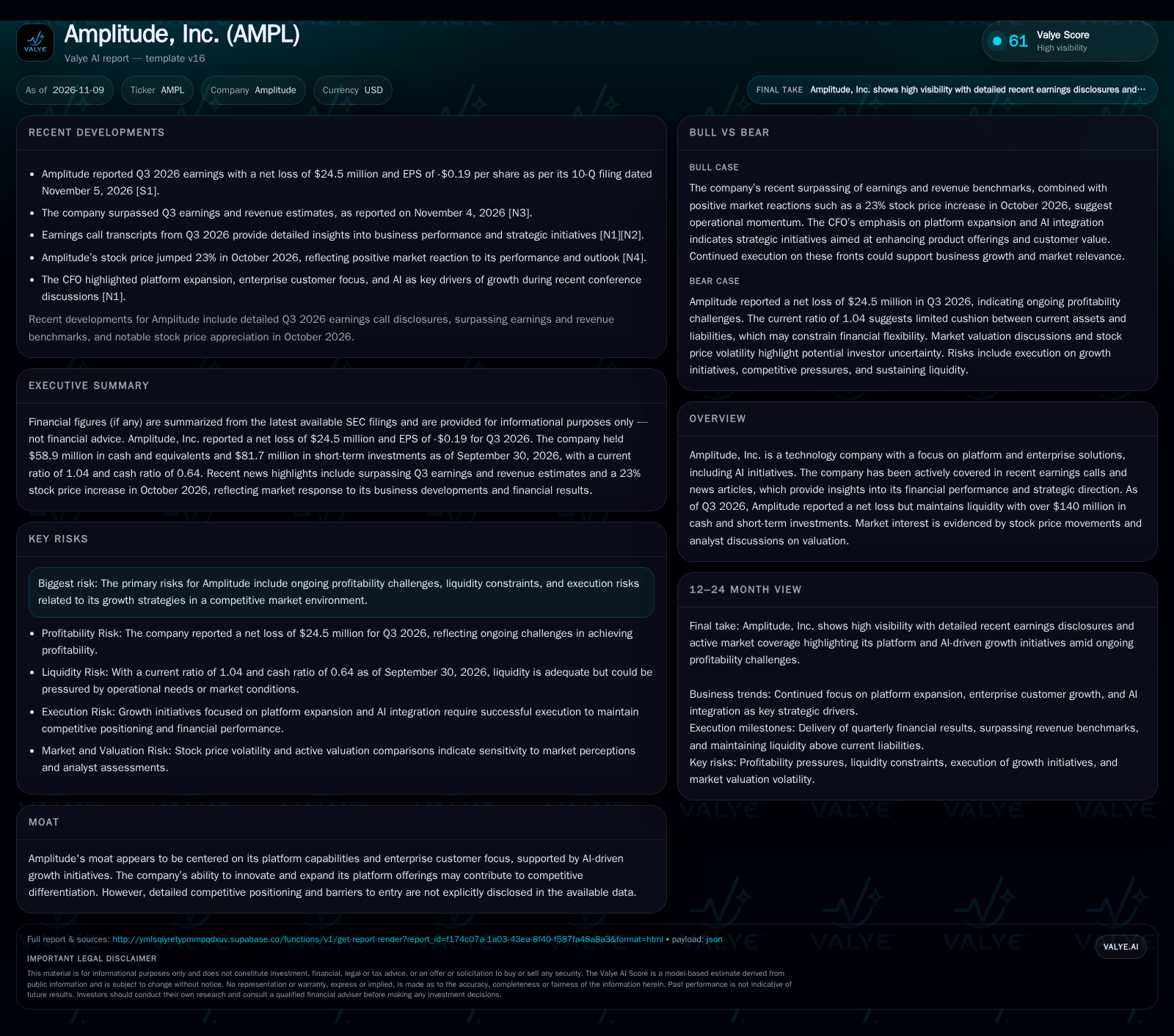
Amplitude reported a Q3 net loss but outperformed earnings expectations, driving renewed market interest. The central question: Can Amplitude’s platform and AI investments deliver margin expansion and revenue durability before potential financial flexibility erodes? [S1] [N1] [N3]
Amplitude, Inc. enters late 2026 with a renewed spotlight on its ability to scale a differentiated analytics platform for enterprise customers. While recent earnings beat expectations and triggered a sharp stock rally, the company continues to post net losses and maintains only a reported liquidity position buffer. The strategic bet is clear: leverage AI and platform breadth to win larger enterprise contracts and deepen customer integration. The challenge is equally stark—translate these investments into sustainable revenue growth and margin expansion before cash constraints limit strategic options or force a change in trajectory.
Operational Momentum Meets Financial Constraints in Q3 2026
Amplitude reported a net loss of $24.5 million for Q3 2026, with basic and diluted EPS of -$0.19 per share, continuing a pattern of unprofitability [S1]. As of September 30, 2026, the company held $58.9 million in cash and equivalents and $81.7 million in short-term investments, totaling $140.5 million in liquid assets. The company reported cash and liquidity metrics for the period; these figures do not by themselves establish operating runway, investment capacity, financial flexibility, or financing capacity. [S1]
Despite these financial challenges, Amplitude surpassed Q3 earnings and revenue estimates, which contributed to a 23% stock price increase in October 2026 [N3] [N4]. The CFO has publicly emphasized platform expansion, enterprise customer focus, and AI initiatives as key growth drivers on recent earnings calls [N1] [N2]. These facts set the stage for a company at a crossroads: operational progress is evident, but the margin for financial error is narrowing.
The Economics of Product Analytics: Volume, Value, and the Cost of Innovation
Amplitude’s core revenue model is likely rooted in a SaaS (Software-as-a-Service) structure, where customers—primarily enterprises—pay for access to its analytics platform. Pricing often scales with user seats, data volume, or feature tiers, and enterprise contracts can command higher average revenue per account (ARPA) compared to mid-market or SMB segments. The company’s push into AI-driven analytics and broader platform capabilities is intended to justify larger contract sizes, drive upsell/cross-sell, and reduce churn by embedding the product more deeply into customers’ workflows.
However, persistent net losses suggest that current gross margins and/or operating leverage are insufficient to absorb R&D, sales, and marketing outlays. AI and platform innovation require substantial upfront investment, especially when targeting sophisticated enterprise buyers. If Amplitude can achieve greater revenue mix from higher-margin enterprise deals, operating leverage may improve as revenue growth outpaces fixed costs. Conversely, if competitive pricing pressure or customer acquisition costs remain high, profitability may remain elusive. The company’s $140.5 million in liquid assets provides a buffer, but not an indefinite runway if losses persist [S1].
Enterprise Analytics: Platform Breadth, AI Differentiation, and the Contest for Customer Stickiness
Amplitude competes in a crowded digital analytics and product intelligence market, where established software vendors, cloud-native startups, and adjacent platform providers all vie for share. Potential competitor categories include horizontal analytics platforms, customer experience analytics providers, and cloud hyperscalers with bundled analytics offerings. Amplitude’s moat depends on its ability to offer differentiated analytics powered by AI, seamless integration with customer tech stacks, and workflow tools that become mission-critical for product and growth teams.
Switching costs in analytics rise if customers build data pipelines, dashboards, and automated decisioning processes around a vendor’s platform. AI initiatives may enhance stickiness if they enable predictive or prescriptive insights that are difficult to replicate elsewhere. However, barriers to entry are not insurmountable—customers can be enticed by bundled pricing, integration with broader cloud ecosystems, or superior feature sets from competitors. The question is whether Amplitude’s current innovation pace and platform breadth are sufficient to maintain pricing power and defend share as enterprise budgets tighten and competitors invest aggressively.
AI-Driven Platform Expansion Unlocks High-Value Enterprise Contracts
The most favorable scenario for Amplitude is that its investments in AI and platform capabilities resonate with enterprise buyers, leading to a step-change in average contract value and improved retention. If the company can deliver unique, actionable insights that materially impact product and business outcomes for its clients, customers may be willing to pay premium prices and expand usage.
Confirmation of this scenario would come from sustained outperformance versus revenue targets, a rising mix of large enterprise contracts, and evidence of declining churn or increasing net dollar retention. Additional indicators would include margin expansion as fixed costs are leveraged over a growing revenue base, and public customer references or case studies highlighting AI-driven wins. Falsification would be signaled by stagnating enterprise growth, flat or declining ARPA, or continued margin compression despite innovation outlays.
Incremental Gains as Platform Expansion and AI Adoption Progress, but Profitability Remains Distant
The most plausible path is one of gradual improvement: Amplitude continues to win enterprise business and expand its platform, but the pace of revenue and margin gains is offset by ongoing investment requirements and competitive friction. AI features are adopted, but may take several cycles to materially differentiate the product and justify higher price points or larger deployments.
In this scenario, the company maintains modest top-line growth and meets or modestly exceeds consensus expectations, but remains unprofitable through at least the next 12-24 months. Liquidity is managed carefully, with cash burn slowing but not eliminated. Evidence supporting this scenario would be continued earnings beats without meaningful net income improvement, stable or slightly reported liquidity-ratio trends, and incremental enterprise customer disclosures. A deviation would be seen if operating losses widen, liquidity erodes faster than expected, or the company is forced to raise capital or cut expenses.
Rising Costs and Competitive Intensity Outpace Revenue Gains, Forcing Strategic Retrenchment
Confirmation would come from missed revenue or margin targets, declining analyst sentiment, and a deteriorating balance sheet. If enterprise customers prove slow to adopt new platform features or AI-driven tools, or if competitors successfully undercut on pricing or integration, Amplitude may face churn or contract downgrades. The company could be forced into a strategic reset—scaling back innovation, restructuring sales, or exploring M&A—if it cannot restore a path to profitable growth.
Signals That Will Determine If Amplitude’s Platform and AI Thesis Can Deliver Sustainable Economics
Quarterly net retention rate, if disclosed, to gauge whether enterprise customers are expanding their usage and contract values over time.
Gross margin trends: improvement would suggest successful pricing or operational leverage from platform investments; compression could signal competitive or cost pressures.
Enterprise customer count and average contract value (ACV): rising numbers would confirm traction in the targeted segment.
AI product adoption metrics, if disclosed: customer case studies or usage data demonstrating that new AI features are driving engagement and upsell.
Churn or downgrade rates among large customers: elevated churn would undermine the stickiness thesis.
Product release cadence and integration announcements: regular, high-impact launches and new ecosystem partnerships would support the innovation narrative.
Any disclosure of planned capital raises, debt issuance, or cost restructuring as a response to liquidity pressures.
Disclaimer: This is research-only, informational analysis and not investment advice. It may include AI-generated interpretation and general industry context. Always verify important details using primary sources.

Comments