
SiTime 2026: MEMS Precision Timing at an Inflection—AI Demand, Supply Headwinds, and the Stakes of Portfolio Expansion
SiTime’s MEMS-based timing portfolio is positioned to disrupt legacy quartz solutions as AI datacenters and advanced electronics demand higher reliability and integration. Recent product launches and acquisitions expand its addressable market, but operational risks—from supply constraints to acquisition integration—will test whether SiTime can translate technical leadership into lasting economic advantage.
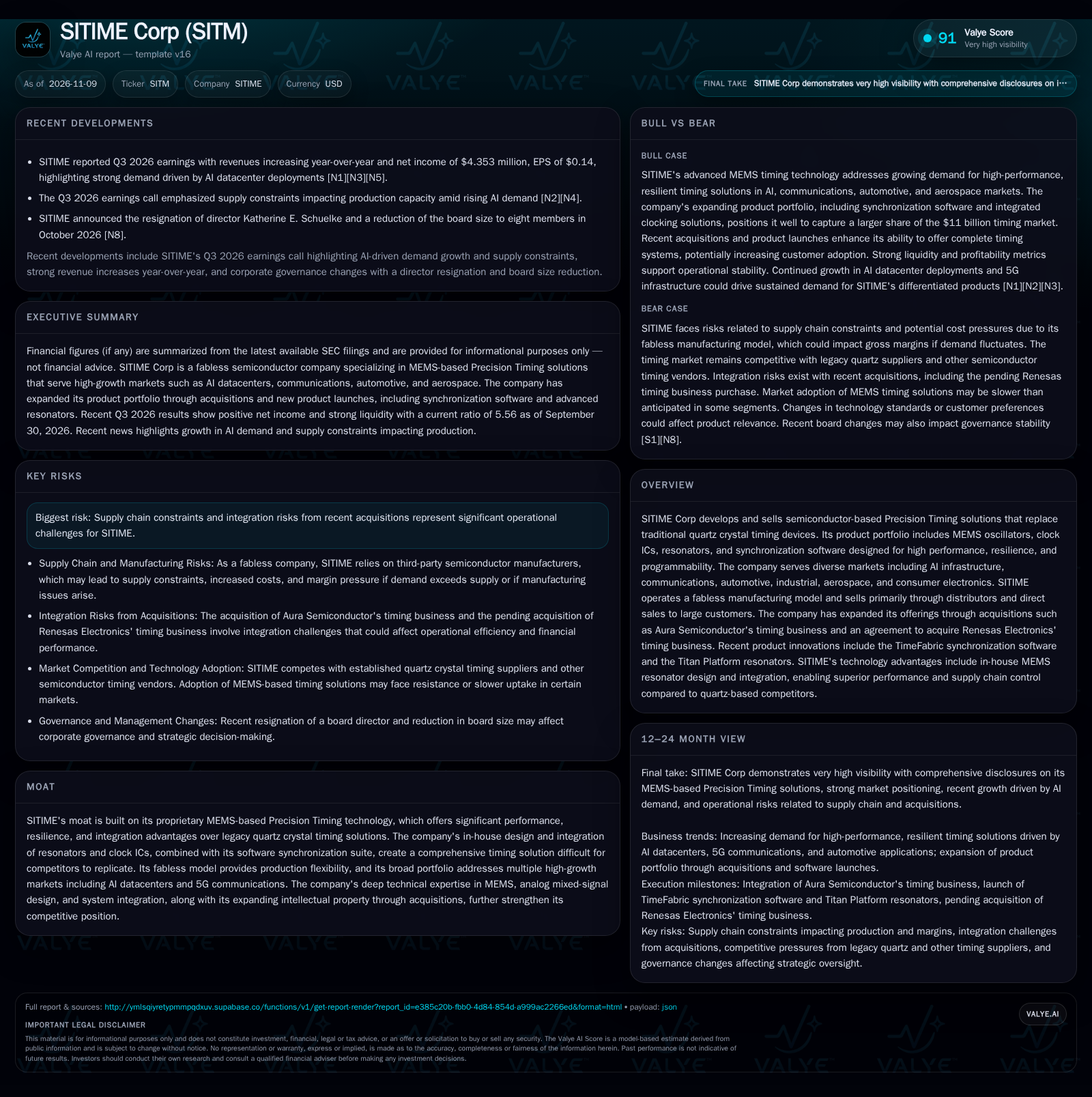
SiTime is expanding its MEMS precision timing portfolio through acquisitions and new products targeting high-performance markets like AI datacenters and automotive. The pending $1.5B Renesas timing business acquisition could accelerate scale, though integration and margin risks loom. The company's ability to execute on integration, manage supply, and capture share from legacy quartz incumbents will determine whether its technical edge converts to durable economic returns. [S1] [S2] [N2] [N8]
SiTime is at a strategic crossroads as it seeks to transform the $11 billion global timing market with its MEMS-based solutions, aiming to displace legacy quartz components across high-growth verticals like AI datacenters, communications, and automotive electronics. With a major acquisition of Renesas Electronics’ timing business pending and new product platforms coming to market, SiTime’s next phase will test whether its technology and expanded portfolio can deliver sustainable share gains and margin leverage—or whether operational hurdles will blunt its momentum. [S1] [S2] [N2] [N8]
Recent Financials, Product Expansion, and Supply Pressures Define SiTime’s 2026 Landscape
SiTime reported net income of $4.353 million for Q3 2026 and ended the quarter with current assets of $657.8 million against current liabilities of $118.4 million, yielding a current ratio of 5.56. This suggests a reported liquidity position as the company pursues both organic and acquisitive growth. [S2]
The company is in the process of acquiring Renesas Electronics’ timing business for approximately $1.5 billion in cash and stock, a move that, if completed, would significantly expand SiTime’s product breadth and customer base. [S1]
Recent product launches include the TimeFabric synchronization software suite (targeting AI datacenter applications) and the Titan Platform for standalone resonators, which reportedly improves performance by 100x versus prior solutions. [S1]
Despite these advances, the Q3 2026 earnings call and news coverage highlighted that SiTime is experiencing supply constraints, limiting its ability to fully capitalize on AI-driven demand growth. [N2] [N4]
MEMS Timing Economics: Margins, Scale, and the Challenge of Fabless Supply
SiTime’s business model is built around high-value, fabless MEMS timing devices and supporting software, with principal revenue drivers being the volume and mix of oscillators, clock ICs, resonators, and software licenses. As MEMS-based solutions replace quartz, they often command a premium due to superior performance, programmability, and integration capabilities—especially in demanding segments like AI infrastructure, automotive (ADAS), and communications.
Gross margins in MEMS timing can be attractive if the company leverages proprietary IP, in-house resonator design, and software value-add. However, as a fabless operator, SiTime is exposed to foundry pricing, supply bottlenecks, and potentially higher per-unit costs if it cannot secure sufficient wafer capacity or negotiate favorable terms with manufacturing partners.
Recent acquisitions (Aura Semiconductor’s clocking IP, pending Renesas timing business) could drive operating leverage by broadening the product set and enabling more complete clock-tree solutions, potentially increasing average deal size with customers. However, integration costs and the risk of duplicative R&D or sales expenses may temporarily compress margins.
Capital intensity remains relatively low compared to vertically integrated semiconductor peers, but large acquisitions—such as the $1.5B Renesas deal—will test SiTime’s ability to deploy capital efficiently while maintaining balance-sheet strength.
Technology Differentiation Versus Incumbency: SiTime’s Competitive Stakes in Precision Timing
SiTime’s core competitive advantage lies in its proprietary MEMS resonator and analog mixed-signal expertise, enabling higher precision, resilience, and integration than legacy quartz suppliers. Its recent moves to provide full clock-tree solutions (oscillators, clock generators, jitter cleaners, buffers, synchronization software) strengthen its ability to compete for system-level sockets in high-value applications.
However, the timing market is structurally competitive, with entrenched quartz incumbents (many with deep customer relationships), other MEMS timing entrants, and traditional clock IC suppliers. Switching costs for OEMs can be high due to qualification cycles, reliability requirements, and risk aversion, especially in automotive, aerospace, and communications.
SiTime’s fabless model allows for scalability and flexibility, but also exposes the company to supply-side risks not faced by integrated device manufacturers. The Renesas timing acquisition could potentially bring scale and customer diversification, but also places SiTime in direct competition with larger, more diversified semiconductor players.
A key differentiator may be SiTime’s software (e.g., TimeFabric), which could create higher switching costs and stickier customer relationships if it proves essential for next-generation AI datacenter and networking performance.
Complete Timing Solutions and AI Megatrend Drive Share Gains and Margin Expansion
If SiTime successfully integrates the Renesas timing business and Aura Semiconductor’s assets, it could become the go-to supplier for complete, high-performance timing solutions across AI datacenters, 5G, and automotive. The combination of MEMS hardware, advanced synchronization software, and broader clock-tree offerings could allow SiTime to displace legacy quartz incumbents and win multi-socket designs with major OEMs.
In this scenario, supply constraints ease—either through improved foundry relationships or capital allocation to secure capacity—enabling SiTime to fully capitalize on strong AI-driven demand and convert backlog into revenue. Operating leverage would be realized as the expanded product set drives higher average selling prices and margins, while R&D and SG&A are absorbed over a broader revenue base.
Evidence confirming this scenario would include: rapid revenue growth outpacing the broader timing market, sustained or expanding gross margins, large design wins in AI and automotive, and smooth integration of the Renesas assets with minimal customer attrition. Announcements of major OEM platform wins, successful cross-selling of software and hardware, and increased attach rates for synchronization solutions would also support the thesis.
Capturing AI and Edge Growth, but Supply and Integration Risks Cap Near-Term Upside
The most plausible trajectory is that SiTime continues to grow above the timing market average, driven by AI, communications, and automotive adoption of MEMS-based solutions, but is periodically constrained by supply chain bottlenecks and the complexities of integrating large acquisitions.
Revenue and margin growth are positive but volatile, with some upside from new product launches (TimeFabric, Titan Platform) and expanded customer reach following the Renesas deal. However, supply-side limitations and initial integration expenses prevent full operating leverage from being realized in the near term.
Indicators for this scenario would be continued positive net income and reported liquidity position, but with quarter-to-quarter fluctuations in revenue growth and margins. Progress on integration milestones—such as product roadmap alignment and customer retention from the acquired businesses—would confirm the base case. Persistent supply constraints or execution hiccups would reinforce this middle path.
Supply Disruptions, Integration Stumbles, and Competitive Pushback Undermine Momentum
A more adverse outcome could unfold if SiTime is unable to resolve ongoing supply constraints, leading to missed deliveries, dissatisfied customers, and lost design wins—particularly in fast-moving AI and communications markets where timing performance is mission-critical.
Integration of the Renesas timing business could prove more challenging than expected, with cultural clashes, product overlap, or customer attrition eroding the value of the acquisition. Cost overruns or delays could compress margins and strain the balance sheet, especially if anticipated revenue synergies fail to materialize.
Meanwhile, legacy quartz suppliers and integrated device manufacturers could respond aggressively—cutting prices, accelerating their own MEMS roadmaps, or leveraging longstanding relationships to slow SiTime’s share gains. In this scenario, SiTime’s technical edge is blunted by operational missteps and competitive retaliation.
Evidence for this downside scenario would include declining gross margins, negative net income, missed integration milestones, customer losses, or publicized manufacturing disruptions. A drop-off in new design wins or delays in product launches would also signal thesis impairment.
Milestones That Will Determine If SiTime’s Technology Edge Converts to Durable Gains
Quarterly gross margin and operating margin trends, especially as the Renesas acquisition closes and integration costs are absorbed.
Revenue growth rates in AI datacenter, automotive, and communications segments—if disclosed—versus overall timing market growth.
Supply chain updates, including foundry agreements, capacity expansions, or commentary on lead times and order fulfillment.
Progress on integration milestones for the Renesas timing business: product rationalization, customer retention, and cross-selling.
Design win announcements with major OEMs in AI, automotive, and communications, particularly where full clock-tree or software attach is involved.
Adoption rates and attach rates for new platforms (TimeFabric, Titan Platform), as disclosed by management or customer testimonials.
Board and management stability, including any further governance changes that might impact strategic execution.
R&D spending as a percentage of revenue, indicating ongoing investment in technology leadership versus acquisition-driven growth.
Disclaimer: This is research-only, informational analysis and not investment advice. It may include AI-generated interpretation and general industry context. Always verify important details using primary sources.

Comments