
Traeger’s Strategic Reset: Platform Ambitions, Channel Shifts, and the Cost of Reinvention
Traeger, Inc. is navigating a pivotal transformation—exiting direct-to-consumer sales, restructuring its global channel footprint, and betting on its IoT-enabled grilling ecosystem. Execution risk, supply-chain exposure, and persistent losses challenge the company’s ability to translate category leadership and community-driven brand power into durable profitability.
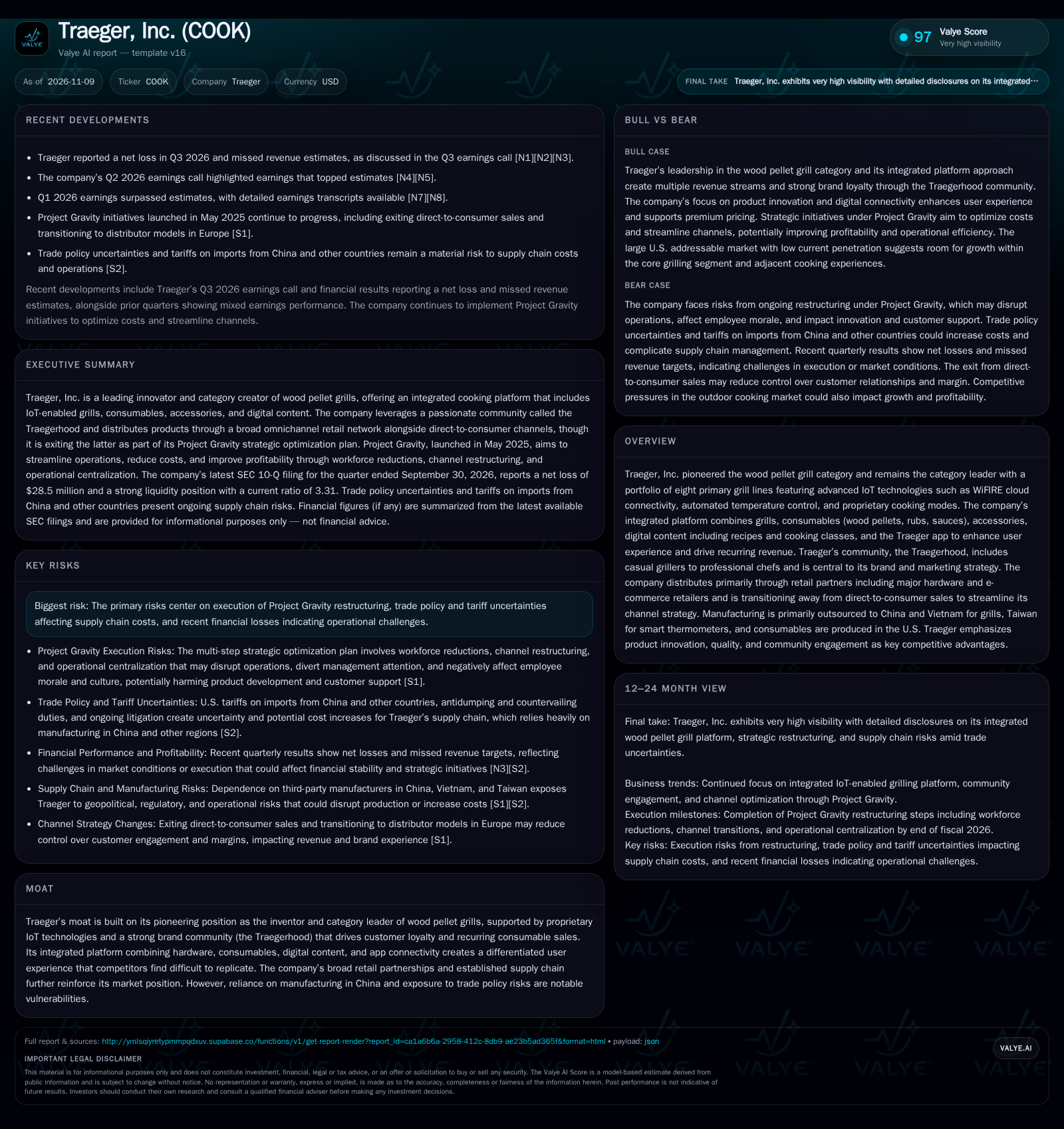
Traeger’s efforts to streamline operations through Project Gravity, exit direct-to-consumer sales, and shift to distributor models in Europe are intended to improve profitability and focus on core retail partnerships. However, continued net losses, missed revenue targets, and ongoing supply chain risks from tariff exposure highlight the uncertainty of this strategic reset’s success. The company’s integrated platform and community are competitive assets, but near-term execution and margin recovery remain the central questions. [S1] [S2] [N1] [N2] [N3]
Traeger, Inc.—pioneer of the wood pellet grill and architect of a connected outdoor cooking ecosystem—is at a strategic crossroads. Its ambitious Project Gravity restructuring aims to streamline the business, cut costs, and pivot away from direct-to-consumer channels toward a more focused retail and distributor model. While the company retains strong brand equity and a loyal community, its Q3 2026 net loss and ongoing supply chain headwinds underscore the high stakes of this transformation. Traeger’s ability to realize operational efficiencies, defend margins, and reignite growth will determine whether its platform vision yields durable value—or if category leadership alone is insufficient in an increasingly crowded and volatile outdoor cooking market. [S1] [S2] [N1] [N2] [N3]
Restructuring, Channel Realignment, and Persistent Losses Define Traeger’s Present
Traeger is in the midst of executing Project Gravity, a strategic overhaul launched in May 2025 to streamline the organization, reduce costs, and improve profitability. Key actions include workforce reductions, exit from direct-to-consumer sales, centralization of its MEATER smart thermometer business, and a transition to a distributor model in certain European markets. The company expects substantial completion of these initiatives by the end of fiscal 2026. [S1]
In its latest reported quarter (Q3 2026), Traeger posted a net loss of $28.5 million and missed revenue estimates, continuing a trend of uneven financial performance over the past year. [S2] [N1] [N2] [N3]
Grills remain Traeger’s core business, accounting for approximately 53% of 2025 revenue, with consumables (such as wood pellets) and accessories making up the remainder. [S1]
The company’s supply chain remains exposed to tariff and geopolitical risks due to its heavy reliance on manufacturing in China and Vietnam. [S1] [S2]
Hardware-Led Platform Model: Recurring Revenue Potential vs. Margin Realities
Traeger’s business model is anchored by the sale of premium, IoT-enabled wood pellet grills—the initial hardware purchase that brings customers into the ecosystem. This hardware-centric approach generates high upfront revenue per unit but typically involves lower ongoing margin visibility unless paired with successful attachment of recurring consumables and accessories.
Recurring revenue is theoretically supported by consumables (wood pellets, rubs, sauces) and accessories, which together made up roughly 47% of 2025 revenue. These categories can offer steadier margins and cash flow if customer retention is strong and usage is frequent. However, the company does not disclose specific metrics on retention rates, average customer lifetime value, or consumable attachment rates, so the durability of this revenue stream remains uncertain.
The company’s significant investment in IoT features (such as WiFIRE cloud connectivity and app integration) aims to deepen engagement and support higher average selling prices, but also introduces additional R&D and support costs. If these features drive brand differentiation and user stickiness, they could justify premium pricing and reduce price-based competition.
Operating leverage is plausible if fixed costs (R&D, marketing, supply chain infrastructure) are spread over a larger installed base. However, persistent net losses suggest either gross margin pressure or insufficient scale to absorb overhead, likely exacerbated by restructuring charges and channel transition costs. [S1] [S2]
Brand, Community, and Ecosystem: Durable Advantages or Eroding Edge?
Traeger’s first-mover status in the wood pellet grill category, proprietary IoT features, and the Traegerhood community underpin its brand moat. This combination aims to create emotional loyalty, ongoing engagement, and a differentiated experience that is difficult for generic grill competitors to replicate.
However, the broader outdoor cooking market is increasingly crowded, with traditional gas and charcoal grill manufacturers, newer pellet grill entrants, and adjacent smart appliances all vying for share. Many competitors have expanded into digital controls and app integration, eroding some of Traeger’s early-mover technological edge.
The company’s withdrawal from direct-to-consumer channels could weaken its direct relationship with customers, making it more reliant on retail partners for customer acquisition and upsell opportunities. This introduces potential for channel conflict, margin pressure, and reduced brand control.
Supply chain dependency on China and Vietnam exposes Traeger to risks that competitors with more diversified manufacturing bases may be better positioned to avoid. Any sustained cost increases due to tariffs or disruptions could narrow pricing power and compress margins further. [S1] [S2]
If Platform Engagement Drives Recurring Revenue, Margin Expansion Could Follow
In a favorable scenario, Project Gravity’s restructuring delivers meaningful cost savings, and the shift to a focused retail and distributor-driven model stabilizes revenue while reducing operating complexity. Traeger’s installed base of IoT-enabled grills continues to grow, deepening engagement through the Traeger app and digital content.
If the company is able to drive high consumable and accessory attachment rates—potentially bolstered by digital engagement and community-driven brand loyalty—recurring revenue streams could increase as a percentage of total sales. This would improve gross margin mix and reduce earnings volatility associated with hardware cycles.
Clear evidence of this scenario would include rising consumable and accessory sales per active grill, improved gross margins, and a return to operating profitability post-restructuring. Sustained growth in app users (beyond the 2.8 million reported for FY2025) and positive retention metrics would further validate the platform thesis. [S1]
Falsification of this scenario would come from continued stagnation or decline in consumables revenue, failure to achieve margin improvement after restructuring, or evidence that exiting DTC channels results in weaker customer engagement and lower average revenue per user.
Restructuring Delivers Cost Savings but Revenue Growth Remains Elusive
The most plausible near-term outcome is that Project Gravity yields some operating cost reductions and modest improvement in profitability, but top-line growth remains under pressure due to channel disruption, heightened competition, and macroeconomic headwinds.
Traeger’s exit from direct-to-consumer sales and the shift to distributor models in Europe may simplify operations but could also lead to lower margins and less control over the customer experience. Gains from cost savings may be offset by reduced pricing power and challenges in driving high-margin consumable and accessory sales through third-party retailers.
The company likely continues to face supply chain and tariff-related cost pressures, limiting potential for significant gross margin expansion until these risks are resolved or mitigated. Quarterly results may remain uneven, with periods of improvement punctuated by setbacks tied to seasonality or external shocks.
Confirmation of this scenario would come from reporting a gradual narrowing of net losses, stable or slightly improving gross margins, and steady (but not accelerating) active user and consumable sales metrics. Persistent lack of operating profitability or flat revenue would undermine the platform growth thesis.
Execution Missteps and External Shocks Compound Losses
In an adverse scenario, Project Gravity fails to deliver the intended cost savings or disrupts core operations, leading to further deterioration in profitability. The exit from direct-to-consumer channels may backfire if retail partners do not compensate for lost direct sales, resulting in lower revenue and reduced brand engagement.
Supply chain disruptions—whether from tariffs, geopolitical instability, or manufacturing issues in China and Vietnam—could drive up costs and cause product shortages, eroding customer loyalty and opening the door for competitors to capture share.
If Traeger is unable to grow recurring revenue from consumables and accessories, the business remains highly dependent on cyclical hardware sales, increasing earnings volatility and limiting operating leverage.
Evidence for this outcome would include widening net losses, declining gross margins, loss of retail shelf space, or reported challenges in maintaining supply chain continuity. Negative trends in app engagement or community activity would further signal erosion of the company’s competitive position.
Milestones That Will Reveal Whether Traeger’s Platform Transformation Succeeds
Progress toward substantial completion of Project Gravity restructuring by the end of fiscal 2026, including cost savings realized and workforce centralization results. [S1]
Trends in gross margin and operating margin post-restructuring—improvement would support the thesis that channel and cost actions are working. [S2]
Reported growth in consumables and accessory revenue per active grill or per app user—if disclosed—would clarify recurring revenue strength.
Active user growth and engagement metrics for the Traeger app, including retention rates and frequency of use—would help test the stickiness of the platform.
Quarterly net income and cash flow trends, particularly any shift toward consistent operating profitability. [S2]
Changes in retail partner mix and shelf presence, as well as any reported loss of key retail relationships.
Supply chain developments—such as material tariff changes, diversification of manufacturing partners, or reported disruptions.
Any management commentary or disclosed metrics on customer lifetime value, repeat purchase rates, or attachment rates for consumables and accessories.
Disclaimer: This is research-only, informational analysis and not investment advice. It may include AI-generated interpretation and general industry context. Always verify important details using primary sources.

Comments