
JOBY Aviation 2026: The Stakes and Scenarios of Scaling Urban Air Mobility
As JOBY Aviation approaches potential commercial launch—with Dubai possibly preceding the U.S.—the company’s vertically integrated strategy, capital resources, and regulatory progress set the stage for a pivotal year. But execution, certification, and adoption risks loom large as the eVTOL market transitions from promise to reality.
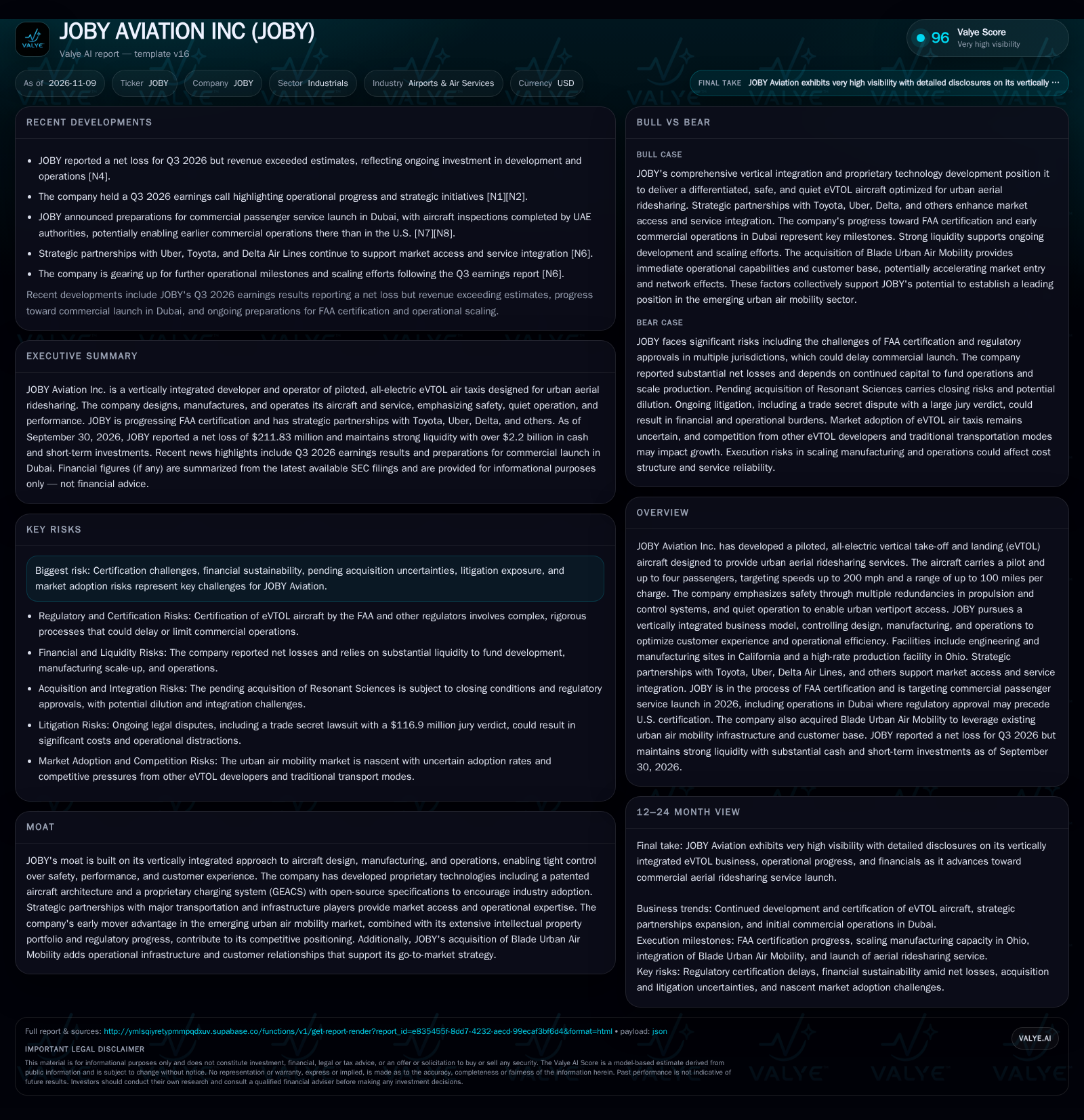
JOBY Aviation is nearing commercial operations for its all-electric eVTOL air taxis, with Dubai positioned as an early launch market. However, regulatory, operational, and market adoption risks remain high as the company seeks to transition from development to scaled commercial service. [S1] [S2] [N7] [N8]
JOBY Aviation stands at the threshold of a commercial inflection point in the urban air mobility sector. With its piloted, all-electric eVTOL aircraft designed for city ridesharing, JOBY is preparing for initial passenger flights—potentially in Dubai ahead of the U.S.—as regulatory milestones near. The company’s reported liquidity position, vertically integrated model, and strategic partnerships could enable it to capitalize on early market entry. However, the next year will test whether JOBY can surmount certification, operational, and adoption risks to convert technical achievement into viable, scaled business operations.
Dubai Readiness, Capital Position, and Certification Timelines Define Near-Term Outlook
JOBY’s most material current development is its progress toward commercial launch in Dubai, where local authorities have completed aircraft inspections. This raises the possibility of JOBY operating the first paying eVTOL passenger flights in the UAE before securing FAA certification in the U.S. [N7] [N8]. This milestone could validate the air taxi model in a real-world, high-visibility market and set a precedent for global regulatory acceptance.
Financially, JOBY reported a Q3 2026 net loss of $211.83 million but maintains $521.5 million in cash and equivalents alongside $1.68 billion in short-term investments as of September 30, 2026. The company reported cash and liquidity metrics for the period; these figures do not by themselves establish operating runway, investment capacity, financial flexibility, or financing capacity. [S2]
Strategically, the acquisition of Blade Urban Air Mobility gives JOBY immediate access to urban air mobility infrastructure and a customer base in key metropolitan corridors, potentially accelerating network effects as commercial operations commence [S1].
However, certification with the FAA remains pending, and the company faces material risks including a $116.9 million jury verdict in a trade secret dispute and the uncertain closing of the Resonant Sciences acquisition [S2].
How JOBY’s Vertically Integrated Model Could Shape Unit Economics and Profit Pathways
JOBY’s vertically integrated approach—designing, manufacturing, and operating its own eVTOL aircraft and ridesharing service—aims to capture the full economic stack from vehicle sales or operation to end-customer experience. This structure could enable superior margin retention compared to a pure OEM or platform model, provided scale economies and high utilization are achieved.
The core revenue model comprises three channels: (1) company-operated air taxi services, (2) affiliate-operated services using JOBY aircraft, and (3) direct sales, including to defense and international customers [S1]. The relative mix will be critical: company-operated services could yield higher lifetime value per aircraft but require significant upfront capital and operational risk, while direct sales may offer faster revenue recognition but less recurring margin.
Pricing power is unproven and will depend on passenger willingness to pay for time savings, convenience, and perceived safety versus traditional transport. Early deployments in Dubai and with partners like Delta could serve as bellwethers for price elasticity and load factors. Variable costs will be driven by battery cycles, maintenance, pilot wages, and vertiport fees, while fixed costs will hinge on manufacturing scale, R&D amortization, and infrastructure investment.
Capital intensity remains high: ongoing certification, facility build-outs (notably in Ohio), and proprietary charging infrastructure (GEACS) will continue to consume cash until meaningful commercial volumes are reached [S1]. If JOBY can demonstrate high utilization per airframe and operational efficiency, operating leverage could materialize rapidly—but low initial utilization or regulatory setbacks could delay breakeven.
Strategic Partnerships, Intellectual Property, and Early Mover Status: Durable Advantages or Temporary Lead?
JOBY’s competitive stance is built on several pillars: a robust intellectual property portfolio, proprietary aircraft architecture, and a proprietary charging system (GEACS) with open-source elements to encourage ecosystem adoption [S1]. The company’s focus on safety (with multiple redundancies) and quiet operation is designed to win regulatory and community acceptance for urban deployments.
Partnerships with Toyota (manufacturing and supply chain expertise), Uber (platform integration), Delta and ANA (network and loyalty access), and Dubai RTA (regulatory/infrastructure alignment) give JOBY a potential edge in market entry, distribution, and operational learning [S1]. The Blade acquisition further accelerates access to established urban routes and customers.
However, the eVTOL space is crowded with well-funded competitors—including other eVTOL developers and traditional aerospace incumbents—each pursuing different approaches to certification, operations, and ecosystem building. Substitution risk from ground-based rideshare, premium automotive, and even high-speed rail in dense city pairs is non-trivial if eVTOL convenience or cost advantages are not realized.
A central question is whether JOBY’s early regulatory progress, proprietary technology, and vertically integrated model will translate into sustainable switching costs, network effects, or brand loyalty—or whether the market will commoditize as certification barriers fall and more aircraft enter service.
If Dubai’s Launch Proves the Model: The Virtuous Cycle of Adoption, Network Effects, and Capital Efficiency
A favorable scenario for JOBY sees the Dubai launch proceeding on schedule, with positive customer adoption and regulatory validation. Early operational data could demonstrate high load factors, on-time performance, and safety, attracting both consumer interest and regulatory confidence globally.
This would enable JOBY to accelerate U.S. and international certifications, leverage Blade’s urban infrastructure, and expand via both owned and affiliate operators. Strategic partners could facilitate rapid market expansion, and proprietary infrastructure (GEACS) could become a potentially leading standard, deepening ecosystem lock-in.
The virtuous cycle: strong early adoption improves utilization and margins, attracting more partners and customers, which in turn funds further expansion and product improvement. Evidence confirming this scenario would include: robust Dubai ridership and utilization metrics (if disclosed), early regulatory approvals in additional markets, and affiliate/operator orders for additional aircraft.
Urban Air Mobility’s Inaugural Years: Gradual Ramp, Mixed Adoption, and Proving the Operating Model
The most plausible trajectory is a gradual, city-by-city ramp of eVTOL operations, with Dubai providing proof of concept but not immediate mass adoption. Regulatory approval in the U.S. may lag, pushing broader revenue inflection into 2027 or later. Early load factors and pricing may require adjustment as customers weigh cost, convenience, and perceived safety.
The service mix may tilt toward company-operated routes initially, with affiliate and direct sales growing as the market matures.
Confirmation would come from sequential increases in utilization, gradual expansion of certified routes, and positive feedback from early customers and partners. Falsification would involve persistent low adoption, regulatory delays, or cost overruns that erode the cash runway.
When Execution, Regulation, or Litigation Derail Early Momentum
In a negative outcome, regulatory delays—especially with the FAA—push U.S. commercial service further into the future, while Dubai adoption proves tepid due to operational hiccups, safety incidents, or weak consumer demand. High cash burn continues as fixed costs remain elevated and manufacturing scale is not achieved.
Litigation, such as the $116.9 million trade secret verdict, could drain resources or distract management, especially if additional legal risks materialize or the Resonant Sciences acquisition encounters integration or regulatory hurdles [S2]. Competitive pressure from rival eVTOLs or improved ground-based mobility could further limit revenue growth.
This scenario would be confirmed by continued net losses without clear progress to breakeven, regulatory setbacks, legal or acquisition complications, or a need for dilutive capital raises.
Milestones and Metrics That Will Clarify JOBY’s Path to Commercial Viability
Progress and timeline of FAA certification for JOBY’s eVTOL aircraft; delays or acceleration here will directly impact U.S. launch potential.
Operational data from Dubai: passenger volumes, load factors, on-time statistics, and customer satisfaction (if disclosed) will indicate early product-market fit.
Utilization rates per aircraft and route; high utilization is essential for favorable unit economics and operating leverage.
Mix of company-operated, affiliate-operated, and direct sales revenue as commercial operations scale; a useful metric would be segment disclosure if reported.
Cash burn trajectory and remainingreported liquidity position relative to commercial ramp milestones; continued high burn without revenue inflection would be a red flag.
Resolution status and financial impact of ongoing litigation, especially the trade secret dispute and outcomes related to Resonant Sciences acquisition.
Expansion and adoption of the GEACS charging infrastructure, both for internal use and as an industry standard, would help test ecosystem leverage.
Disclaimer: This is research-only, informational analysis and not investment advice. It may include AI-generated interpretation and general industry context. Always verify important details using primary sources.

Comments