
Yum China 2026: Brand Scale, Regulatory Risk, and the Challenge of Sustained Expansion
Yum China’s latest quarter underscores the financial power of its KFC and Pizza Hut brands, but margin pressures, a sub-1 current ratio, and intensifying regulatory and competitive headwinds in China complicate the path for its coffee and retail growth ambitions.
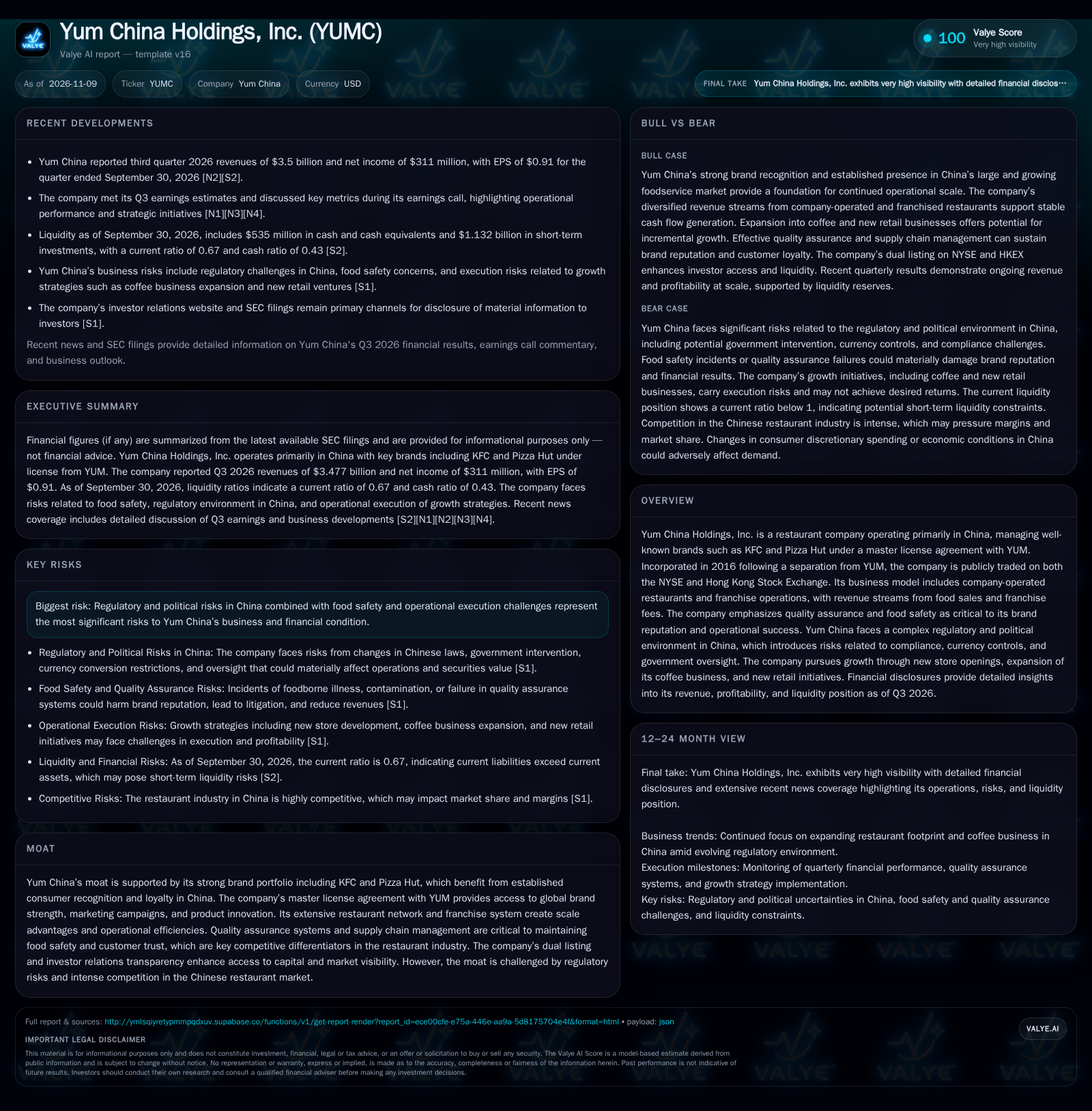
Yum China reported Q3 2026 revenues of $3.477 billion and net income of $311 million, confirming ongoing scale and profitability from its core restaurant brands [S2] [N2]. However, a current ratio of 0.67 and cash ratio of 0.43 signal a need for careful near-term liquidity management [S2]. Growth initiatives in coffee and new retail face both execution and market acceptance risks, while the company’s fortunes remain tightly linked to China’s regulatory climate and consumer trends [S1] [S2].
Yum China’s third quarter 2026 results reinforce its status as the leading Western quick-service operator in China, with $3.5 billion in revenue and $311 million in net income driven by its KFC and Pizza Hut brands [S2] [N2]. Yet, the company’s below-par current ratio and the escalating complexity of China’s regulatory and competitive landscape mean that future performance will depend not just on scale, but on tight execution, adaptation to shifting consumer habits, and prudent financial stewardship. The stakes are heightened as Yum China pursues growth in the crowded coffee and retail segments, navigating both the benefits and burdens of its YUM brand heritage.
Q3 2026 Results Highlight Scale and Emerging Financial Tensions
Yum China reported $3.477 billion in revenue and $311 million in net income for the third quarter of 2026, confirming the continued strength of its core KFC and Pizza Hut brands as the backbone of its financial performance [S2] [N2]. These results met market expectations and were accompanied by public discussion of operational execution and strategy [N1] [N3] [N4].
The company’s liquidity snapshot as of September 30, 2026, shows $535 million in cash, $1.132 billion in short-term investments, current assets of $2.608 billion, and current liabilities of $3.918 billion—a current ratio of 0.67 and cash ratio of 0.43 [S2].
Yum China’s strategy continues to emphasize expansion into coffee and new retail formats, but these initiatives are still subject to significant execution and market risk, especially in China’s fast-evolving consumer landscape [S1].
Core Restaurant Economics Meet Expansion Ambitions
Yum China’s money-making engine is its portfolio of company-operated and franchised restaurants, with KFC and Pizza Hut as the primary revenue drivers. The economic model blends high-volume, standardized menu items with scale-driven supply chain efficiencies, supporting both gross margin stability and operating leverage in mature markets.
Revenue streams include direct food sales from company-operated stores and franchise fees from franchised units. Franchising offers capital-light growth and higher-margin, recurring fee income, while company-operated units allow for greater control but require more upfront investment and working capital.
Expansion into coffee and new retail formats—such as specialty beverages and convenience-focused store concepts—could diversify revenue and boost average ticket size, but these ventures typically involve lower initial margins, higher promotional intensity, and require upfront capital for store development and marketing. If successful, scale could eventually improve margins, but early-stage economics are more volatile and dependent on brand acceptance.
Fixed costs (rent, labor, supply chain) are significant, so top-line growth can drive operating leverage. However, rising labor costs, ingredient inflation, and competitive pricing pressure could erode margins if not offset by productivity gains or mix shift to higher-margin products.
Brand Power, Scale, and the Battle for Consumer Loyalty
Yum China’s primary competitive advantage is the strength and ubiquity of its KFC and Pizza Hut brands—a legacy built over decades, with deep localization of menus and marketing for Chinese consumers. This brand equity supports customer loyalty and helps attract franchisees.
However, the Chinese restaurant sector is fiercely competitive, with domestic QSR chains, local fast-casual concepts, and international entrants all vying for share. Digital-first local brands, food delivery aggregators, and convenience stores further fragment the landscape and can erode traditional QSR traffic.
The company’s master license agreement with YUM ensures access to global brand assets, product innovation, and marketing campaigns, but also creates dependence on the parent for strategic direction and brand stewardship. This dynamic can be both a strength, in terms of global best practices, and a constraint, if local market needs diverge from global standards.
Regulatory scrutiny and compliance requirements in China are an ongoing challenge, as is the risk of sudden policy shifts or food safety incidents that could damage reputation and customer trust.
If Coffee and Retail Expansion Achieve Scale, Margin Mix Could Improve
A favorable outcome for Yum China would see its coffee and new retail initiatives gain traction, driving incremental traffic, higher average ticket, and improved utilization of existing store infrastructure. If these segments achieve scale and brand resonance, they could provide higher-margin, capital-light growth that diversifies away from core fried chicken and pizza dependence.
Evidence supporting this scenario would include sustained same-store sales growth in coffee and retail segments, improved store-level economics, and positive customer adoption metrics—such as loyalty program uptake or repeat purchase rates—if disclosed. Margin expansion, particularly in the face of labor and input cost inflation, would reinforce the thesis that new formats are additive rather than dilutive.
Confirmation would also come from management commentary or disclosure of accelerated store openings, franchise interest in new concepts, and limited promotional discounting needed to drive adoption.
Mature Brands Steady the Ship but Growth Hinges on Execution
The most plausible trajectory is that Yum China’s core KFC and Pizza Hut brands continue to anchor steady revenue and profit, with incremental but uneven contributions from coffee and retail expansion. The company sustains operational scale, but faces periodic margin pressure from labor cost inflation, supply chain volatility, and aggressive local competition.
Growth remains positive but moderates as new concepts require time to scale and competitive intensity caps pricing power.
This scenario would be confirmed by stable or modestly rising same-store sales in core brands, continued profitability, and gradual—rather than breakout—expansion in coffee and retail. Absence of major food safety or regulatory setbacks would be critical to maintaining this base case.
Regulatory or Food Safety Shock Could Trigger Margin and Liquidity Stress
A negative scenario could unfold if Yum China faces a severe regulatory intervention, abrupt policy change, or a high-profile food safety incident. Such events could lead to temporary or permanent restaurant closures, large-scale reputational damage, and rapid sales declines.
Given the company’s current ratio below 1, a sudden revenue shock could rapidly strain liquidity, forcing asset sales, debt issuance, or reduced investment in growth initiatives. Margins would compress further if promotional activity is needed to regain customer trust.
This downside would be confirmed by negative headlines around regulatory sanctions, store closures, or food safety investigations, as well as abrupt declines in same-store sales and negative operating cash flow. Management guidance cuts or changes to store opening plans would also signal stress.
Milestones and External Forces That Will Shape Yum China’s Trajectory
Trends in same-store sales growth for both core brands and new coffee/retail formats, if disclosed, as a direct indicator of consumer demand and competitive positioning.
Store count growth and composition—particularly the ratio of company-operated to franchised units, and the pace of new concept rollouts.
Gross and operating margin trends, especially in the face of rising input and labor costs.
Liquidity evolution: changes in current ratio, cash levels, and working capital management steps disclosed in future filings.
Evidence of regulatory or policy shifts affecting QSR operations or foreign-invested enterprises in China.
Food safety or quality assurance incidents reported in the media or company disclosures.
Management commentary on coffee and retail business performance, including any data on customer retention, ticket size, or digital engagement.
Disclaimer: This is research-only, informational analysis and not investment advice. It may include AI-generated interpretation and general industry context. Always verify important details using primary sources.

Comments