
Lyntris 2026: Defense Contracting Scale, Funding Reliance, and the Stakes of Government-Driven Growth
Lyntris Inc. supports over 200 defense programs and 150 customers with advanced sense-to-act connectivity solutions, but its financial trajectory and long-term relevance are tightly coupled to U.S. government appropriations, sole-source contracting, and the evolving priorities of national security technology.
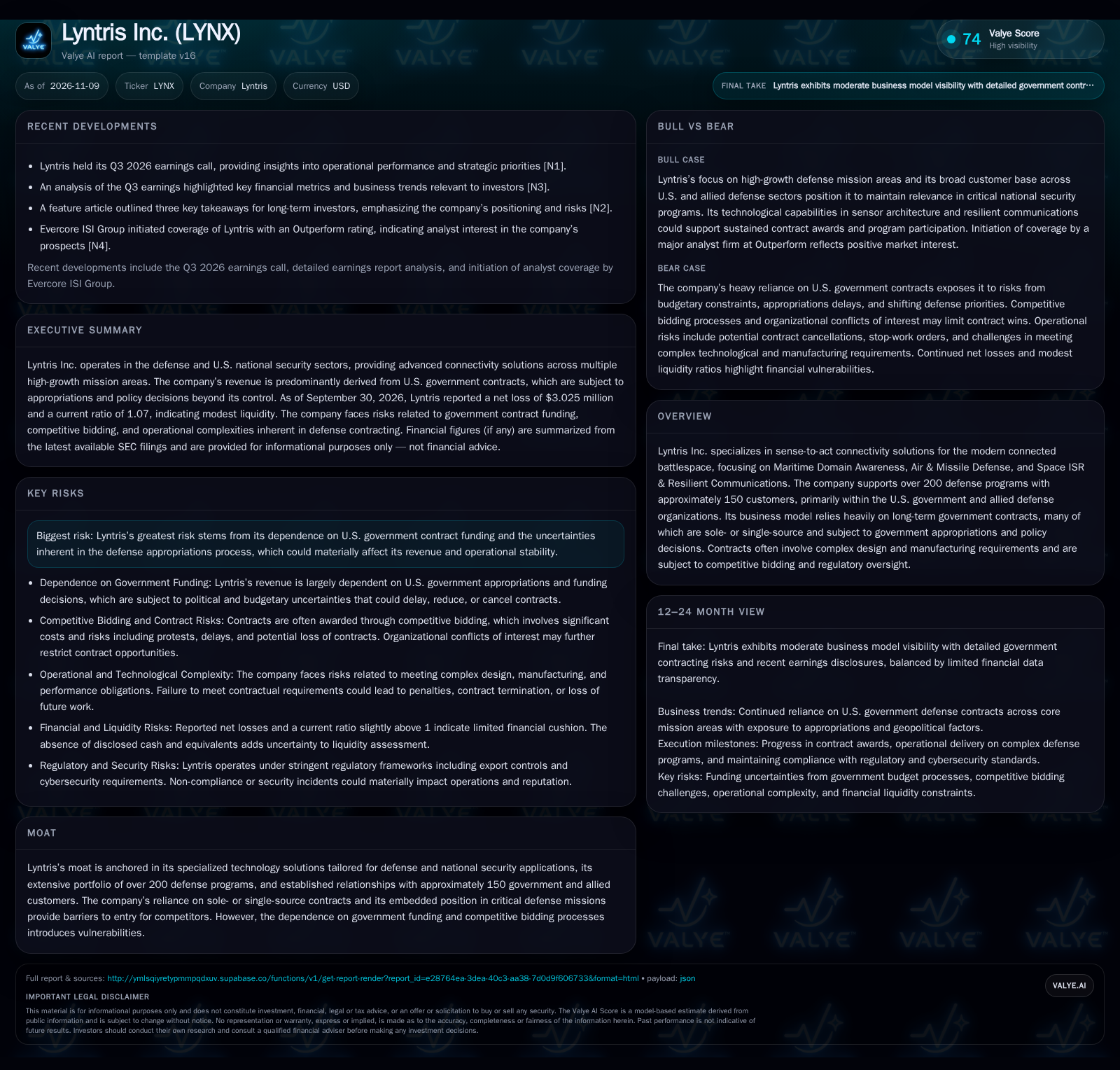
Lyntris operates at scale within the U.S. defense sector, serving over 200 programs and 150 customers, with 89% of its revenue tied to U.S. government contracts as of Q3 2026. Despite market interest and a broad mission set in maritime, missile defense, and space, the company reported a net loss and maintains only reported liquidity position. Its future hinges on government funding cycles, contract execution, and its ability to manage operational and regulatory complexity in a highly competitive and policy-driven environment. [S1] [N1] [N3] [N4]
Lyntris Inc. occupies a strategically significant but operationally challenging position in the U.S. defense-industrial landscape, delivering connectivity solutions for over 200 programs spanning maritime, missile defense, and space. With 89% of revenue sourced from U.S. government contracts—primarily sole- or single-source—the company enjoys embedded relationships but faces acute exposure to the unpredictable rhythms of federal appropriations and evolving national security priorities. Despite recent external validation and a broad mission footprint, Lyntris’s reported liquidity position and persistent net losses underscore the financial and executional tightrope inherent in defense contracting. The company’s long-term value proposition will be defined by its ability to secure appropriations, deliver on complex programs, and adapt to the shifting terrain of defense technology and procurement. [S1] [N1] [N3] [N4]
Operational Scale and Funding Exposure Define Lyntris’s 2026 Snapshot
As of September 30, 2026, Lyntris supports over 200 defense programs and approximately 150 customers, with 89% of its revenue for the first nine months of 2026 derived from U.S. government contracts—most in sole- or single-source positions. This entrenched role provides visibility into critical national security missions across maritime, air, and space domains. The overwhelming reliance on appropriations and government funding cycles introduces material risk to both revenue consistency and operational planning. Analyst initiation at Outperform by Evercore ISI Group reflects market confidence but does not reduce the underlying exposure to exogenous budgetary decisions. [S1] [N1] [N3] [N4]
How Government Contracting Shapes Revenue, Margin Potential, and Financial Leverage
Lyntris’s business model is built on long-term, complex government contracts—primarily sole- or single-source—which typically provide some pricing stability but are still subject to annual appropriations and periodic recompete. Revenue streams are largely non-recurring in the pure commercial sense, as each contract can be subject to policy-driven modification, termination, or delay. The company’s technology focus—spanning sensor architecture, hardware, and secure communications—suggests high upfront engineering and integration costs, with variable margins depending on contract type (cost-plus, fixed-price, or indefinite delivery/indefinite quantity).
Operating leverage is likely present at scale due to the fixed cost of technology development and systems integration, but is capped by the episodic and uncertain nature of government funding. Capital needs are driven by the requirement to pre-fund program execution and maintain compliance with stringent regulatory and cybersecurity standards. Cash flow can be lumpy, depending on milestone payments, contract modifications, and the timing of government outlays. [S1]
Barriers and Vulnerabilities: Sole-Source Advantage Meets Procurement Risk
Lyntris’s core advantage lies in its embeddedness within over 200 defense programs and its specialized technology tailored for high-priority national security missions. Sole- or single-source contract positions can create switching frictions—customers may be reluctant to risk operational continuity or security by changing vendors. This position also limits the field of direct competitors to a small set of highly specialized defense contractors with the requisite clearances, technical capabilities, and program history.
However, these advantages are counterbalanced by the realities of government procurement: contracts are subject to competitive bidding at renewal, and organizational conflicts of interest may disqualify Lyntris from pursuing certain opportunities. Substitution risk exists if government priorities shift toward newer technologies (such as AI-driven autonomous systems or commercial-off-the-shelf solutions) or if funding is redirected to other mission areas. The company’s broad customer base—spanning Navy, intelligence, primes, and allied defense organizations—provides some diversification, but the fundamental exposure to U.S. appropriations and policy cycles remains acute. [S1]
Sustained Appropriations and Program Wins Could Unlock Margin Expansion
A favorable trajectory for Lyntris would involve sustained or increased defense appropriations in its core mission areas, leading to the renewal and expansion of existing programs and the award of new sole-source contracts. If the company successfully executes on complex program requirements—demonstrating technical superiority and on-time delivery—it may deepen its relationships with key agencies and secure additional long-term positions. Margin expansion could result if Lyntris is able to leverage its fixed R&D investment across a growing portfolio, while winning higher-value contracts with favorable terms.
Confirmation of this scenario would come from a visible uptick in contract awards or modifications, improved operating income, and evidence of higher program renewal rates. Analyst upgrades, positive customer references, and announcements of new technology deployments in priority defense domains would further support the bull case. Falsification would occur if appropriations in key areas stagnate or decline, or if Lyntris loses sole-source status on major programs.
Navigating Appropriations Volatility While Maintaining Program Breadth
The most plausible outcome is that Lyntris continues to operate at scale within the defense contracting ecosystem, experiencing periodic volatility in revenue and operating margin as a function of appropriations cycles and competitive bidding outcomes. The company retains a significant footprint across maritime, missile defense, and space missions, but growth is episodic and dependent on both execution and external funding.
Incremental improvements in contract execution, compliance, and technology delivery may allow Lyntris to maintain or slightly expand its program footprint. Confirmation would come from stable program counts, recurring customer engagement, and steady (if uneven) revenue streams. Falsification would be indicated by a sharp reduction in awarded programs, material contract cancellations, or an inability to cover operating costs without further dilution or borrowing.
Funding Shocks, Contract Cancellations, and Liquidity Erosion
A negative scenario for Lyntris would be triggered by appropriation delays, budget cuts, or shifting defense priorities that lead to contract cancellations, stop-work orders, or a reduction in sole-source designations. This would result in declining revenue, underutilized R&D and manufacturing capacity, and mounting operating losses. If the company is unable to secure new business at a pace sufficient to offset lost contracts, cash flow could deteriorate and liquidity could become a binding constraint.
Downside confirmation would include a drop in the number of active programs, rising operating losses, late or missed deliveries, and negative disclosures regarding contract disputes or regulatory compliance failures. The absence of new contract wins or visible customer endorsements in core mission areas would further validate the bear case.
Milestones That Will Clarify Lyntris’s Trajectory in Defense Contracting
The quarterly number and total value of new contract awards—especially sole- or single-source positions—would help validate Lyntris’s continued embeddedness in critical missions.
Disclosure of contract renewal rates, particularly in high-priority domains such as maritime and space ISR, would provide insight into customer retention and competitive resilience.
If disclosed, the mix of contract types (cost-plus vs. fixed-price) and associated gross margins would clarify the underlying economics and risk profile.
Trends in operating cash flow and working capital requirements, beyond static balance-sheet ratios, would reveal the company’s ability to self-fund program execution.
Evidence of successful delivery milestones—such as on-time system deployments or customer acceptance events—would signal operational execution and de-risk future awards.
Announcements of new technology integrations or expansions into adjacent mission areas would indicate Lyntris’s ability to adapt to evolving defense priorities.
Disclosures regarding regulatory compliance, cybersecurity incidents, or contract disputes would help assess operational and reputational risk.
Disclaimer: This is research-only, informational analysis and not investment advice. It may include AI-generated interpretation and general industry context. Always verify important details using primary sources.

Comments