
Inseego 2026: FWA Expansion, Margin Pressures, and the Stakes of Carrier Concentration
Inseego’s 2026 pivot—defined by the Nokia FWA acquisition and a sharper 5G focus—brings expanded product breadth and deeper carrier engagement, but also exposes the company to margin volatility, integration execution, and concentrated customer risk. The company’s ability to convert technology positioning into durable, profitable growth remains an open question as operating expenses rise and liquidity tightens.
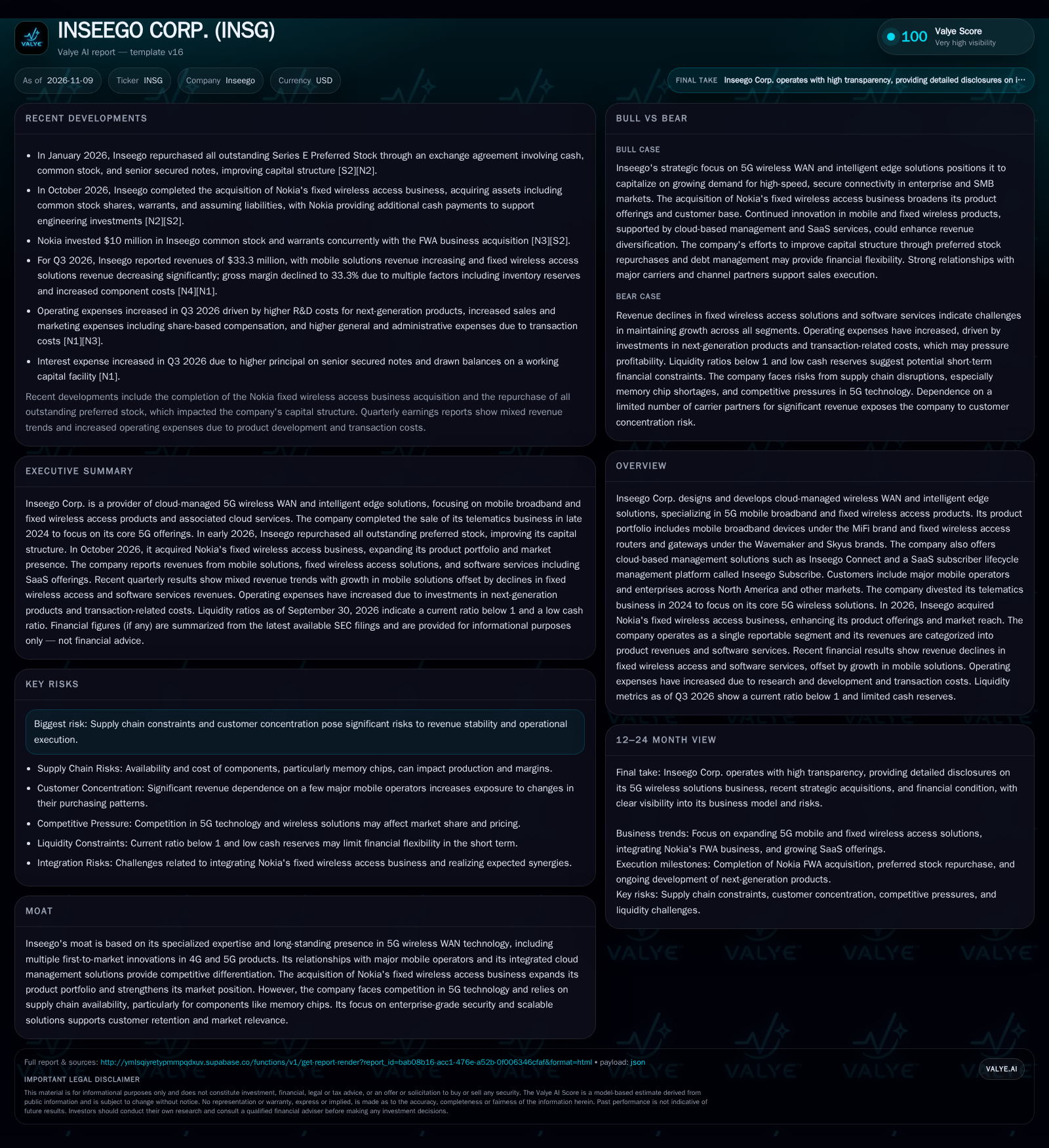
Inseego’s acquisition of Nokia’s fixed wireless access business and its continued investment in 5G WAN solutions expand its market reach and product portfolio, but the company faces tangible headwinds: gross margins have dropped, operating expenses are up, and liquidity is tight. The company’s reliance on major carrier customers and the challenge of integrating new assets increase execution risk, even as industry demand for 5G connectivity grows. Whether Inseego can translate its strategic moves into sustainable economics will depend on successful integration, margin recovery, and diversification of its customer base. [S2] [N2] [N3]
Inseego’s 2026 transformation—marked by the acquisition of Nokia’s fixed wireless access business and a sharpened focus on 5G WAN and edge solutions—signals a bid to capture greater share of the enterprise connectivity market. The sharp swing in fixed wireless access revenues, driven by major carrier purchasing patterns, highlights both the growth opportunity and the hazards of customer concentration. As Inseego integrates new assets and chases scale, its ability to stabilize margins and diversify its revenue base will determine whether its strategic reset delivers on its promise.
Strategic Moves Reshape Portfolio but Expose Margin and Liquidity Strains
The completion of Inseego’s acquisition of Nokia’s fixed wireless access (FWA) business in October 2026 marks a significant expansion of its 5G solutions portfolio and engineering capabilities. The deal included a $10 million equity investment and a $10 million cash payment from Nokia earmarked for interoperability R&D, underscoring the strategic intent to accelerate product integration and market reach. [S2] [N2] [N3]
However, Q3 2026 results reveal acute financial pressures: gross margin fell to 33.3% (from 41.6% the prior year), primarily due to lower software services revenues, inventory reserves, and higher component costs. Revenues declined 27.5% year-over-year, driven by a $13.5 million drop in FWA sales to a key carrier, only partially offset by higher mobile broadband sales. [S2] [N1]
Operating expenses rose due to increased R&D (for next-generation products), higher sales and marketing outlays, and transaction costs. Liquidity is tight—Inseego reported $6.6 million in cash and equivalents and a current ratio of 0.93 as of September 30, 2026. [S2] [N1] [N3]
Revenue Composition and Margin Dynamics in a 5G-Centric Model
Inseego’s revenue model blends hardware sales (MiFi mobile devices, Wavemaker and Skyus FWA routers) and recurring software/services, primarily through cloud-managed platforms and its Inseego Subscribe SaaS. Historically, the company’s higher-margin SaaS and software services have helped offset the lower gross margins of hardware sales. The Q3 2026 margin compression reflects a mix shift toward hardware (as FWA sales fell sharply) and increased costs for components, suggesting limited pricing power in the near term. [S2] [N1]
The business is capital intensive, with working capital needs for inventory, R&D, and ongoing integration of acquired assets. As operating expenses rise—partly due to higher R&D and sales/marketing for next-gen product launches—fixed costs are climbing faster than gross profit, eroding operating leverage.
Interest expense has also increased, driven by higher senior secured note balances and working capital facility usage. This structure implies that, unless Inseego can restore higher-margin software revenues and/or achieve meaningful scale in hardware, the path to sustainable profitability remains challenging.
Carrier Partnerships, Product Breadth, and the Realities of a Crowded 5G Landscape
Inseego’s core strength lies in its technical expertise in 5G WAN and mobile broadband, as well as longstanding relationships with major North American carriers (T-Mobile, Verizon, AT&T) and Canadian partners. The Nokia FWA acquisition adds depth to its product lineup, potentially enabling cross-sell and up-sell opportunities in the enterprise and carrier channel.
However, the 5G hardware and managed services market is intensely competitive, with alternative suppliers ranging from large network OEMs to nimble device startups. Major carriers wield significant bargaining power and can shift volumes quickly based on price, performance, and integration needs—evidenced by the sharp Q3 revenue drop tied to a single carrier’s purchasing decision. Substitutes such as in-house carrier solutions, integrated CPE from global OEMs, and alternative wireless access technologies create a cap on pricing power and limit differentiation to areas such as software integration, security, and customer support.
Inseego’s competitive position will depend on its ability to deliver integrated hardware-software offerings, deepen SaaS adoption (where switching costs can be higher), and diversify its revenue base beyond a handful of large carriers.
If Integration Delivers and SaaS Scales, Margin Recovery and Growth Could Follow
A favorable outcome for Inseego hinges on successful integration of the Nokia FWA business, leading to a strengthened, more complete product suite and deeper carrier relationships. If the company can leverage Nokia’s technology, cross-sell to new verticals, and accelerate adoption of its Inseego Subscribe and Connect cloud platforms, software/services revenue could grow, restoring gross margins toward historical levels.
Evidence supporting this scenario would include a rebound in software services (SaaS) revenue, stabilization or growth in FWA hardware sales to multiple carrier partners (reducing concentration), and margin improvement despite ongoing R&D investment. Additional wins in enterprise and government verticals, as well as visibility into multi-year SaaS contracts, would further validate the thesis.
Near-Term Volatility as Inseego Absorbs FWA Assets and Battles Margin Headwinds
The most plausible path is a period of operational volatility as Inseego integrates the Nokia FWA assets, contends with rising costs, and works to diversify its customer base. Hardware sales may remain lumpy, reflecting carrier procurement cycles, while software/services revenue faces pressure from competitive pricing and slower adoption.
In this scenario, gross margin remains below recent historical averages, and operating expenses stay elevated due to integration costs and continued R&D. Liquidity constraints may limit flexibility, particularly if working capital needs rise or if major carrier orders remain inconsistent. Confirmation would come from continued margin and revenue swings, persistent negative operating leverage, and tight cash balances. Falsification would require evidence of margin stabilization, improved cash flow from operations, and a more balanced hardware/software mix.
Carrier Concentration and Integration Risks Amplify Financial Fragility
An adverse scenario emerges if Inseego fails to integrate the Nokia FWA business swiftly, leading to operational disruption, missed cross-sell opportunities, and further customer attrition. If key carriers reduce orders or switch to competitors, revenue concentration could become acute, driving further gross margin compression.
In this case, persistent declines in FWA and SaaS revenues, combined with high fixed costs and elevated interest expense, could push the company toward a liquidity crisis. Additional working capital strain or supply chain shocks—especially for critical components—would exacerbate the situation. Evidence for this scenario would include continued year-over-year revenue declines, further gross margin erosion, shrinking customer count, and deteriorating balance sheet metrics.
What Will Determine If Inseego’s 5G Bet Pays Off?
Quarterly gross margin trends, especially any recovery or further erosion, will indicate whether product and SaaS mix is moving in a favorable direction. [S2] [N1]
Revenue concentration by carrier partner: monitoring the proportion of sales to top customers will reveal progress on diversification or worsening dependency. If disclosed, multi-year contract wins or losses would be highly informative.
Growth rate and mix of software services/SaaS revenue versus hardware sales—acceleration in SaaS would suggest improved margin resilience and potential for stickier customer relationships. [S2]
Integration milestones for the Nokia FWA business—updates on cost synergies, technology interoperability, and product roadmap execution will gauge the pace and success of integration.
Quarterly R&D spend and product launch cadence: continued investment is necessary for competitiveness, but excess spending without revenue conversion would be a red flag.
Supply chain stability and component cost trends, especially for memory chips, as ongoing volatility could impact margins and fulfillment.
Management commentary on pipeline, vertical market expansion, and new customer additions—if disclosed—will help test the thesis of broader market penetration.
Disclaimer: This is research-only, informational analysis and not investment advice. It may include AI-generated interpretation and general industry context. Always verify important details using primary sources.

Comments