
NewLake Capital Partners: Navigating Cannabis Real Estate’s Regulatory and Credit Risk Maze
With a focused portfolio of 34 state-regulated cannabis properties under triple-net leases, NewLake Capital Partners faces both the income stability of specialized real estate and the volatility of a federally gray market. The company's financials highlight steady rent collection and prudent cash management, but persistent regulatory uncertainty and tenant credit risks remain central to its future trajectory.
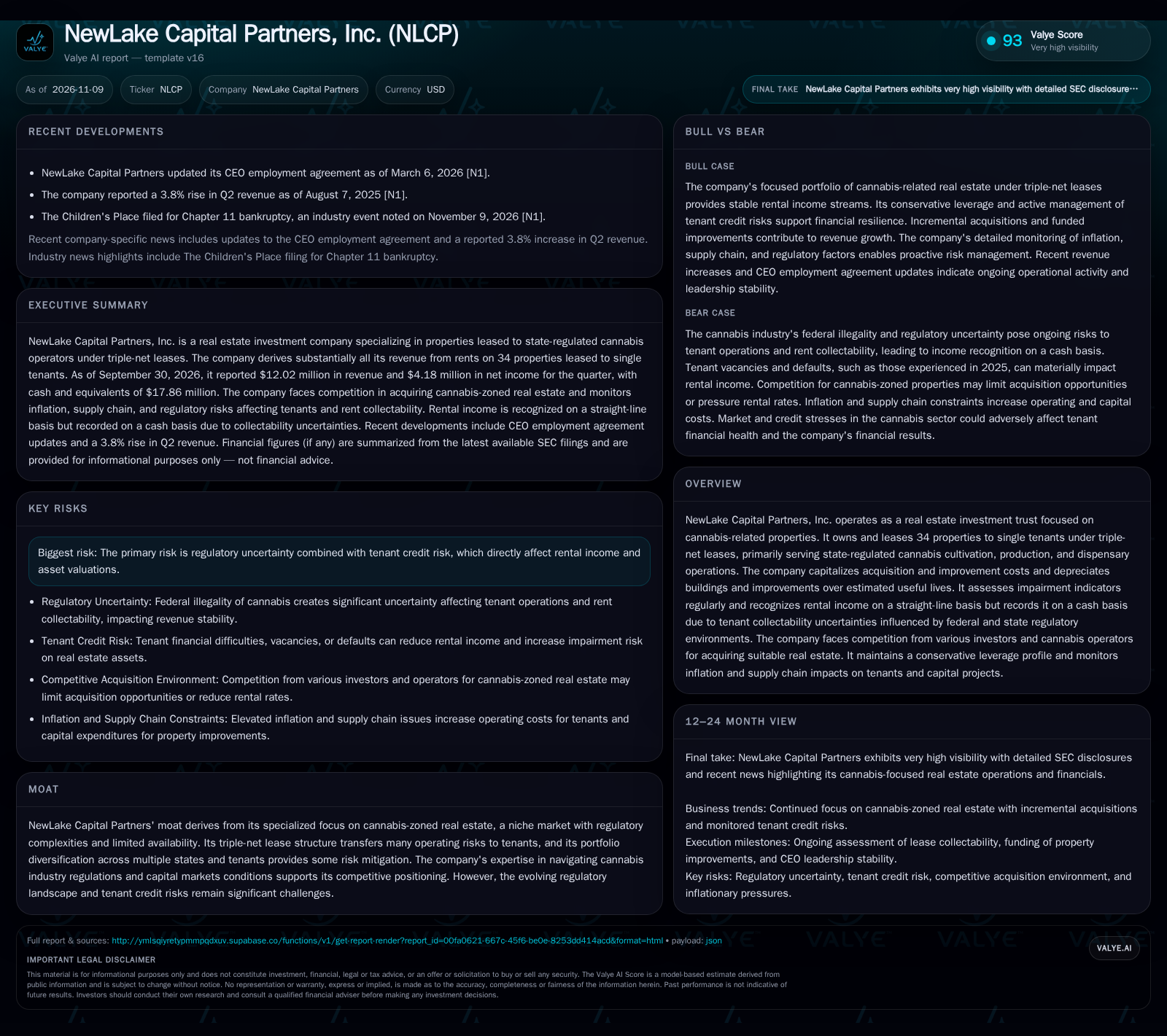
NewLake Capital Partners operates as a cannabis-focused real estate investment company, leasing 34 properties to single cannabis tenants under triple-net leases. While recent financials show stable rental income and conservative cash management, ongoing regulatory uncertainty and tenant credit risk are critical challenges. The company’s performance will hinge on its ability to manage tenant health and adapt to evolving cannabis regulations. [S1] [S2]
NewLake Capital Partners sits at the intersection of two volatile realities: the promise of state-legal cannabis and the persistent risks of federal prohibition. By owning and leasing 34 cannabis-zoned properties to single tenants under triple-net leases, the company seeks to deliver stable rental income while shifting many operating costs to tenants. However, the unique regulatory headwinds facing the cannabis sector—combined with tenant credit risk and competition for limited real estate—mean that NewLake’s apparent financial stability is continuously tested by industry and legal uncertainties. Its future depends on managing these risks while capitalizing on the growth and institutionalization of legal cannabis real estate.
Recent Financials and Portfolio Snapshot: What Stands Out Now
As of September 30, 2026, NewLake Capital Partners reported $12.02 million in revenue and $4.18 million in net income for the quarter, maintaining a cash and cash equivalents balance of $17.86 million [S2]. The company’s portfolio consists of 34 properties leased to single cannabis operators, primarily for cultivation, production, or dispensary use [S1]. These properties are operated under triple-net leases, which transfer many responsibilities—including taxes, insurance, and maintenance—to the tenant. Rental income is recognized on a straight-line basis but recorded on a cash basis due to persistent concerns around collectability, reflecting the sector’s heightened tenant credit risk and regulatory unpredictability [S1]. Recent activities include further property acquisitions and funding of improvement allowances, indicating ongoing, if measured, portfolio growth [S1]. These facts highlight both the company’s steady current cash generation and its exposure to tenant and regulatory risks, which remain central to its business outlook.
How the Cannabis Real Estate Model Drives Returns—and Where It’s Vulnerable
NewLake’s core economic engine is the triple-net lease structure: tenants pay rent and cover property expenses, providing the landlord with relatively predictable cash flows and limited operating cost exposure. This structure is especially attractive in cannabis real estate, where tenants—often limited in access to conventional financing—may pay a premium for specialized, compliant facilities. However, the sector’s regulatory status introduces unique credit risk: federal illegality means tenants lack bankruptcy protection, and their financial health can be volatile, with cash-based operations and limited access to bank lending.
Revenue visibility is enhanced by long-term lease terms typical in the sector, but this is offset by the need to recognize rental income on a cash basis rather than accrual, underscoring the real risk of payment interruptions if tenants struggle. The company capitalizes acquisition and improvement costs and depreciates assets, so portfolio growth requires upfront capital outlays—often funded by equity or retained earnings, given limited debt options in cannabis finance. While operating leverage is favorable when properties remain leased and tenants pay reliably, any spike in vacancies or nonpayment can rapidly erode margins and force asset impairments.
Capital needs are moderate relative to more development-intensive REITs, but tenant improvement allowances and property upgrades can impose periodic cash demands. The company’s conservative leverage profile suggests a cautious approach to expansion, but also limits upside in a rapidly institutionalizing sector if competitors with deeper capital move aggressively.
Specialization as Double-Edged Sword: Competitive Advantages and Threats
NewLake’s specialization in cannabis-zoned real estate offers both differentiation and exposure. On the positive side, deep knowledge of state-level cannabis regulations, property compliance, and operator needs creates a barrier to entry for generalist real estate investors. The limited supply of compliant properties and the operational complexity of cannabis facilities further restrict the competitive field, supporting pricing power in select markets.
However, this specialization also narrows the tenant pool and increases counterparty risk: if a tenant fails, finding a replacement is more challenging than in mainstream commercial real estate. The company faces competition not only from other cannabis-focused REITs and private funds but also from vertically integrated cannabis operators seeking to own their real estate outright. Additionally, as the cannabis sector matures and institutional capital becomes more comfortable with its risks, NewLake may see both increased competition for acquisitions and pressure on rental yields.
Potential substitute products include sale-leaseback financing from larger cannabis MSOs (multi-state operators), direct ownership by operators, or—if federal legalization occurs—entry of traditional institutional REITs with lower cost of capital. Thus, while NewLake’s current moat is meaningful, it is contingent on regulatory barriers and sector fragmentation.
What If the Regulatory and Credit Clouds Lift?
In a favorable scenario, legislative progress at the federal level—such as passage of SAFE Banking or some form of legalization—could lower tenant credit risk, improve rent collectability, and unlock cheaper capital for both operators and landlords. This would likely increase asset values, reduce the need for cash-basis accounting, and expand the pool of potential tenants and acquirers for cannabis-zoned properties. NewLake could then accelerate portfolio growth, benefit from cap rate compression, and potentially access conventional debt markets, improving returns on equity.
Confirmation of this scenario would include: tenants consistently paying on time (allowing a shift from cash to accrual-based revenue recognition), declining tenant turnover and default rates, increased acquisition activity, and management guidance signaling greater comfort with future growth. Evidence of federal legislative movement, improving tenant financials, and competitive acquisitions by mainstream REITs would further validate this pathway.
Managing Through Ongoing Uncertainty: Likely Outcomes Absent Major Legal Shifts
The most plausible path assumes continued state-level legalization with no immediate federal action, leaving cannabis real estate in a regulatory gray area. NewLake would maintain a cautious acquisition pace, focus on tenant underwriting, and continue to recognize revenue on a cash basis. Modest portfolio growth would be balanced by periodic tenant stress or vacancies, requiring active asset management and occasional impairment charges.
The company’s financials would remain stable but not break out, with net income and dividend payouts fluctuating in response to tenant payment cycles and property-level performance. Conservative leverage and a measured approach to capital allocation would help buffer shocks, but lack of access to public debt and ongoing competition for properties would cap expansion. Confirmation of this scenario would include steady, but unspectacular, quarterly results; continued cash-basis revenue recognition; and a mix of small acquisitions and occasional tenant issues. Falsification would require either a pronounced increase in tenant defaults or a regulatory breakthrough enabling step-change growth.
When Tenants Struggle and Regulation Disappoints: Stress-Test Outcomes
The downside risk is that tenant credit quality deteriorates, whether due to state-level regulatory reversals, price compression in cannabis markets, or broader economic stress. Increased tenant defaults or vacancies would force NewLake to take asset impairments, reduce rental income, and potentially delay dividends or halt acquisitions. If collectability issues worsen, management may be forced to restructure leases or offer concessions, further eroding margins.
A further adverse scenario could unfold if competition for properties intensifies while rental rates stagnate, squeezing acquisition economics and compressing yields. In the extreme, a combination of state-level setbacks (such as license revocations) and persistent federal illegality could materially impair the value and liquidity of the portfolio. Evidence confirming this downside would be a spike in nonpaying tenants, asset write-downs, dividend cuts, and public disclosure of broader tenant distress.
Testing the Thesis: Concrete Developments That Will Shape NewLake’s Trajectory
Quarterly trends in cash-basis rental income versus accrual-basis expectations—especially any sustained divergence.
Tenant payment patterns, including on-time rent collection rates and any increases in delinquencies or vacancies.
Disclosure of new property acquisitions, tenant improvement funding, or asset sales that materially shift portfolio composition.
Changes in competitive dynamics for cannabis-zoned real estate, including evidence of new entrants or existing operators opting for ownership over leasing.
Federal or state regulatory developments that could affect tenant credit quality or access to capital for both operators and landlords.
Any move from cash-based to accrual-based revenue recognition, which would signal greater confidence in rent collectability.
Management commentary on tenant underwriting standards, portfolio risk concentration, and willingness to deploy capital for growth.
Disclaimer: This is research-only, informational analysis and not investment advice. It may include AI-generated interpretation and general industry context. Always verify important details using primary sources.

Comments