
Snap Inc. 2026: Platform Diversification, Advertising Volatility, and the Stakes of MAU Transition
Snap Inc. enters late 2026 at a strategic crossroads—balancing innovation in AR and AI, a large global user base, and incremental profitability against intensifying competition and ongoing advertising headwinds. With the company shifting focus to monthly active users and expanding its monetization levers, the next phase will test both the durability of its engagement model and the resilience of its ad-driven economics.
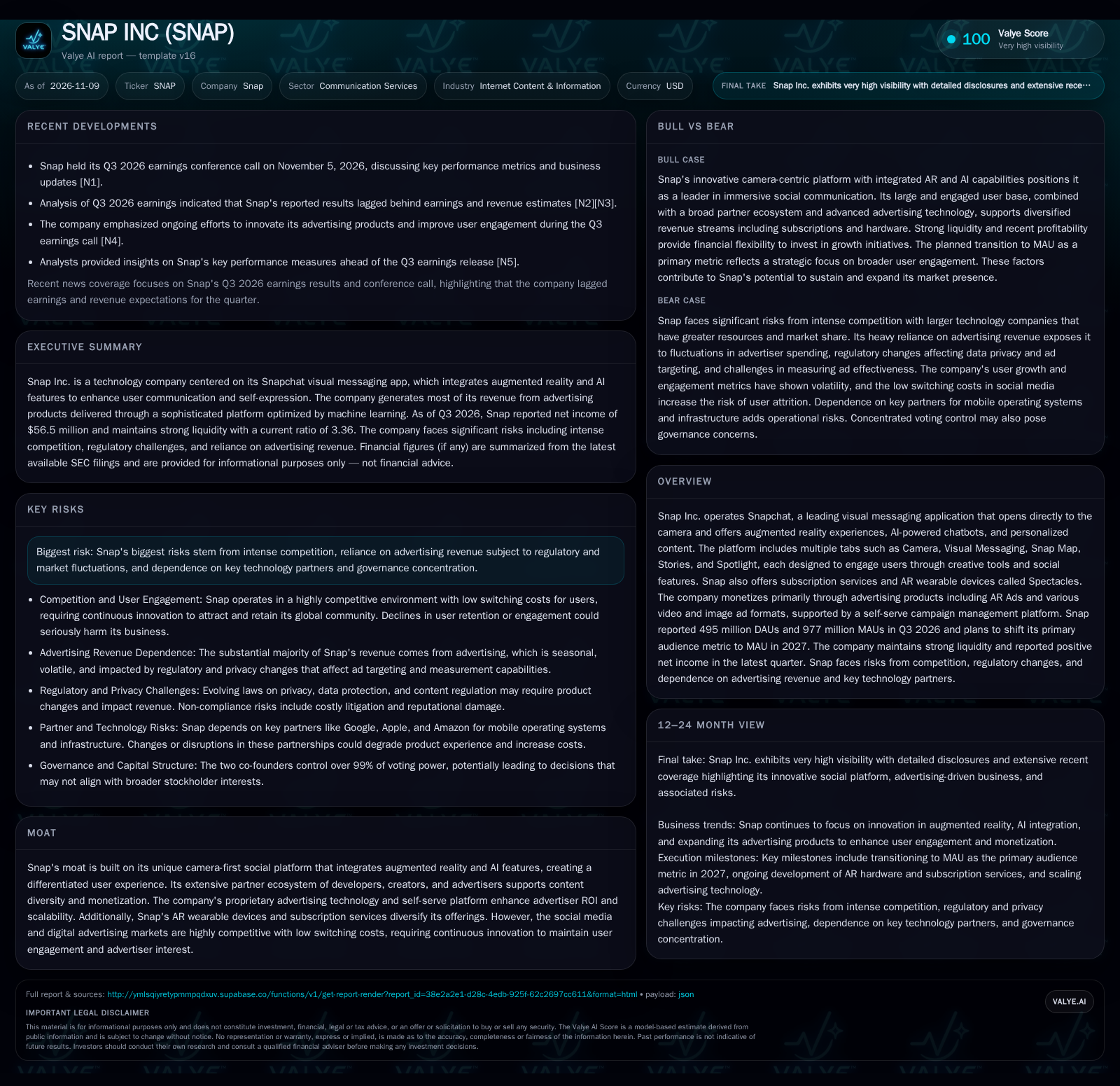
Snap reported 495 million daily and 977 million monthly active users in Q3 2026, with a shift to MAU as its primary user metric slated for 2027. While the company achieved positive net income and maintains reported liquidity position, Q3 results lagged estimates, highlighting ongoing advertising volatility. Snap’s business model remains heavily reliant on ad revenue, but AR, AI, and subscriptions offer potential diversification. The core question: can Snap translate its product innovation and user scale into more stable, higher-margin growth in the face of competitive and regulatory pressures? [S2] [N2] [N3]
Snap Inc. stands at a critical inflection point as it closes out 2026, having reported both solid user scale—with nearly a billion monthly active users—and a return to quarterly profitability. Yet these achievements are set against a backdrop of underwhelming Q3 results relative to expectations, persistent dependence on volatile advertising markets, and heightened scrutiny from both competitors and regulators. As Snap pivots its core user metric to monthly actives and doubles down on AR and AI-driven experiences, the company faces the perennial challenge of converting engagement and innovation into durable, diversified monetization. The next year will be pivotal in demonstrating whether Snap’s platform can evolve beyond its advertising roots and mitigate the structural risks endemic to the social media sector.
Q3 2026 Performance: Scale, Profitability, and Shifting Metrics
Snap Inc. reported 495 million daily active users (DAUs) and 977 million monthly active users (MAUs) in Q3 2026, reaffirming the platform’s global reach. The company posted net income of $56.5 million for the quarter, marking continued progress toward profitability after a period of volatility. Notably, Snap announced it will transition to MAU as its primary audience metric in 2027, reflecting an emphasis on broader engagement over daily stickiness. Despite these positives, Q3 results lagged consensus estimates, underscoring the ongoing unpredictability of Snap’s advertising-driven top line. The company’s reported liquidity position, with a current ratio of 3.36 and cash/equivalents plus short-term investments totaling over $2.7 billion as of quarter-end. [S2] [N2] [N3]
How Snap’s Monetization Model Leverages Engagement—and Its Inherent Fragility
Snap’s revenue engine is built almost entirely on digital advertising, spanning formats such as AR Ads, Snap Ads, Story Ads, and Sponsored Snaps. The self-serve ad platform is underpinned by machine learning, enabling granular targeting and optimization. This model benefits from high user engagement and a young, mobile-first audience attractive to advertisers. However, ad revenue is inherently cyclical and sensitive to both macro conditions and changes in privacy regulation or platform policies—particularly given Snap’s dependence on iOS and Android ecosystems for distribution and tracking.
While Snap has introduced subscription offerings (Snapchat+, Lens+, Platinum) and AR hardware (Spectacles), these lines remain secondary to advertising and their contribution to margin expansion is still unproven. Subscriptions and hardware could, over time, provide a more stable and recurring revenue stream, but their scale and profitability are not yet established. The company’s cost structure includes significant R&D and infrastructure spend, which is necessary to sustain product innovation, but creates operating leverage risk if revenue growth stalls.
A Camera-First Platform in a Crowded Social and Ad Tech Arena
Snap’s competitive advantage lies in its differentiated, camera-centric user experience infused with AR and AI features, which foster high engagement and creativity among a predominantly younger demographic. Its broad partner ecosystem—including developers, creators, and publishers—enables content variety and platform stickiness. However, the social and digital advertising markets are intensely competitive, with low switching costs and rapidly evolving consumer preferences.
Major technology platforms—ranging from established social networks to short-form video and emerging immersive experiences—compete directly for user attention and advertiser budgets. Snap also faces indirect competition from messaging apps, live-streaming platforms, and newer entrants experimenting with generative AI or AR. The risk of commoditization is real, as features pioneered by Snap (such as Stories and AR Lenses) have historically been replicated by larger, better-capitalized rivals, eroding early-mover advantages. Retention and monetization depend on Snap’s ability to continually out-innovate and deepen both user and advertiser relationships.
What Could Drive Snap’s Next Phase: AR Monetization, Subscription Adoption, and MAU Leverage
A favorable outcome for Snap would see the company successfully leveraging its large MAU base to drive both advertising and non-advertising revenue streams. If AR-powered ad formats, creator monetization programs, and AI-driven content recommendations lead to higher engagement and improved ad pricing, Snap could achieve more resilient and higher-margin growth. Subscriptions could meaningfully supplement ad revenue if adoption rates accelerate and churn stays low, especially as exclusive features or ad-free experiences gain traction.
Hardware, such as Spectacles, could evolve into a meaningful ecosystem play—either as a direct revenue line or as a means to deepen engagement and data capture, thereby fueling better ad targeting and retention. Confirmation of this scenario would come from sustained MAU expansion, rising ARPU (average revenue per user), increased subscription penetration, and evidence that Snap can weather regulatory changes without major disruptions to ad measurement or targeting.
Enduring Platform Engagement, But Advertising Volatility Persists
The most plausible trajectory is that Snap maintains its position as a leading visual messaging and AR platform, with engagement levels remaining high but revenue growth exposed to ongoing advertising volatility. Incremental gains from subscriptions and hardware may offset some ad cyclicality, but are unlikely to fundamentally alter the margin structure in the near term. MAU expansion could enable more consistent monetization, but competition and privacy regulation will continue to constrain pricing and targeting effectiveness.
Evidence supporting this scenario would include relatively stable MAU/DAU trends, modest increases in non-ad revenue, and continued investment in product innovation. On the other hand, a sharper-than-expected decline in user growth or repeated misses on revenue/earnings would suggest that engagement or monetization is deteriorating faster than anticipated.
When User Growth, Monetization, or Measurement Falter
A negative scenario would emerge if Snap experiences a sustained decline in user growth, engagement, or advertiser demand—potentially driven by competitive displacement, shifting consumer behavior, or regulatory constraints that further limit ad targeting. The company’s reliance on key mobile platforms for distribution and data access leaves it vulnerable to changes in OS policies or ecosystem priorities.
If Snap fails to diversify its revenue base and subscriptions/hardware remain niche, the business could revert to break-even or negative margins, especially if ad CPMs or fill rates fall. A further risk is that privacy and measurement changes outpace Snap’s ability to adapt its ad tech stack, resulting in lower ROI for advertisers and budget reallocations to other platforms. Confirmation would come from declining MAU/DAU, falling ARPU, negative operating leverage, or a material deterioration in cash flow.
Signals That Will Shape Snap’s Monetization and Engagement Outlook
Monthly active user (MAU) and daily active user (DAU) trends, including regional breakdowns and user cohort retention, if disclosed.
Average revenue per user (ARPU) by geography and segment, to assess monetization efficiency and the impact of new ad formats or subscription adoption.
Growth rates and churn for subscription services (Snapchat+, Lens+, Platinum), as well as the contribution of non-advertising revenue to the overall mix, if disclosed.
Ad pricing (CPM), fill rates, and advertiser count, to gauge the health and competitiveness of Snap’s core revenue engine, if disclosed.
Ad measurement, targeting effectiveness, and the impact of regulatory or OS privacy changes on Snap’s ability to deliver ROI for advertisers.
Progress and user adoption for AR hardware (Spectacles) and the broader AR ecosystem, including developer and creator engagement.
Operating expense growth (especially R&D and infrastructure) relative to revenue, to monitor operating leverage and investment discipline.
Changes in strategic partnerships with key technology platforms (Google, Apple, Amazon), and any signals of ecosystem friction or risk.
Disclaimer: This is research-only, informational analysis and not investment advice. It may include AI-generated interpretation and general industry context. Always verify important details using primary sources.

Comments