
CION Investment Corp in 2026: Regulatory Limits, Portfolio Fluctuations, and Middle-Market Lending Dynamics
CION Investment Corp’s latest results highlight the operational complexities of a non-diversified BDC navigating regulatory limits, portfolio credit risks, and episodic portfolio company events. The company’s net loss, capital market dependence, and concentrated exposures underscore the central tension between yield-seeking in private credit and the structural risks of the BDC model.
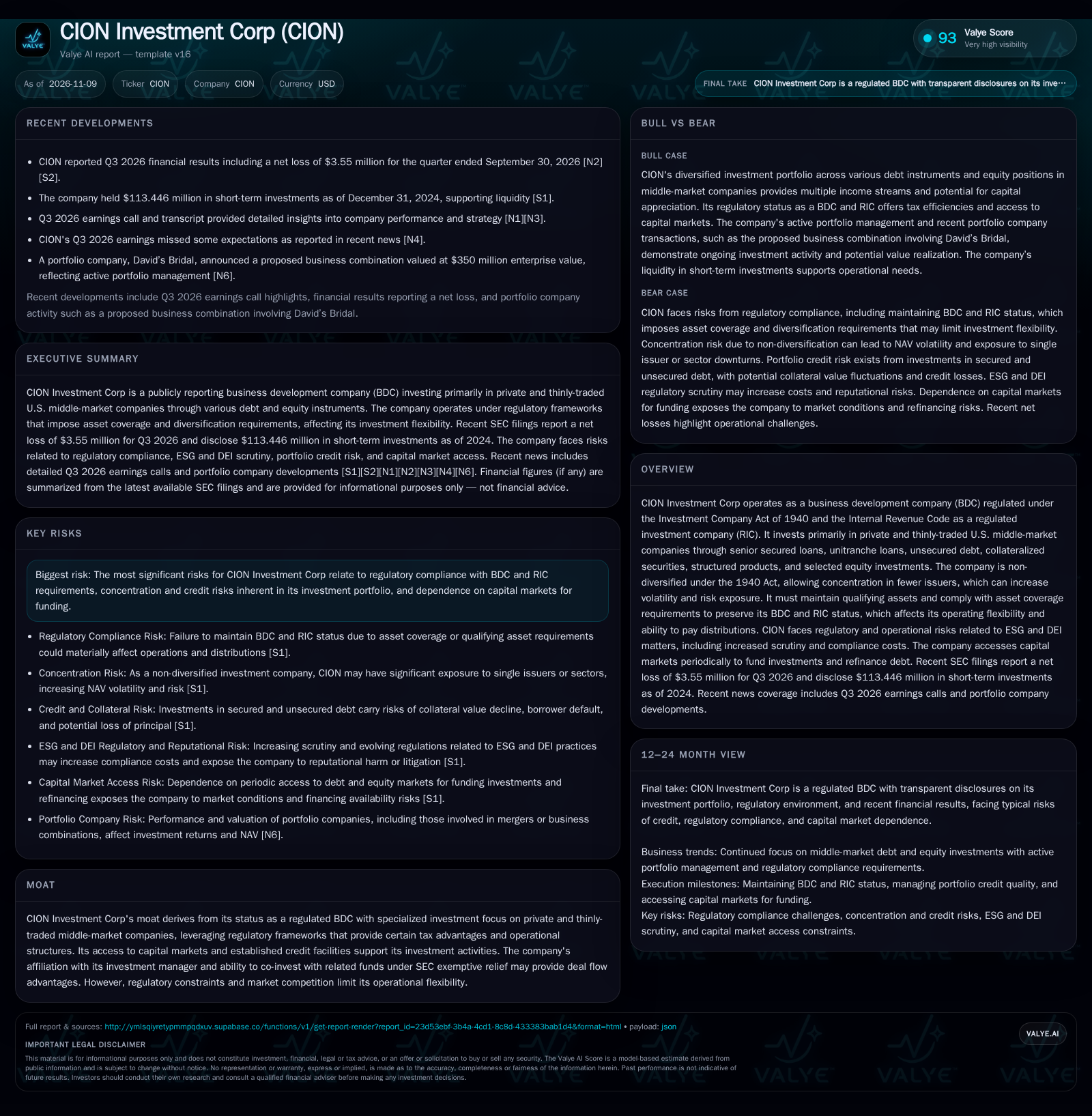
CION Investment Corp reported a Q3 2026 net loss and continues to concentrate investments in U.S. middle-market debt. Its non-diversified status allows for higher-yielding but riskier exposures, while regulatory asset and leverage constraints shape its capacity to invest and pay distributions. Recent portfolio activity, including a $350 million David’s Bridal combination, illustrates both potential upside and the volatility inherent in BDC portfolios. The company’s performance will hinge on credit outcomes, capital market access, and regulatory compliance.
CION Investment Corp’s third-quarter 2026 results and recent portfolio developments spotlight the structural trade-offs of the BDC model, especially for non-diversified players operating in the private middle-market lending space. While the company’s mandate enables pursuit of higher-yielding opportunities through concentrated exposures, it also exposes shareholders to greater NAV swings, credit events, and regulatory pressures. A net loss this quarter, ongoing capital market reliance, and episodic portfolio company transactions capture both the income potential and the risks that define CION’s business. Future outcomes will depend on credit performance, successful capital raising, and the ability to navigate evolving regulatory and ESG demands.
Recent Net Losses, Portfolio Moves, and Regulatory Environment
CION Investment Corp reported a net loss of $3.55 million for Q3 2026, reflecting near-term portfolio and credit headwinds [S2]. This loss follows a period of active portfolio management, including a proposed $350 million enterprise value business combination involving David’s Bridal, one of its portfolio companies [N6]. The company’s non-diversified BDC structure allows for concentrated positions, which can generate higher yields but also increase NAV volatility and exposure to single-issuer or sector events [S1]. As of December 31, 2024, CION held $113.446 million in short-term investments, providing a liquidity buffer but not necessarily long-term resilience [S1]. The company’s ability to access capital markets for funding and refinancing remains a critical operational lever [S1].
The regulatory environment governing BDCs like CION imposes not only quantitative limits on leverage and asset coverage ratios but also qualitative constraints related to asset eligibility and diversification. These rules are designed to protect investors by limiting excessive risk-taking, yet they can also restrict management’s agility in reallocating capital swiftly in response to market shifts or credit deterioration. For a non-diversified BDC, this tension is particularly acute, as concentrated exposures may require rapid adjustments that are hampered by regulatory thresholds. Consequently, the company’s capital deployment strategies must carefully balance yield objectives with compliance, which can introduce timing mismatches or force suboptimal portfolio decisions during periods of market stress.
Translating Lending Activities into Income and Risk for CION’s BDC Model
CION generates revenue primarily from interest and fee income on its portfolio of debt investments—primarily senior secured loans, unitranche and mezzanine debt, and select equity positions in U.S. middle-market companies [S1]. The company’s income stream depends on the credit quality of its borrowers, the yield on its investments, and the ability to deploy capital efficiently within regulatory constraints. BDCs are required to distribute at least 90% of taxable income to maintain RIC status, which limits retained earnings and makes external capital raising essential for growth and portfolio repositioning.
Operating leverage is inherently limited in this model, as most income is passed through to shareholders. Fixed costs include management and administrative fees, while variable costs are tied to portfolio servicing and credit management. The use of leverage can amplify returns but is strictly regulated via asset coverage requirements, which limit the extent of debt financing and can force asset sales or restrict distribution capacity in adverse scenarios. Because CION is non-diversified, the economics are more sensitive to credit events—either positive, such as portfolio company exits, or negative, such as defaults or markdowns.
The interplay between yield generation and risk mitigation in CION’s lending activities is further complicated by the middle-market segment’s inherent information asymmetries and lower liquidity. Unlike broadly syndicated loans, middle-market debt often lacks transparent pricing and secondary market depth, which can obscure timely valuation and credit signals. This opacity necessitates robust internal credit monitoring and proactive engagement with portfolio companies to anticipate credit events. Moreover, the limited ability to quickly exit positions without significant markdowns underscores the importance of capital market access for refinancing and managing liquidity. Thus, the economics of CION’s BDC model hinge not only on underwriting discipline but also on dynamic portfolio management capabilities and market conditions that influence funding costs and exit opportunities.
CION’s Position in Middle-Market Credit: Strengths and Structural Boundaries
CION’s competitive position derives from its focus on private, thinly-traded middle-market lending—a segment that can offer higher yields and lower competition from traditional banks. As a regulated BDC, CION benefits from tax pass-through status and access to retail and institutional capital seeking income in a low-yield environment. Its affiliation with its investment manager and the ability to co-invest with related funds may enhance deal flow and underwriting capacity.
However, these advantages are counterbalanced by regulatory limits on leverage, asset composition, and portfolio concentration. The non-diversified structure can attract investors seeking differentiated yield but also heightens the risk of outsized losses from idiosyncratic events. CION competes with other BDCs, private credit funds, and, to a lesser extent, banks and CLOs for deal origination. The company’s ability to source attractive risk-adjusted investments, manage credit quality, and maintain access to low-cost capital will determine its competitive durability.
CION’s competitive advantage in middle-market credit also depends on its ability to leverage proprietary sourcing channels and specialized underwriting expertise to identify mispriced risk or niche opportunities that larger competitors may overlook. However, the non-diversified structure inherently concentrates idiosyncratic risk, making the company more vulnerable to sector-specific downturns or individual borrower distress. This risk profile necessitates rigorous stress testing and scenario analysis to evaluate potential impacts on NAV and distributions under adverse conditions. Additionally, regulatory constraints on leverage and asset composition can limit the firm’s capacity to scale or pivot quickly, which may disadvantage it relative to less regulated private credit funds or CLO structures that can deploy capital with greater flexibility and speed.
Potential Upside from Portfolio Exits and Credit Management
A favorable scenario for CION would involve successful exits or recapitalizations of existing portfolio companies—such as the proposed $350 million David’s Bridal transaction—generating realized gains and validating underwriting standards [N6]. Improved credit performance across the portfolio, combined with stable or tightening credit spreads, would enhance interest income and reduce provisioning needs. Continued access to capital markets at attractive rates would allow CION to grow and diversify its portfolio, potentially reducing concentration risk over time.
Evidence of this scenario would include a series of realized gains or mark-ups on portfolio investments, stable or increasing net investment income, and consistent or growing distributions to shareholders. A reduction in non-accruals and credit markdowns would further support the thesis. Conversely, an increase in defaults, markdowns, or regulatory constraints on leverage would falsify the upside case.
Base Outlook: Middle-Market Lending Under Credit and Regulatory Strains
The most probable trajectory for CION is continued navigation of the inherent volatility of middle-market lending. The company is likely to experience episodic gains from select portfolio events, such as business combinations or repayments, offset by periodic credit losses and valuation markdowns. Regulatory requirements will continue to shape portfolio composition and leverage, limiting the degree of flexibility in response to shocks.
In this scenario, net investment income remains sufficient to support regular distributions, but NAV and earnings exhibit quarter-to-quarter variability. Access to capital markets remains available but is subject to pricing and investor sentiment. Confirmation would come from steady investment activity, maintenance of regulatory compliance, and moderate fluctuation in portfolio credit metrics. A material worsening in credit quality, inability to raise new capital, or regulatory breach would challenge this scenario.
Downside Risks from Portfolio Concentration and Funding Challenges
A negative outcome could result from one or more large portfolio company defaults or markdowns, particularly given CION’s non-diversified exposures. A severe deterioration in middle-market credit conditions could trigger asset coverage breaches, force distressed asset sales, or restrict distributions. An inability to access capital markets for refinancing or new investment would compound these pressures, potentially leading to a downward spiral in NAV, liquidity, and investor confidence.
This scenario would be confirmed by a spike in non-accruals, regulatory warnings or covenant breaches, forced asset liquidations, or suspended distributions. News of significant portfolio company failures or distressed sales would further validate the downside risk.
Factors Influencing CION’s Risk-Reward Balance Over the Coming Year
Quarterly changes in non-accrual investments and realized credit losses, as these directly affect income and NAV volatility.
Updates on the David’s Bridal business combination or similar portfolio company exit events, which could materially impact returns [N6].
Net investment income and distribution coverage ratios, if disclosed, to gauge sustainability of payouts.
Compliance with asset coverage and qualifying asset tests, as any breach could trigger regulatory or operational consequences.
Ability to raise new debt or equity capital on favorable terms, especially in volatile markets.
Portfolio concentration metrics, such as exposure to top five holdings, which signal vulnerability to idiosyncratic events, if disclosed.
Shifts in regulatory or ESG compliance costs and their impact on operating expenses.
Disclaimer: This is research-only, informational analysis and not investment advice. It may include AI-generated interpretation and general industry context. Always verify important details using primary sources.

Comments