
Evergy’s Regulatory Anchors, Data Center Demand, and the Stakes of Capital-Intensive Modernization
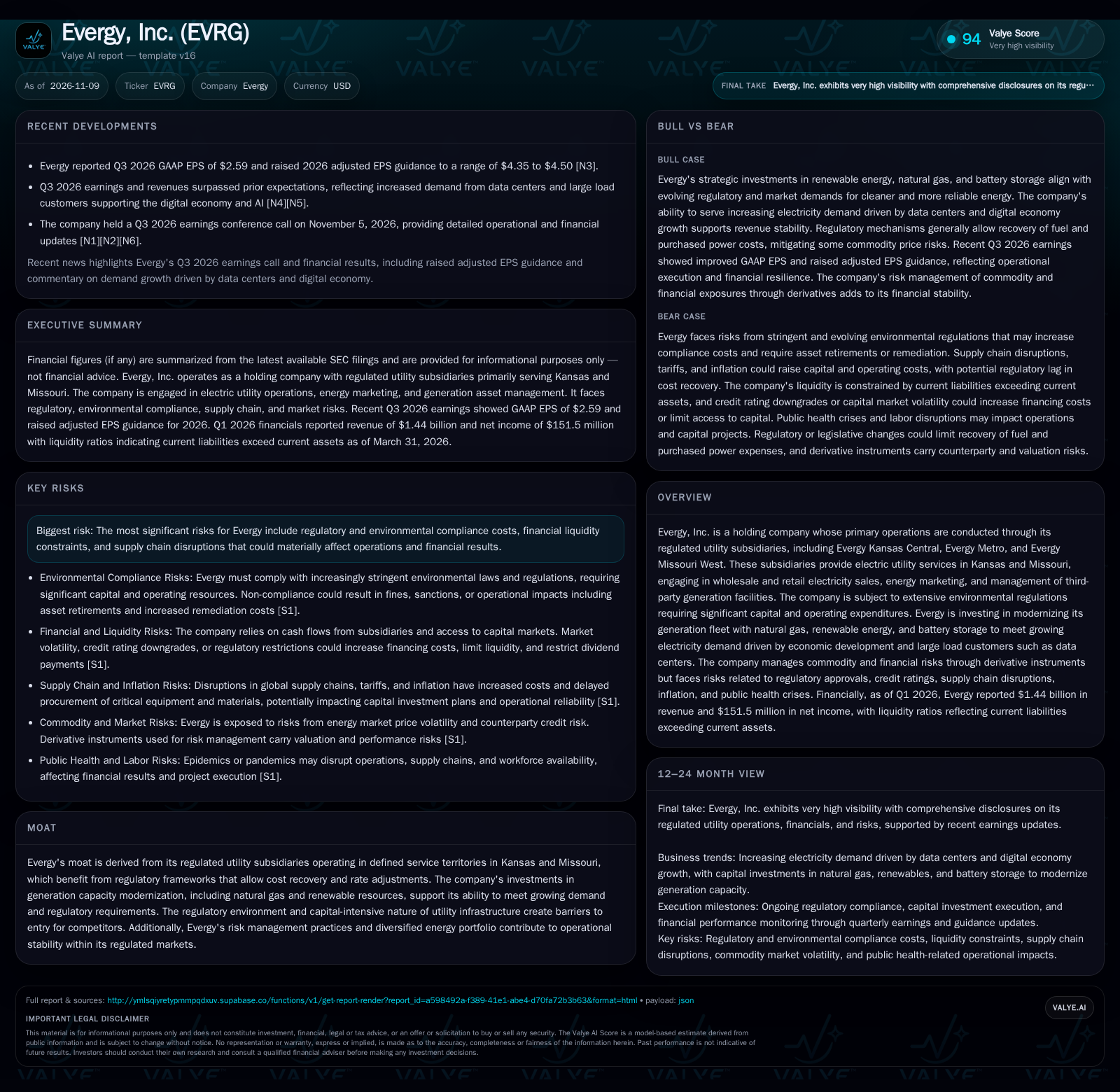
Evergy’s Q3 2026 earnings and raised guidance highlight the near-term boost from data center-driven demand and the regulated utility model’s revenue stability.
Evergy’s Q3 2026 earnings and raised guidance highlight the near-term boost from data center-driven demand and the regulated utility model’s revenue stability. The company’s aggressive capital investment in renewables, gas, and storage aims to align with long-term growth and compliance mandates. Yet, its low current and cash ratios, dependence on regulatory cost recovery, and exposure to supply chain and capital market volatility mean that execution and regulatory alignment will be critical for sustaining returns as its modernization program ramps.
Evergy, Inc.’s recent financial outperformance—driven by surging demand from data centers and digital economy clients—spotlights the evolving role of regulated utilities at the intersection of infrastructure modernization and the AI-powered growth cycle. The company’s strategic pivot toward renewables, gas, and storage reflects both regulatory mandates and an opportunity to monetize new load growth.
Recent Results Highlight Demand Surge and Raised Guidance
Evergy reported Q3 2026 GAAP EPS of $2.59 and raised its 2026 adjusted EPS guidance to a range of $4.35 to $4.50, driven in part by higher-than-expected demand from data centers and large load customers supporting the digital economy and AI sector [N3] [N4] [N5]. This marks a material outperformance versus prior expectations and signals that the company is capturing new growth vectors beyond traditional residential and commercial segments.
The company reported cash and liquidity metrics for the period; these figures do not by themselves establish operating runway, investment capacity, financial flexibility, or financing capacity. While not uncommon for regulated utilities that rely on predictable cash flows, this profile raises sensitivity to capital market conditions and regulatory timing.
Strategic capital investment continues apace: Evergy is deploying resources into natural gas, renewables, and battery storage to modernize its fleet and meet both regulatory and customer-driven demand [S1]. These investments are intended to secure capacity for growing digital-economy loads while maintaining compliance with evolving environmental mandates.
How Evergy’s Regulated Model Shapes Revenue, Cost Recovery, and Returns
Evergy’s core economics are defined by its status as a regulated utility holding company. Subsidiaries operate in Kansas and Missouri under defined service territories, selling electricity at rates approved by state regulators [S1]. The regulatory model typically allows for cost recovery (including capital expenditures and operating expenses) plus an allowed rate of return on invested equity, providing revenue visibility and some inflation pass-through.
The primary revenue levers are electricity sales volumes—now increasingly influenced by large data center and digital economy customers—and the regulatory rate base. Rate base growth is driven by capital investment in generation, transmission, and distribution assets, including the recent focus on renewables, natural gas, and storage. Higher capital outlays expand the rate base, which can ultimately support higher regulated returns if approved by regulators.
However, the model is capital-intensive and exposes Evergy to regulatory lag: there may be a gap between when costs are incurred and when they are reflected in customer rates. If inflation or supply chain disruptions drive costs above forecast, or if regulators deny or delay recovery, margin compression can occur. Fixed costs are high, so incremental demand growth (such as from data centers) can drive significant operating leverage if rates are set appropriately. Funding needs are ongoing, as utilities must continually invest to maintain and expand the grid, meet evolving standards, and serve new loads.
Regulatory Barriers, Infrastructure Scale, and the Threat of Disintermediation
Evergy’s competitive moat is anchored in regulatory protection: exclusive rights to serve its defined territories and a cost-of-service rate model mean that direct competition for core utility customers is structurally limited [S1]. The capital-intensive nature of grid and generation infrastructure creates high barriers to entry. In theory, customer switching costs are high due to the lack of practical alternatives for large-scale electric service.
However, new competitive dynamics are emerging at the margin. Large data center and industrial customers may seek direct power purchase agreements (PPAs) with third-party renewable developers, or invest in distributed generation and storage. If regulators permit or encourage retail choice or behind-the-meter solutions, Evergy could see some erosion of load growth or margin on the most attractive customer segments.
Peer competition is most relevant in the context of capital allocation and regulatory benchmarking—how efficiently Evergy invests, manages costs, and delivers service relative to other regional utilities. The company’s ability to secure favorable regulatory treatment for its modernization investments will be critical to sustaining its advantage, as will its risk management around commodity costs and derivative exposures.
If Data Center Growth and Regulatory Alignment Drive Accelerated Earnings Expansion
The most favorable scenario for Evergy is one in which the digital economy’s demand for electricity continues to surge, led by hyperscale data centers and AI infrastructure locating within its service territories. If Evergy can efficiently bring new natural gas, renewables, and storage assets online—on time and on budget—and secure timely regulatory approval to incorporate these investments into its rate base, earnings could exceed current guidance.
This scenario would be confirmed by continued upward revisions to earnings guidance, rapid rate base growth, and regulatory filings that demonstrate constructive cost recovery for new capital projects. Additional signs would include successful negotiation of long-term contracts or special tariffs with large load customers, and minimal regulatory pushback on new project approvals. Evidence of operating leverage—i.e., earnings growing faster than revenue as fixed costs are spread over a larger base—would further support this case.
Regulated Growth Moderated by Execution and Regulatory Lag
The most plausible path is that Evergy delivers steady, regulator-approved rate base growth as it modernizes its fleet, with earnings generally tracking guidance but subject to periodic fluctuations from cost pressures, regulatory lag, or macro shocks. Demand from data centers and digital economy customers remains a tailwind, but not all incremental costs are recovered immediately, and some project delays or supply chain issues are absorbed.
This scenario would be confirmed by earnings delivery in line with guidance, moderate annual growth in the rate base, and a manageable but persistent gap between capital outlays and cost recovery. Regulatory filings may reflect some contested elements, but most investments are ultimately approved. If disclosed, trends in allowed vs. earned returns and the proportion of costs deferred vs. recovered in rates would help validate this scenario.
When Regulatory, Supply Chain, or Capital Market Frictions Erode Value
The adverse scenario would unfold if supply chain disruptions, inflation, or policy shifts drive project costs well above forecasts, while regulators delay or disallow rate recovery. In the extreme, the company could be forced to slow or defer critical modernization projects, risking reliability issues or customer dissatisfaction.
Confirmation of this scenario would come from downward earnings revisions, regulatory denials or protracted rate cases, negative credit actions, or sharp increases in interest expense. Persistent negative free cash flow, higher short-term borrowings, or covenant concerns (if disclosed) would further substantiate downside risk.
Milestones and Metrics That Will Reveal Evergy’s Strategic Trajectory
Regulatory approval rates for new capital projects—timely and favorable treatment would support the thesis; any denials or delays would be a red flag.
Actual versus budgeted costs and timelines for new generation, storage, and transmission investments, especially in the context of supply chain and inflation pressures.
Trends in large customer (data center, digital economy) load growth and any disclosed long-term contracts or special rate arrangements.
Credit rating actions or commentary from major agencies, as these directly affect financing costs and capital access.
Quarterly updates on adjusted EPS guidance and the underlying drivers (e.g., load growth, rate base expansion, regulatory outcomes).
Changes in liquidity metrics or disclosed refinancing plans, especially if short-term borrowings increase or cash flow becomes negative.
If disclosed, the split between costs recovered in current rates versus costs deferred or subject to future recovery—this would clarify regulatory lag and margin risk.
Updates on derivative exposures and counterparty risks, as significant mark-to-market swings or credit events could impact financial results.
Disclaimer: This is research-only, informational analysis and not investment advice. It may include AI-generated interpretation and general industry context. Always verify important details using primary sources.

Comments