
Matson’s LNG Fleet Renewal: Strategic Leverage or Capital-Intensive Gamble in U.S.-Asia Shipping?
Matson, Inc. is executing a $1 billion LNG-ready vessel renewal to enhance its protected U.S. Jones Act routes and Pacific reach. As regulatory, fuel, and macroeconomic uncertainties loom, the company’s future hinges on its ability to extract value from new capacity, sustain its operational moat, and adapt to evolving logistics demands.
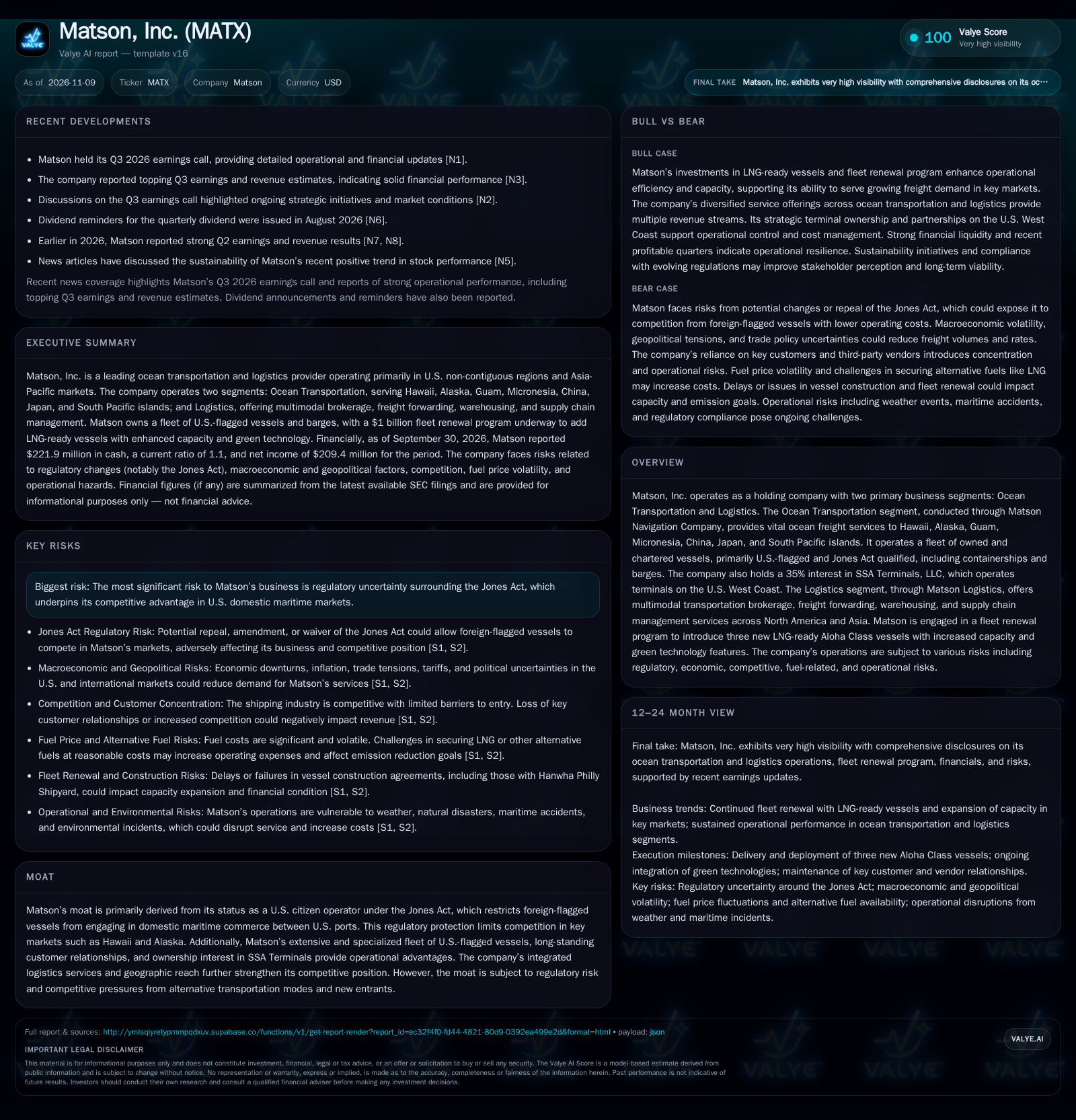
Matson is investing $1 billion in three new LNG-ready containerships, aiming to boost efficiency and green credentials on U.S.-Asia trade lanes. The company’s regulatory moat via the Jones Act remains a key competitive anchor, but the capital-intensive fleet renewal and reliance on stable trade volumes expose it to policy, demand, and fuel-market risks. [S1] [S2] [N1] [N3]
Matson, Inc. stands at a strategic crossroads as it funnels $1 billion into a new generation of LNG-ready containerships, aiming to modernize its fleet and reinforce its prominent position on U.S. domestic and trans-Pacific routes. With recent financial outperformance and a regulatory moat provided by the Jones Act, the company is poised to benefit from efficiency gains and green shipping trends. Yet, the scale of its capital commitment, the potential for regulatory shifts, and unpredictable fuel and trade dynamics mean that Matson’s next phase will test its ability to convert infrastructure investment into durable economic advantage.
Matson’s Major Capital Commitment and Recent Earnings Outperformance
Matson is in the midst of a $1 billion fleet renewal program, constructing three new LNG-ready Aloha Class containerships with increased capacity and green technology. These vessels, intended for deployment primarily on the China service, are a key part of the company’s strategy to enhance operational efficiency and environmental compliance. The program is being funded through a mix of cash, treasury securities, operating cash flow, and available credit facilities [S1].
As of September 30, 2026, Matson reported $221.9 million in cash and equivalents, current assets of $686.7 million versus current liabilities of $623.9 million, and a current ratio of 1.1 [S2]. Net income for the period was $209.4 million, with basic EPS of $7.03 and diluted EPS of $6.96 [S2].
Recent news coverage indicates that Matson topped Q3 2026 earnings and revenue estimates and continues to provide detailed operational and strategic updates to the market [N1] [N3]. This operational momentum is notable as the company navigates its capital-intensive fleet upgrade.
How Matson’s Business Model Turns Ships and Moats into Returns
Matson’s revenue is primarily generated through ocean transportation services—shipping containerized freight and other cargo between the U.S. mainland, Hawaii, Alaska, Guam, and Asia-Pacific. Its U.S.-flagged, Jones Act-qualified fleet allows it to operate essentially free of foreign competition on domestic lanes, supporting premium pricing and relatively stable volumes. The company supplements this with a logistics segment offering multimodal brokerage, freight forwarding, and supply chain management, diversifying revenue streams and providing optionality in market downturns [S1].
The economics of Matson’s core business are capital-intensive and cyclical. Vessel acquisition and renewal require large upfront investments, but once deployed, ships offer significant operating leverage—incremental volume can drive high marginal profitability, especially on protected routes. However, variable costs such as fuel, crew, and maintenance are substantial, and the company’s exposure to fuel price volatility can swing margins significantly. The new LNG-ready vessels are intended to mitigate some fuel risk and address tightening emissions regulations, but their real-world operating economics will depend on LNG fuel availability and cost—a point of uncertainty acknowledged by management [S1].
Matson’s ability to fund its fleet renewal with internal cash flow and credit access reduces near-term financial strain, but the magnitude of the investment increases exposure if freight demand softens or if operating costs escalate. The company’s 35% stake in SSA Terminals also provides a source of joint-venture income and operational control at key U.S. West Coast ports, which helps manage costs and service reliability [S1].
Regulatory Moats and the Evolving Threat Matrix
Matson’s most significant competitive advantage is its compliance with the Jones Act, which restricts domestic maritime commerce to U.S.-built, -owned, and -crewed vessels. This regulatory shield sharply limits foreign competition on its Hawaii and Alaska routes, allowing Matson to maintain dominant share and pricing power on these lanes [S1].
However, this moat is not absolute. Changes to the Jones Act—whether repeal, amendment, or waivers—could expose Matson to lower-cost foreign operators, eroding its core advantage. Furthermore, even within protected markets, competition from other U.S.-flagged carriers and from alternative transportation modes (such as air freight for high-value cargo or integrated logistics providers for end-to-end solutions) remains a constraint.
In the trans-Pacific market, especially the China service, Matson faces direct competition from international shipping giants with greater scale and access to cheaper, foreign-flagged tonnage. Here, Matson’s edge is more about service reliability, specialized port access, and customer relationships rather than regulatory protection. The company’s investment in green technology and terminal partnerships may help differentiate its service, but these factors are unlikely to fully offset potential cost disadvantages if freight rates fall or if new competitors emerge.
What Could Drive a Step-Change in Matson’s Earnings Power
If Matson’s LNG-ready Aloha Class vessels are delivered on time and perform as expected, the company could realize meaningful cost savings from improved fuel efficiency and lower emissions compliance costs. Should LNG fuel be reliably available at favorable prices, Matson may widen its cost advantage over less advanced competitors, especially if environmental regulations tighten further.
A robust U.S. consumer economy and resilient Asia-Pacific trade flows would support high utilization of the new capacity, allowing Matson to capture incremental volume at attractive margins. If the Jones Act remains intact, Matson’s protected routes would continue to provide a stable base of premium business, while its logistics arm could leverage integrated service offerings to win additional share.
Confirmation of the upside scenario would come from above-trend volume growth on China and domestic routes, sustained or expanding operating margins post-fleet renewal, and evidence of customer wins or contract extensions tied to Matson’s green fleet and service reliability. Additional proof would include consistent dividend increases, successful refinancing or paydown of fleet renewal debt, and positive commentary from major shippers regarding service quality and sustainability.
The Most Plausible Trajectory for Matson: Stable Returns, Measured Growth
The central case assumes Matson successfully delivers and integrates the new Aloha Class vessels, achieving moderate fuel and maintenance cost benefits but facing a competitive trans-Pacific freight market with periodic rate volatility. The Jones Act remains in place, preserving the core domestic moat, but growth in protected markets is limited by mature demand and potential price sensitivity among shippers.
Logistics and terminal operations continue to provide diversification, but neither segment transforms overall company economics. LNG fuel is available but not consistently at a discount to conventional fuels, meaning the green fleet delivers regulatory compliance rather than a dramatic cost advantage.
Any significant deviation—such as a rapid volume ramp or a major cost overrun—would challenge this view.
How Matson’s Thesis Breaks: Regulatory, Fuel, or Execution Shocks
A material risk to Matson is a change to the Jones Act that opens protected markets to foreign-flagged competition. This would likely lead to a rapid decline in pricing power and potentially force a re-evaluation of the company’s U.S.-flagged cost structure, with significant downside for earnings and asset values [S1] [S2].
Alternatively, if LNG fuel proves difficult or expensive to source, the new vessels could become operationally disadvantaged, eroding the anticipated economic and environmental benefits. Delays or cost overruns in the shipbuilding program would strain cash flow and could require additional borrowing or asset sales, particularly if freight demand softens during the investment cycle.
Confirmation of a downside scenario would include legislative movement on Jones Act reform, major negative surprises in vessel delivery timelines or costs, sustained underutilization of new capacity, or a sharp contraction in trans-Pacific trade volumes.
What Will Determine Whether Matson’s LNG Fleet Upgrade Pays Off
Delivery schedule and commissioning status for the three new Aloha Class LNG-ready vessels—any slippage or cost overruns would be an immediate red flag.
Volume and utilization trends on the China service and core Jones Act routes; a useful metric would be route-level TEU (twenty-foot equivalent unit) throughput, if disclosed.
Actual realized fuel costs and availability for LNG versus conventional fuels—disclosure on fuel mix and hedging activity would help test cost-saving claims.
Legislative and regulatory developments regarding the Jones Act; any formal moves toward amendment or repeal would have outsized impact.
Customer renewal and retention rates, especially with large shippers in Hawaii and Alaska—contract extensions or losses would clarify revenue visibility.
Operating margin progression post-fleet renewal; evidence of cost savings or dilution would be critical.
Any reported incidents or operational disruptions related to weather, maritime accidents, or environmental compliance, as these could affect service reliability and cost structure.
Disclaimer: This is research-only, informational analysis and not investment advice. It may include AI-generated interpretation and general industry context. Always verify important details using primary sources.

Comments