
GigaCloud Technology: Scaling B2B Ecommerce Amid Trade Uncertainty and Capital Intensity
Strong Q3 2026 revenue and net income reinforce GigaCloud’s operational momentum, but the company’s capital-heavy logistics model and exposure to trade-policy risk create a complex long-term value equation.
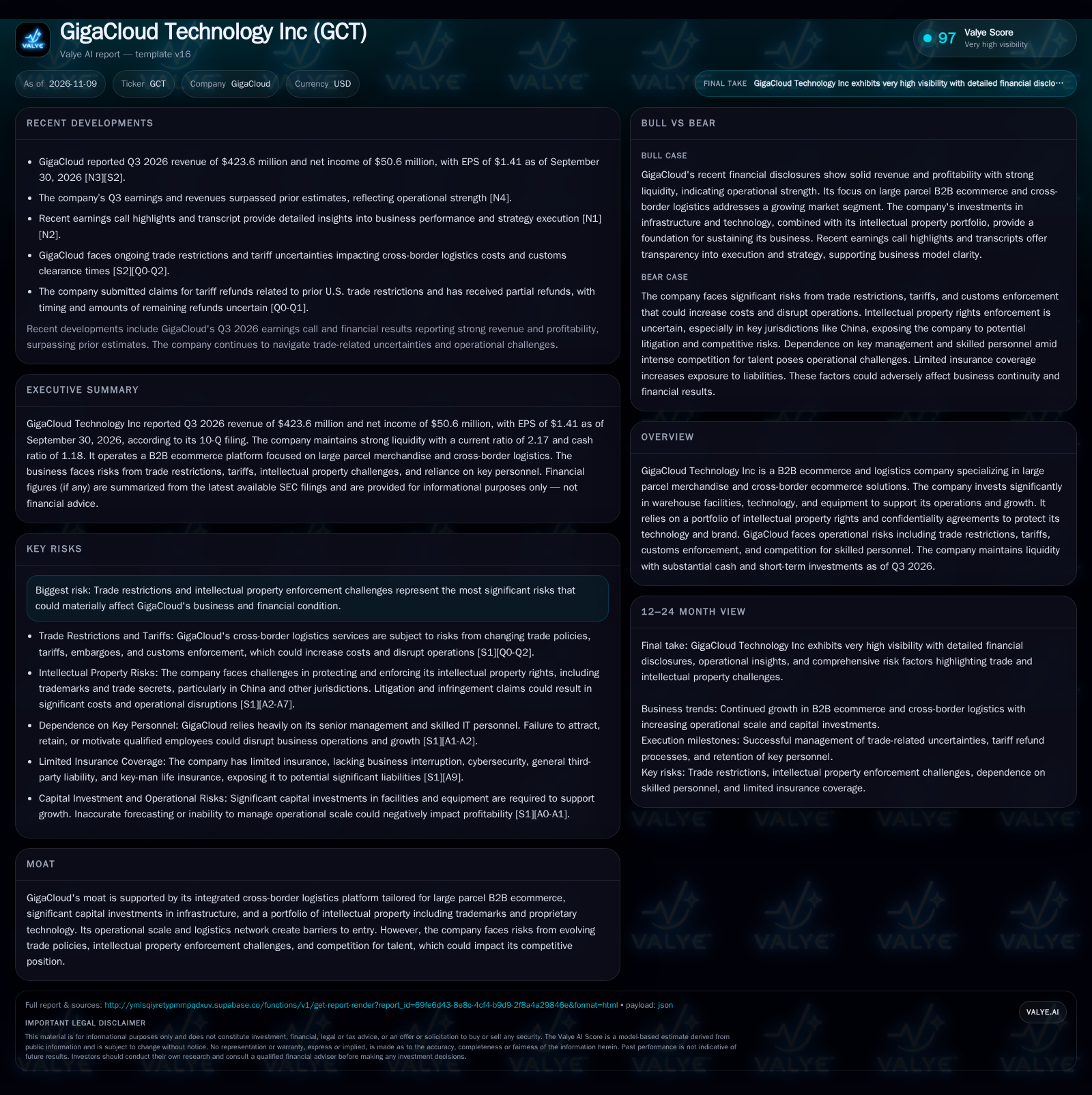
GigaCloud Technology posted robust Q3 2026 results with $423.6 million in revenue and $50.6 million in net income, supported by a reported liquidity position. However, the company’s B2B ecommerce and cross-border logistics platform faces persistent risks from trade restrictions, tariff uncertainties, and the need for ongoing capital investment in warehouses and technology. The sustainability of its growth hinges on managing these external and operational pressures while defending its IP and talent base. [S2] [N3]
GigaCloud Technology Inc’s Q3 2026 results highlight a company firing on most operational cylinders, with strong revenue, positive net income, and substantial liquidity on the balance sheet. Yet beneath this financial momentum, GigaCloud’s core business—B2B ecommerce for large parcels with a cross-border logistics backbone—remains exposed to the unpredictable tides of global trade policy and the constant need for capital investment. As the company seeks to scale, how it balances these external and internal pressures will determine whether current profitability is a springboard or a plateau.
Q3 2026 Performance Anchors GigaCloud’s Near-Term Narrative
GigaCloud Technology reported third quarter 2026 revenue of $423.6 million and net income of $50.6 million, equating to basic and diluted EPS of $1.41 [S2] [N3]. These figures beat prior estimates and underscore recent operational momentum [N4]. As of September 30, 2026, the company had $374.2 million in cash and cash equivalents, $43 million in short-term investments, and a current ratio of 2.17 [S2]. GigaCloud’s business model—centered on a B2B ecommerce platform for large parcel merchandise and cross-border logistics—remains heavily dependent on the smooth functioning of international trade flows and the company’s ability to manage both fixed and variable costs in a dynamic environment.
Analyzing GigaCloud’s Capital-Intensive Platform Economics
GigaCloud’s revenue engine is its B2B ecommerce platform, which specializes in large parcel merchandise and integrates cross-border logistics services. This model likely generates revenue through transaction fees, logistics charges, and possibly value-added services for platform participants, although the exact mix and margin structure are not disclosed. The economics are shaped by high fixed costs—warehousing, technology infrastructure, logistics equipment—and significant ongoing capital investment [S1]. While this capital intensity can create scale advantages and barriers to entry, it also raises break-even thresholds and amplifies the impact of demand fluctuations or trade disruptions.
Variable costs are driven by fulfillment expenses, shipping rates, customs duties, and labor, which are directly exposed to global trade policy and tariff changes. If the company can achieve high throughput and optimize route density, operating leverage may improve, allowing incremental revenue to translate into higher margins. However, the need for continuous investment in facilities and technology means capital allocation discipline is critical.
The capital-intensive nature of GigaCloud’s platform also implies a significant sensitivity to capital market conditions and financing costs. In environments where interest rates rise or credit availability tightens, the cost of funding warehouse expansions, technology upgrades, and working capital needs could increase materially, compressing returns or delaying growth initiatives. Conversely, access to lower-cost capital could accelerate scale economies and enhance competitive positioning. This dynamic underscores the importance of potential financial flexibility and prudent capital allocation strategies, particularly given the long asset life and potential obsolescence risks associated with logistics infrastructure and proprietary technology platforms.
Competitive Barriers and Threats in Cross-Border B2B Logistics
GigaCloud’s primary competitive advantages include its integrated cross-border logistics platform, operational scale, and a portfolio of intellectual property protected by trademarks, copyrights, and trade secrets [S1]. These assets may deter new entrants, especially given the capital and regulatory hurdles inherent in large parcel logistics. However, the company faces counterforces from established global logistics providers, regional B2B ecommerce platforms, and technology-driven disruptors that could replicate or undercut GigaCloud’s offerings.
A critical vulnerability is the enforcement of intellectual property rights, particularly in China and other jurisdictions where legal protections may be inconsistent or slow to enforce [S1]. Infringement by local competitors or platform users could erode differentiation and margin. Additionally, competition for skilled logistics and IT personnel remains intense, limiting the company’s ability to rapidly scale or innovate. The lack of comprehensive insurance coverage further exposes GigaCloud to operational and legal setbacks that could be more easily absorbed by better-insured or more diversified competitors.
From a competitive standpoint, GigaCloud’s reliance on proprietary technology and intellectual property necessitates ongoing investment in innovation and legal defense to maintain differentiation. The company’s ability to evolve its platform capabilities—such as through automation, data analytics, or AI-driven logistics optimization—could create sustainable advantages if executed effectively. However, rapid technological change in the logistics and ecommerce sectors means that failure to keep pace could erode market share. Additionally, regulatory environments in key markets may impose constraints or compliance costs that vary unpredictably, adding complexity to competitive strategy and operational planning.
What Could Drive Sustained Outperformance for GigaCloud
A favorable chain of events would see GigaCloud continue to grow B2B platform volume while successfully navigating trade restrictions and tariff uncertainties. If the company can secure additional tariff refunds and maintain relatively stable cross-border shipping costs, operating leverage could improve as fixed infrastructure is utilized more intensively. Effective retention of key personnel and ongoing investment in proprietary logistics technology may further enhance efficiency, customer stickiness, and margin.
Confirmation of this scenario would include sequential revenue and net income growth, stable or improving gross and operating margins, and evidence of successful platform expansion into new markets or customer segments. Timely resolution of tariff refund claims and minimal disruption from trade policy changes would strengthen the case. Conversely, any sustained margin compression, unexpected capital expenditure spikes, or loss of critical personnel would cast doubt on the durability of this favorable trajectory.
Likely Trajectory: Navigating Growth with Persistent External Frictions
The most plausible outcome is that GigaCloud achieves moderate growth in revenue and earnings, but with intermittent margin volatility tied to trade policy, tariffs, and logistics bottlenecks.
Confirmation would be visible in revenue momentum offset by margin fluctuations, ongoing capital expenditure aligned with platform expansion, and periodic management commentary addressing trade and regulatory risks. Sustained investment in technology and facilities, combined with retention of key personnel, would support this steady-state scenario. If the company demonstrates consistent margin stability and successfully manages trade-related headwinds, the risk profile could shift toward the upside.
How Trade Policy Shocks and Operational Frictions Could Derail the Model
A negative scenario unfolds if GigaCloud faces a combination of adverse trade policy changes, such as new tariffs, embargoes, or stricter customs enforcement, which materially increase cross-border logistics costs or disrupt shipping flows [S1]. Delays or denials in tariff refunds could create cash flow pressures. If these shocks coincide with operational setbacks—such as IT system failures, warehouse capacity constraints, or the loss of key personnel—the company’s high fixed-cost base could quickly erode profitability.
Evidence of this scenario would include sharp increases in logistics expenses relative to revenue, declining margins, negative operating cash flow, or the need to curtail capital investment. Legal or IP disputes, especially in China, could further distract management and drain resources. If liquidity deteriorates and the company is forced to take on expensive debt or equity dilution, long-term value could be impaired.
Operational risks extend beyond trade policy shocks to include potential disruptions from supply chain fragility and geopolitical tensions that can unpredictably affect cross-border flows. For instance, sudden changes in customs procedures or border infrastructure limitations could cause delays that ripple through GigaCloud’s fulfillment network, increasing costs and reducing customer satisfaction. The company’s high fixed-cost structure magnifies the financial impact of such disruptions, as underutilized assets do not scale down quickly. Moreover, the interplay between operational setbacks and financial constraints could create a feedback loop, forcing difficult trade-offs between investment in growth and necessary cost control.
Testing GigaCloud’s Thesis: What Could Confirm or Challenge Long-Term Value
Sequential revenue growth, especially in large parcel B2B ecommerce and cross-border logistics, would support the thesis if disclosed.
Gross and operating margin trends—improvement or stability would indicate effective cost control and operating leverage.
Updates on tariff refund claims, including timing and amounts received, would help clarify exposure to trade policy risk.
Capital expenditure levels and warehouse/technology expansion pace—overspending or delays may signal execution risk.
Retention and turnover rates of key management and IT personnel, if disclosed, would provide insight into organizational stability.
Evidence of IP litigation outcomes, enforcement actions, or infringement challenges, particularly in China, would test the company’s defensibility.
Any new or expanded insurance coverage, or disclosure of uninsured losses, would affect the risk profile.
Disclaimer: This is research-only, informational analysis and not investment advice. It may include AI-generated interpretation and general industry context. Always verify important details using primary sources.

Comments