
Citizens Financial Services 2026: Profitability, Governance, and the Unanswered Questions of Community Banking Scale
Citizens Financial Services Inc posted net income of $11.92 million and held $27.36 million in cash as of Q3 2026, reflecting ongoing profitability and liquidity.
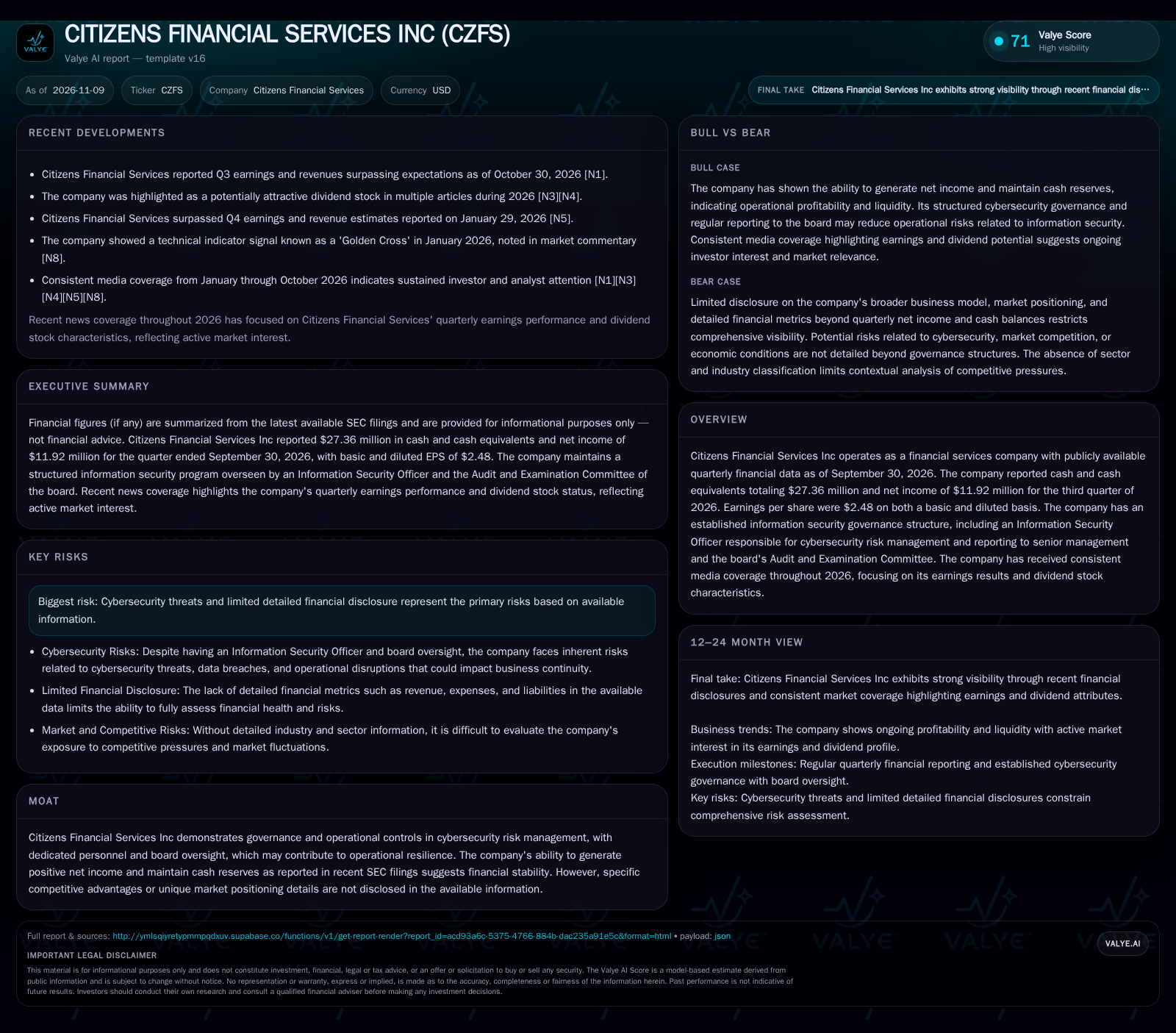
Citizens Financial Services Inc posted net income of $11.92 million and held $27.36 million in cash as of Q3 2026, reflecting ongoing profitability and liquidity. The company maintains a formalized cybersecurity governance framework with board oversight. However, the lack of detailed information on its lending, deposit, or non-interest operations obscures the full picture of risk, growth levers, and competitive dynamics. The thesis hinges on whether stable earnings and risk controls can offset the analytical blind spots around business model and market exposure. [S2] [N1]
Citizens Financial Services Inc stands out for its consistent profitability, with $11.92 million in net income and $27.36 million in cash reported for Q3 2026. The company has also formalized its cybersecurity governance, with direct board oversight—a notable safeguard in an increasingly digital financial landscape. Yet, the absence of granular disclosure on loan, deposit, or fee income, as well as competitive context, leaves investors with an incomplete view of the company’s long-term economic engine and risk profile. The central question is whether stable, visible earnings and robust risk management can compensate for the analytical opacity in the core business model and its exposure to sector headwinds.
Recent Profitability and Governance: The State of Play at Citizens Financial Services
Citizens Financial Services reported net income of $11.92 million for the quarter ended September 30, 2026, translating to $2.48 per share on both a basic and diluted basis. Cash and cash equivalents stood at $27.36 million at quarter-end. These figures signal a period of sustained profitability and liquidity. The company also highlights a formal information security governance structure: an Information Security Officer oversees cybersecurity risk management and reports directly to the COO and the board’s Audit and Examination Committee, which receives quarterly updates. This level of board engagement in cybersecurity is increasingly expected but not universal among smaller financial institutions. [S2]
Meanwhile, recent earnings and revenue results have consistently beaten market expectations, capturing ongoing analyst and investor attention and suggesting operational execution is meeting or exceeding consensus benchmarks. However, the company’s disclosures offer little insight into the composition of its revenue streams, asset quality, or the competitive environment it operates within. [N1] [N5]
Dissecting Profit Drivers: What Could Underpin Earnings at a Community Bank
The available facts confirm that Citizens Financial Services is generating positive net income and maintains a visible cash reserve, but provide no detail on the sources and sustainability of profitability. In the traditional community banking model, net interest margin (the spread between lending yields and funding costs) is the primary driver of earnings, with fee income from services and wealth management sometimes providing supplementary upside. Operating leverage typically comes from scaling assets without a commensurate increase in fixed costs, but loan losses, margin compression, or rising compliance costs can quickly erode profitability.
Without line-item disclosure, it is unclear how much of Citizens’ earnings derive from core lending versus non-interest sources, or what the risk profile of its loan book may be. Community banks often face pressure from rising deposit costs, regulatory compliance expenses, and competition from both larger banks and fintechs. The company reported cash and liquidity metrics for the period; these figures do not by themselves establish operating runway, investment capacity, financial flexibility, or financing capacity. The presence of a formal information security program suggests investment in operational resilience, but it also adds to the fixed cost base, potentially impacting efficiency ratios if not offset by sufficient scale or revenue diversity.
Where Does Citizens Stand? Evaluating Potential Moats and Market Pressures
Citizens Financial Services’ governance structure for cybersecurity risk management is more robust than that seen at some smaller banks, with direct board oversight and a dedicated officer. This may reduce operational risk and enhance customer trust, particularly as digital threats become more sophisticated. However, the company’s actual competitive position remains opaque: there is no disclosure of market share, geographic footprint, product differentiation, or customer mix.
In the absence of detail, it is reasonable to assume that Citizens operates in the highly competitive community and regional banking segment, where switching costs for customers are low and product commoditization is high. Larger banks and fintech entrants can exert pricing pressure on both sides of the balance sheet, while regulatory requirements and technology investments drive up fixed costs. Without clear evidence of unique capabilities—such as a dominant local presence, specialized lending, or technology-enabled service delivery—Citizens’ competitive moat may be limited to operational soundness and risk management, rather than sustainable economic advantage.
How Consistent Execution Could Translate Into Durable Value Creation
A constructive scenario for Citizens Financial Services hinges on its ability to maintain or expand net interest margins, keep credit losses low, and leverage its operational risk controls to avoid costly disruptions or compliance setbacks. If the company’s strong earnings and liquidity are underpinned by a high-quality loan book, disciplined underwriting, and a loyal deposit base, it could deliver steady returns and potentially return capital to shareholders via dividends or buybacks—especially if it operates in markets underserved by larger competitors.
Upside confirmation would come from future disclosures showing stable or growing net interest income, low non-performing asset ratios, and evidence of fee-based revenue growth. Additional proof points would include positive trends in efficiency ratios (cost to income), continued outperformance of earnings versus peer group, or the announcement of strategic partnerships or technology investments that expand the customer base or product set. Sustained analyst and investor interest, as reflected in ongoing media coverage, could also reinforce the company’s relevance and valuation premium. [N1] [N3] [N4] [N5] [N8]
Stable Earnings, Incremental Growth, and the Limits of Visibility
The most plausible near-term outlook is for Citizens Financial Services to maintain operational profitability and conservative liquidity, with incremental growth tied to modest loan expansion and careful cost management. The company’s structured approach to cybersecurity and board oversight likely reduces the risk of major operational setbacks or regulatory penalties. However, absent further disclosure, it is reasonable to expect that earnings growth will be constrained by conventional community banking headwinds: margin pressure from rising deposit costs, limited pricing power, and a need to continually invest in compliance and technology.
Falsification would come from a sudden deterioration in earnings, asset quality, or regulatory standing—or from disclosures indicating a more volatile or concentrated business model than the current financial snapshot suggests.
Hidden Vulnerabilities: Where Limited Disclosure Could Mask Emerging Risks
The primary risk is that Citizens Financial Services’ solid headline profitability masks underlying vulnerabilities—such as concentrated loan exposures, rising credit losses, or an inability to compete for low-cost deposits. If the company is exposed to sectors or geographies under economic stress, or if rapid deposit outflows force higher-cost funding, margins could compress quickly. Additionally, as compliance and cybersecurity costs rise, operating leverage could turn negative if asset growth stalls.
Downside confirmation would be evidenced by a sudden drop in net income, higher loan loss provisions, or regulatory intervention. Negative news coverage, a breakdown in the company’s cybersecurity defenses, or a rapid deterioration in reported liquidity would also serve as warning signs. The lack of disclosure around loan mix, deposit concentrations, and capital ratios makes it difficult to rule out these risks, and investors must be alert to any new information that challenges the apparent stability.
Testing the Thesis: What Could Confirm or Challenge the Operating Story at Citizens Financial Services
Disclosure of net interest margin trends and sources of non-interest income, if reported, would clarify revenue durability and profitability drivers.
Updates on loan book composition and credit quality—such as non-performing asset ratios or sector exposures—would help assess risk and resilience.
Any changes in deposit base composition, funding costs, or customer concentration would reveal vulnerability to rate cycles and competitive pressures.
Efficiency ratio trends (cost to income), if disclosed, would indicate whether operational leverage is being achieved or eroded by compliance and technology costs.
Evidence of continued or expanded board-level oversight of cybersecurity, including incident disclosures or regulatory findings, would test the strength of risk management.
Sustained or shifting analyst and media coverage, especially around earnings surprises or operational setbacks, may serve as early indicators of changing market perception.
Disclaimer: This is research-only, informational analysis and not investment advice. It may include AI-generated interpretation and general industry context. Always verify important details using primary sources.

Comments