
Ducommun 2026: Backlog, Restructuring, and the Tensions of Aerospace-Defense Scale
Ducommun closes Q3 2026 with a record defense backlog, positive net income, and a multi-year restructuring underway. The company’s ability to translate backlog into profitable growth—amid cyclical markets, operational shifts, and capital constraints—will determine whether it can secure a durable margin and competitive stature in the evolving aerospace and defense landscape.
The core question is whether Ducommun can convert its backlog into sustained earnings growth and margin expansion, or if operational and market headwinds will erode its gains.
Ducommun Inc. enters late 2026 with several defining features: a record defense contract backlog, positive net income for the third quarter, and an ongoing restructuring plan that seeks to sharpen operational efficiency across its core segments. Yet, the company operates in highly cyclical and regulation-prone aerospace and defense markets, where execution missteps or contract volatility can quickly undermine momentum. The strategic stakes for Ducommun are clear: can it leverage its backlog and technical capabilities into lasting margin expansion and scale, or will restructuring friction and market headwinds constrain its ambitions?
Backlog Strength, Restructuring, and Q3 Profitability Define Ducommun’s Current Position
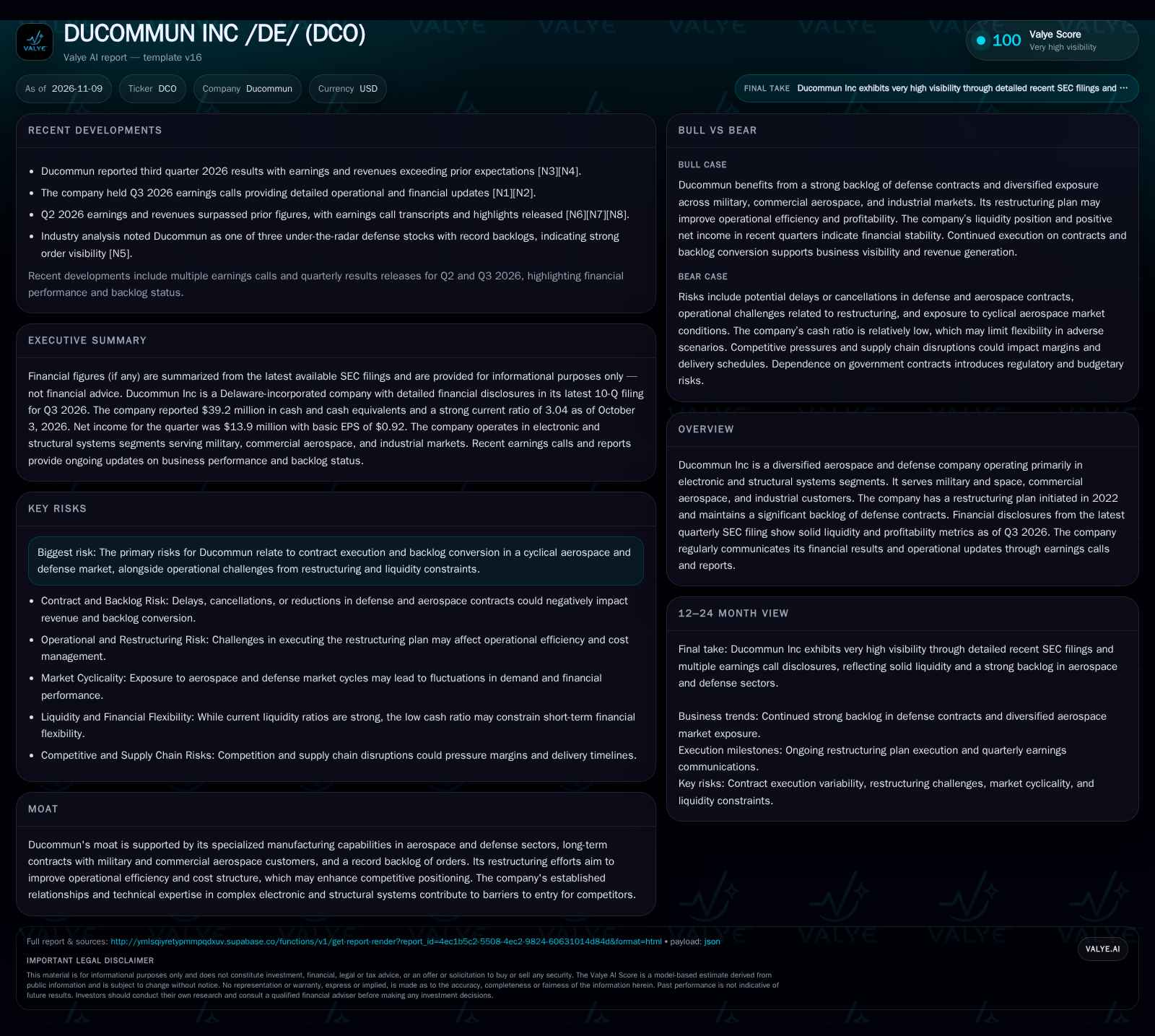
As of October 3, 2026, Ducommun reported cash and cash equivalents of $39.2 million, a current ratio of 3.04, and net income for the quarter of $13.9 million, with diluted EPS of $0.89 [S2]. These figures suggest that, on paper, the company is maintaining positive operating momentum. The company’s record backlog of defense contracts—highlighted in recent industry coverage—provides significant forward revenue visibility, especially in its Electronic and Structural Systems segments. Additionally, Ducommun’s restructuring plan, initiated in 2022, continues to be a central theme, targeting operational efficiency and cost improvement across the business [S1]. This combination of strong backlog, ongoing restructuring, and near-term profitability forms the factual bedrock for Ducommun’s current investment case.
How Ducommun’s Business Model Converts Backlog into Profitable Scale
Ducommun’s core economics are shaped by its exposure to high-value, high-reliability components for aerospace and defense applications. The company’s business model relies heavily on long-term contracts, particularly in the defense sector, where multi-year programs offer revenue visibility but also require precise execution and working capital management. Pricing is often set by competitive bids and government program budgets, limiting margin flexibility but providing volume stability when contracts are secured.
Operating leverage is a central lever: fixed costs in engineering, compliance, and manufacturing facilities can create margin expansion as volumes rise. However, this also means that underutilization—due to contract delays or cancellations—can rapidly compress margins. The restructuring plan aims to rationalize cost structures and consolidate performance centers, theoretically raising the break-even point and improving variable cost absorption if demand holds steady [S1].
Capital needs are non-trivial: manufacturing for aerospace and defense demands ongoing investment in specialized equipment, process certification, and supply chain resilience. The company reported cash and liquidity metrics for the period; these figures do not by themselves establish operating runway, investment capacity, financial flexibility, or financing capacity. [S2]
Competitive Edges and Threats in Aerospace-Defense Manufacturing
Ducommun’s competitive positioning is anchored in its technical expertise, long-term customer relationships, and ability to deliver on complex, high-reliability systems for both military and commercial aerospace markets. Barriers to entry in this space include rigorous certification requirements, entrenched supplier relationships, and the need for scale to absorb compliance and R&D costs. The company’s record backlog suggests successful navigation of these barriers, at least in the near term.
Counterforces are substantial: major defense primes and specialized aerospace manufacturers often compete for the same program awards, and any consolidation among large OEMs could shift bargaining power and supply chain dynamics. Technology substitution—such as shifts to additive manufacturing, new materials, or alternative propulsion—could erode legacy product relevance unless Ducommun invests aggressively to keep pace. Furthermore, customer concentration risk is inherent, given the heavy exposure to a handful of defense and commercial aerospace programs.
Supply chain disruptions and cost inflation, which have affected the broader aerospace sector in recent years, remain ongoing risks. The company’s ability to differentiate on delivery reliability, technical integration, or cost efficiency will be central to defending its position as contracts come up for renewal or rebid.
If Backlog Converts Smoothly: Margin Expansion and Strategic Optionality
Should Ducommun successfully execute on its record backlog—delivering projects on time, within budget, and without major operational disruptions—the company could see meaningful revenue growth and margin expansion. The restructuring plan, if effective, would further amplify this by lowering fixed costs and raising throughput efficiency, allowing more incremental profit to drop to the bottom line.
A favorable scenario would be confirmed by sequential improvement in gross and operating margins, rising return on invested capital, and evidence of backlog conversion into recognized revenue without material delays or cost overruns. Additional wins in new defense or aerospace programs, or successful entry into higher-value segments (such as advanced electronics or composite structures), would also support the case for durable competitive gains.
Falsification of this scenario would come from persistent restructuring charges, margin compression despite rising revenues, or a sudden drop in backlog due to contract terminations or customer delays.
Execution Frictions: The Most Likely Outcome Is Incremental Progress, Not Breakout Growth
The most plausible path for Ducommun is one of steady, if unspectacular, progress. Backlog provides a revenue floor, but actual conversion rates may fluctuate due to the complexity of aerospace and defense program schedules. The restructuring plan likely yields some cost improvements, but also introduces risks of execution missteps, temporary inefficiencies, or culture disruption.
Evidence for this scenario would be continued profitability, stable or slightly improving margins, and gradual reduction in restructuring expenses. Signs of base-case stress would include repeated delays in backlog conversion, flat or declining margins despite the restructuring, or incremental erosion of liquidity.
Contract Volatility or Restructuring Missteps Could Trigger Margin Erosion
The principal downside risk is that Ducommun encounters significant delays, cancellations, or pricing resets on major defense or aerospace contracts, which would directly impair backlog conversion and revenue realization. If coupled with restructuring execution failures—such as cost overruns, operational disruptions, or loss of key personnel—the company could see margins contract sharply and profitability turn negative.
A prolonged downturn in commercial aerospace demand, or adverse defense budget shifts, would magnify these pressures. Supply chain shocks or unexpected regulatory changes could further exacerbate cost and delivery pressures.
This scenario would be confirmed by sequential declines in revenue and margin, rising restructuring or impairment charges, rapid drawdown of cash balances, or negative free cash flow despite a strong nominal backlog.
Milestones That Will Clarify Ducommun’s Backlog Conversion and Margin Story
Quarterly gross and operating margin trends—if disclosed—will offer early signals on whether restructuring efforts are translating into improved profitability.
Backlog conversion rates: How quickly is Ducommun turning contracted backlog into recognized revenue, and are there signs of project delays or cancellations?
Restructuring expense trajectory: A declining trend in restructuring charges would suggest operational stabilization; persistent or rising charges would indicate ongoing friction.
Liquidity movement: Changes in cash and equivalents, especially relative to working capital needs, will be critical if external shocks or capital projects arise.
New contract wins or major program awards: Evidence of continued commercial momentum and market share defense in core segments.
Customer concentration metrics—if disclosed—would help assess vulnerability to contract or program-specific shocks.
Supply chain stability: Any disclosures or commentary on input cost inflation, delivery disruptions, or inventory buildup will shape margin outlook.
Evidence of successful entry into adjacent or higher-value product lines (such as advanced composites or electronics) would test the thesis of sustainable growth.
Disclaimer: This is research-only, informational analysis and not investment advice. It may include AI-generated interpretation and general industry context. Always verify important details using primary sources.

Comments