
Prestige Consumer Healthcare 2026: Acquisition Integration, Manufacturing Risks, and the Stakes of OTC Brand Scale
Prestige Consumer Healthcare’s growth hinges on integrating recent acquisitions, managing manufacturing and regulatory risks—especially in sterile eye care—and navigating shifting consumer and retailer dynamics in the OTC market. With customer concentration and supply chain disruptions as persistent threats, the company’s ability to sustain brand-led momentum will be tested.
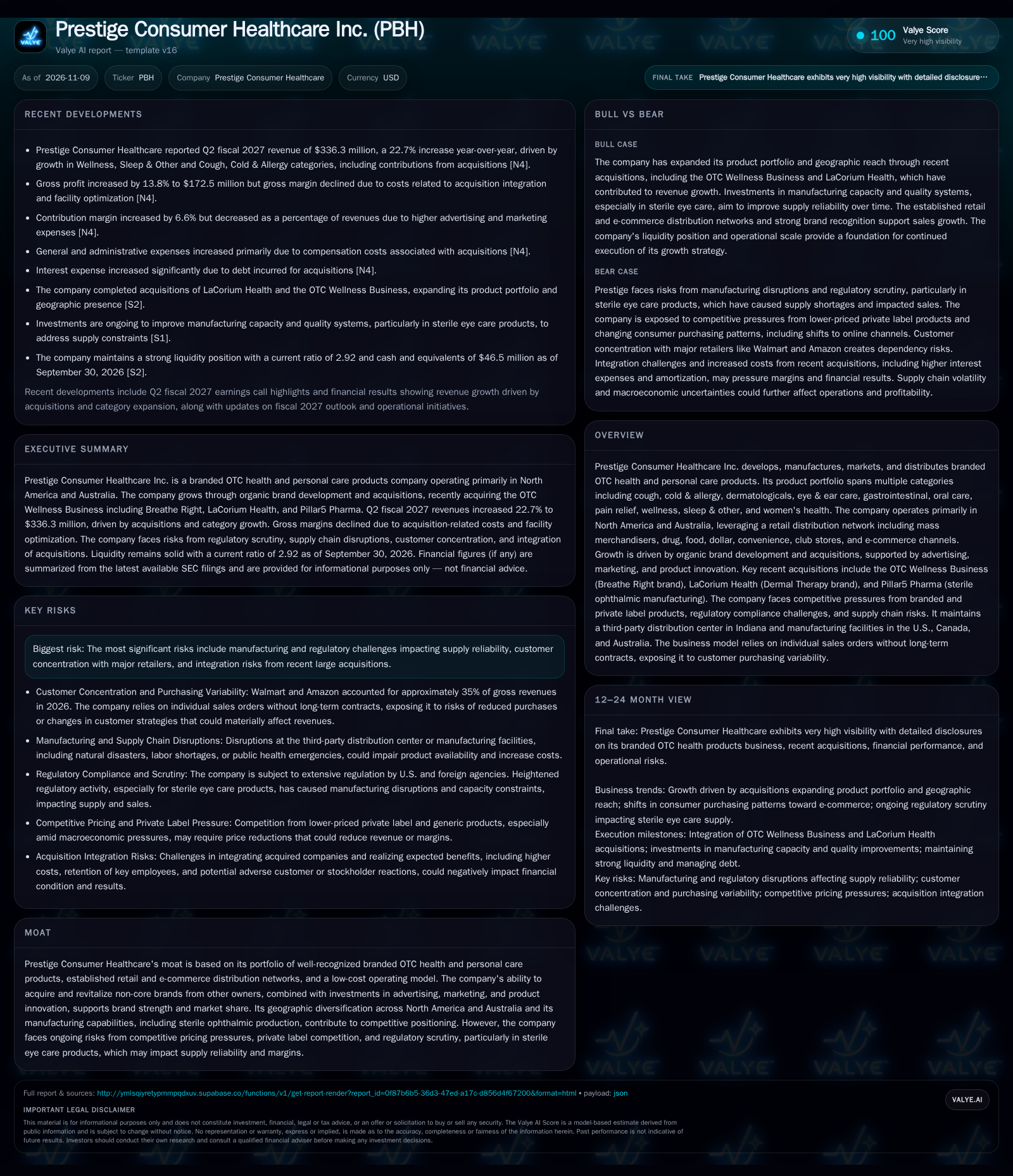
Prestige Consumer Healthcare’s recent revenue jump stems from major acquisitions and category expansion, but the company faces acute regulatory and supply chain risks, especially in sterile eye care. High customer concentration with Walmart and Amazon, lack of long-term contracts, and increased leverage from acquisitions underscore the need for successful integration and operational improvement to defend margins and maintain growth [S1] [S2] [N4].
Prestige Consumer Healthcare’s recent expansion through major acquisitions has delivered a notable revenue boost, but the company now faces a complex operational and strategic landscape. With Walmart and Amazon representing over a third of sales and no long-term contracts in place, customer concentration risk is acute. At the same time, regulatory scrutiny and manufacturing disruptions in sterile eye care threaten supply reliability, while higher debt and increased marketing spend squeeze margins. The next phase for Prestige will test whether it can integrate its new assets, defend its branded portfolio against private label pressure, and adapt to evolving retailer and consumer dynamics in the OTC health market.
Acquisitions Drive Top-Line Growth but Expose New Risks
Prestige Consumer Healthcare reported a 22.7% year-over-year revenue increase in Q2 fiscal 2027, reaching $336.3 million, mainly attributed to the acquisitions of the OTC Wellness Business (including Breathe Right), LaCorium Health, and Pillar5 Pharma [N4] [S2]. These deals have expanded both the product portfolio and geographic reach, particularly in Australia and the sterile eye care segment. However, the integration has brought new challenges: contribution margin increased by 6.6% in absolute terms but declined as a share of revenue due to stepped-up advertising and marketing costs for acquired brands [N4]. Interest expense has also climbed, reflecting the debt taken on to finance these acquisitions [N4].
The company’s customer concentration has intensified, with Walmart and Amazon now accounting for about 35% of gross revenues and the top ten customers representing a significant portion of total sales [S1]. Sales are made on individual orders without long-term contracts, increasing exposure to abrupt changes in retailer purchasing or inventory strategies [S1]. Ongoing regulatory scrutiny and manufacturing disruptions—especially in sterile eye care—have led to supply shortages and additional investments in quality and capacity improvements [S1] [S2].
How Prestige Turns Brand Equity into Cash Flow—And Where the Leverage Lies
Prestige’s business model is built on acquiring and revitalizing established OTC brands, then supporting them with advertising, marketing, and product innovation. Revenue growth is driven by both organic brand performance and bolt-on acquisitions, but the economics depend on brand strength, pricing discipline, and supply reliability. In the current period, higher advertising and marketing expenses have pressured margins even as contribution margin dollars rose [N4]. This spending is intended to drive consumer demand and defend shelf space, but it may not be fully offset by pricing power if private label and generic competition intensifies.
The company has increased leverage to fund acquisitions, as evidenced by higher interest expense [N4]. The company reported cash and liquidity metrics for the period; these figures do not by themselves establish operating runway, investment capacity, financial flexibility, or financing capacity. [S2] Most sales are transacted through large retailers and e-commerce platforms, with no long-term contracts, making volumes inherently variable and sensitive to retailer strategies and end-consumer trends [S1]. Operating leverage is present—fixed costs in manufacturing and advertising mean that incremental sales can boost margins—yet this cuts both ways if volumes or pricing come under pressure.
Capital needs are moderate in ordinary periods but can spike with regulatory-driven manufacturing upgrades or acquisition integration. Ongoing investments in sterile eye care manufacturing are required to address compliance and supply constraints [S1] [S2].
Brand Portfolio, Private Label Threats, and the Limits of OTC Differentiation
Prestige’s primary competitive advantage is its portfolio of recognized OTC brands, broad distribution across mass retail and e-commerce, and skill in acquiring and revitalizing non-core brands from larger companies. This strategy has historically allowed Prestige to compete on brand equity and consumer trust, even as private label and generic alternatives offer lower prices [S1].
However, the OTC market is characterized by intense competition, with switching costs for consumers generally low and pricing pressure acute during periods of economic stress. Prestige’s exposure to Walmart and Amazon as major customers increases vulnerability to shifts in retailer strategy, such as greater emphasis on private label or changes in shelf allocation. The company’s investments in advertising and product innovation are necessary to defend market share but may not prevent erosion if consumer preferences or retailer priorities shift.
The recent acquisitions broaden category presence and geographic reach—potentially buffering some competitive risks—but integration challenges and regulatory scrutiny, especially in sterile eye care, may limit the speed at which Prestige can realize synergies or defend margins.
If Integration Succeeds and Supply Issues Ease, Margin Expansion Is Plausible
In a favorable scenario, Prestige successfully integrates its recent acquisitions, leveraging cross-selling opportunities and marketing synergies to drive both revenue growth and operating margin improvement. Investments in manufacturing capacity and quality systems—particularly in sterile eye care—lead to more reliable supply, reducing lost sales and lowering per-unit production costs over time.
If advertising and marketing spend efficiently support brand loyalty and shelf presence, and if the company can pass selective price increases through to consumers without losing share to private label, contribution margins could recover. The expanded portfolio, especially with the Breathe Right and LaCorium Health brands, could provide more diversification against category-specific shocks.
Evidence that would support this scenario includes: sustained or accelerating revenue growth from acquired brands, sequential improvement in contribution margin as a percentage of sales, reduced supply disruptions in eye care products, and successful debt reduction or stable interest coverage ratios.
Execution Strains Offset Growth: Integration, Margin Pressure, and Retailer Dynamics
The most plausible outcome is that Prestige maintains moderate revenue growth, with the benefits of recent acquisitions partially offset by ongoing margin pressure from higher marketing costs, integration expenses, and supply chain volatility. Regulatory scrutiny in sterile eye care likely persists, requiring continued investment and limiting immediate margin recovery.
Customer concentration with Walmart and Amazon remains a structural vulnerability; even absent contract losses, changes in retailer inventory strategies or promotional focus could cause quarter-to-quarter sales volatility. The company’s debt service burden remains elevated due to acquisition financing, but liquidity is managed adequately as long as cash flow from operations remains stable.
Confirmation of this scenario would come from steady but not accelerating revenue growth, contribution margins stabilizing below historical peaks, ongoing regulatory disclosures about manufacturing compliance, and continued high proportion of sales from the top ten customers.
Supply Disruptions, Retailer Shifts, or Regulatory Setbacks Could Undermine the Model
In a negative scenario, manufacturing disruptions—especially in sterile eye care—persist or intensify, leading to prolonged supply shortages, lost shelf space, and reputational damage. Regulatory action could further restrict production or trigger costly remediation, eroding profitability and cash flow.
A major customer, such as Walmart or Amazon, could reduce purchasing, shift to private label, or change inventory management strategies, causing a sharp and sudden revenue decline. Without long-term contracts, Prestige would have limited recourse to stabilize volumes. Integration of recent acquisitions could also stumble, resulting in higher-than-expected costs and lower synergy realization.
Evidence confirming this scenario would include: material declines in sales to one or more top customers, extended or repeated manufacturing shutdowns or recalls, regulatory enforcement actions, or a sustained increase in debt leverage ratios due to weaker cash generation.
Milestones and Metrics That Will Reveal If Prestige’s Growth Model Is Durable
Sequential and year-over-year revenue growth from acquired brands such as Breathe Right and LaCorium Health would help test the success of integration and category expansion.
Trends in contribution margin—both absolute and as a percentage of revenue—will indicate whether marketing investments are translating to profitable growth or simply defending share.
Frequency and severity of manufacturing disruptions, especially in sterile eye care, should be monitored via regulatory disclosures or supply chain updates.
Changes in sales concentration among the top ten customers, particularly Walmart and Amazon, would signal shifting retailer dynamics and risk exposure.
Progress on reducing interest expense or overall debt levels would provide evidence of successful cash flow generation and financial discipline.
Any updates on regulatory compliance status for manufacturing facilities, especially regarding FDA or international requirements, would be critical for assessing supply reliability.
A useful metric would be e-commerce channel growth versus traditional retail, as this could reshape margins and customer concentration risk.
Monitoring inventory and receivables trends (if disclosed) would provide clues about working capital management and potential demand volatility.
Disclaimer: This is research-only, informational analysis and not investment advice. It may include AI-generated interpretation and general industry context. Always verify important details using primary sources.

Comments